Home addresses, phone numbers, personal and work emails, internal documents and the metadata in online posts. For businesses, leadership contact details and employee directories are the common targets.
Doxxing: How it works, examples and how to prevent it
How doxxing works, from breaches and scraping to WHOIS and OSINT, the risks to executives and companies, and the controls that cut exposure.
 By 9 mins readPublished Updated
On this page
Doxxing (or doxing) is collecting someone's private information and publishing it online without their permission, usually to harm them. Home addresses, phone numbers, personal emails, family details and internal business documents are all targets.
For a company, a doxxed executive means harassment, embarrassment, reputational damage and sometimes a physical security problem. CEOs, board members and public-facing staff are the usual targets because exposing them has the largest effect.
Cybersecurity reports put the rise in doxxing incidents against corporate executives and employees at over 35% since 2023. Attackers build the profiles from social media and other public exposure.
Doxxing differs from an insider leak in that it mostly uses information that is already public or easy to obtain. The motive is the same: intimidate, disrupt or damage. Against organizations the usual reasons are reputational sabotage, extortion, intimidation, hacktivism and competitive disruption.
What being doxxed means
Being doxxed is having personal or sensitive information exposed online without consent, to harass, intimidate or harm you. When the target is an executive, employee or board member, the damage reaches the company's reputation and operations as well.
Risks to executives, employees and board members
- Threats and harassment, online and offline: abusive messages, coordinated campaigns, threats against family or physical safety. A 2024 CrowdStrike threat report found C-level executives and HR heads to be frequent targets of impersonation and recruitment-related scams built on publicly available data.
- Reputational damage. Leaked material is used to spread false narratives or tie a person to a controversy. Patterns reported in Verizon's Data Breach Investigations Report (DBIR) show reputation-driven attacks rising, most of all against technology and finance leaders with a visible online presence.
- Identity theft and fraud. Addresses, phone numbers, correspondence and financial data feed identity theft, social engineering and account takeover. The Cybersecurity and Infrastructure Security Agency (CISA) has warned that doxxing campaigns often precede phishing or fraud attempts against corporate employees.
- Physical risk. A published home address, office address or daily routine exposes the person and their family to stalking, swatting or assault, and leaves the company with a protection problem.
That makes executive and employee data protection a security policy matter and an HR policy matter.
What it costs the business
- Trust. Clients, investors and the public judge a company by whether it can protect its own people and data.
- Disruption. Mass harassment, false alarms and safety concerns interrupt normal work, most of all when a leader is targeted or forced offline.
- Regulatory attention. An exposure invites questions about privacy and compliance controls.
- Money. Legal fees, crisis communications, security upgrades and, in extortion cases, ransom demands.
Sectors at higher risk
Attackers pick targets whose data will bring media attention, money or political effect. Five sectors see most of it.
- Technology. Visible executives and contested products. Firms working on AI, data analytics or surveillance draw activist groups and competitors.
- Healthcare. Sensitive patient and employee data, so an exposure brings privacy violations, regulatory penalties and distress. Workers and executives are targeted to pressure the organization or to feed patient data into financial fraud.
- Financial services. Banks, fintechs and investment firms hold personal and financial data in volume. Attackers want insider information, market manipulation or extortion money.
- Public sector. Officials, regulators and public servants are doxxed for political reasons, usually by hacktivist groups protesting a policy.
- Companies in the public eye. A live controversy gives attackers a reason to damage reputation, incite harassment or mobilize an online pile-on.
How doxxing works
Attackers combine several methods, and data that looks harmless on its own becomes identifying once it is combined.
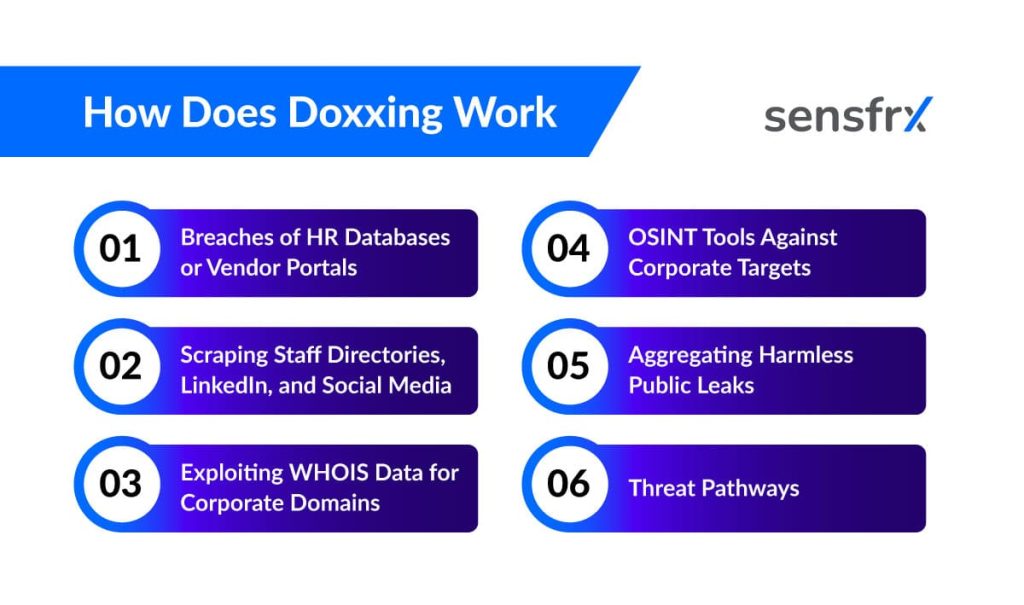
1. Breaches of HR databases or vendor portals
A compromised HR system or vendor portal gives up names, emails, phone numbers and job titles in one pull. The data goes to identity theft, executive impersonation and financial fraud. The defenses are MFA, least-privilege access, alerts on login anomalies and security audits of the vendors who hold your staff data.
2. Scraping staff directories, LinkedIn and social media
Public profiles map the org chart and identify the people worth targeting, which is what a convincing phishing or social engineering campaign needs. Limit what the public directory shows, train staff to lock down social media privacy settings, and watch for company data turning up online.
3. WHOIS data on corporate domains
WHOIS records can carry a registrant's name, phone number and email, enough to impersonate the domain administrator or phish the registrar. Use WHOIS privacy, lock the registrar account, and verify any domain-related request through an internal channel.
4. OSINT tools against corporate targets
Open-source intelligence (OSINT) tools pull together GitHub repositories, TLS certificates and job listings to find credentials, exposed subdomains and internal policies. Run attack surface scans on a schedule, clean up public content, and read job postings for what they give away about your stack.
5. Aggregating harmless public leaks
Presentations, roadmaps and employee bios each give away a little; together they make a social engineering script. Review external material before it goes out and put an approval step in front of publication.
6. Who does it
Doxxing comes from three directions.
- Unhappy insiders with legitimate access who leak internal data.
- Cybercriminal groups who use leaked data for extortion.
- Hacktivist collectives with a political or ideological grievance.
An insider risk program, secured telephony and authentication processes, and a response plan for voice- and data-based incidents cover all three.
Doxxing examples
Three patterns recur. In each, the attacker collects, connects and publishes information from several sources, which is the MITRE ATT&CK framework's "TA0043: Reconnaissance" phase applied to a person rather than a network.
Reconnaissance is the gathering of public data to pick targets and understand their footprint before an attack. In doxxing it turns scattered personal or corporate details into one profile.
- Corporate leadership exposure. Executives' personal emails and phone numbers posted on social media, followed by harassment and extortion attempts. The data comes from conference materials, company announcements and LinkedIn activity, matched against old breach dumps.
- Third-party data breach. A vendor's compromised system exposes employee data from several clients, which is then published. Merged with public details, it is used for impersonation, fraud and targeted phishing.
- Public campaigns. Activist groups doxx an organization to expose confidential M&A plans or push a corporate decision. These start from small, overlooked details and build through OSINT tools into a broader narrative.
Doxxing is rarely one incident. It is the sum of small leaks and public disclosures that, combined, give a complete picture of a target, and it turns into a reputational and operational crisis if no one notices the buildup.
How to prevent doxxing in B2B
Prevention is policy, awareness and technology together, because attackers rely on public data and human error.
1. Set a policy on what gets published
Decide what employee and executive information may appear in public. Keep personal contact details, direct email addresses and identifiable photos out of press releases and announcements. One policy, applied across departments, stops the accidental exposure.
2. Audit the digital footprint
Review the company website, social accounts and third-party platforms on a schedule and remove personal information that is unnecessary or out of date. Include domain registries, public code repositories and media kits, which leak internal and employee data by accident.
3. Train staff and executives
Human error is one of the most common causes of exposure. Run periodic training on social engineering, phishing and oversharing, and use real doxxing cases so people take it seriously.
4. Mask WHOIS and monitor
Use WHOIS privacy so domain registration does not expose admin contacts or company email addresses. Monitor the dark web, leak forums and social platforms for employee or company information, so you contain an exposure before it is used.
5. Tighten technical controls
Enforce multi-factor authentication, restrict access by least privilege, secure the email gateway and patch on a schedule. Each one cuts the information available to an attacker.
6. Write the incident response plan
Incidents still happen. Write a response plan that names communication channels, escalation steps and roles. Include how to verify what was leaked, how to notify affected employees, when to involve legal, and when to call law enforcement. A plan that exists before the incident limits panic, damage and downtime.
Legal and ethical implications
Doxxing is treated as harassment, as a data privacy violation and, in some cases, as corporate espionage. Companies under GDPR, CCPA or local cybersecurity frameworks are expected to handle personal and employee data securely.
Prosecuting a doxxer is hard because of jurisdiction and anonymity. Work with legal counsel and law enforcement from the start.
Where to start
Doxxing crosses the line between digital and physical security. For a person it means harassment and distress; for a business, reputational and financial damage that outlasts the incident.
Privacy practices, trained staff, technical controls and a rehearsed response together cut the exposure. Start with the footprint audit in step 2: it shows you what an attacker already has.
Sensfrx scores the logins, signups and payments that leaked data gets used for. Start on the free plan and see the risk score on your own traffic.
Doxxing FAQ