Blockchain in transaction fraud prevention: What it fixes and what it does not
How a shared ledger, consensus and smart contracts help prevent transaction fraud, where they fall short, and five real deployments from Maersk to Walmart.
 By 13 mins readPublished Updated
On this page
- Limitations of traditional fraud prevention methods
- What a blockchain is
- Immutability and transparency in practice
- Use cases in preventing transactional fraud
- How blockchain changes fraud prevention
- The mechanism in more detail
- Benefits of blockchain in fraud detection
- Challenges of blockchain in fraud prevention
- Real deployments of blockchain against fraud
- What blockchain does and does not fix
- Where Sensfrx fits
- Frequently asked questions (FAQs)
Transaction fraud is any payment or transfer the account holder did not authorize: a stolen card used at checkout, an account opened in someone else's name, a phished login drained. For a business that earns online, each case is a direct loss plus a chargeback, a support ticket and a customer who may not come back.
The numbers are large. A 2020 LexisNexis Risk Solutions study put US firms' losses to fraudulent transactions at $3.5 billion. Losses at that scale slow growth as well as cutting profit.
Repeated fraud also costs reputation. Customers talk on social media, and news that a company's checkout is being abused travels faster than the fix.
Operational consequences
Every fraud case takes analyst time, support time and sometimes engineering time away from the product. Delivery slips, service slows, and the customers who waited remember it next time.
Global card fraud losses
The Nilson Report, a payments industry analyst, put worldwide card fraud losses at $27.85 billion for 2018 and projected $35.67 billion by 2023, a rise of nearly 28% in five years. The growth of online shopping over that period gave fraudsters more places to use stolen card data.
Digital payments fraud
Mobile wallets and peer-to-peer (P2P) transfers are targets alongside cards. A LexisNexis Risk Solutions survey found that merchants who accepted digital wallet payments reported a higher rate of fraudulent transactions than those who did not.
Impact of data breaches
Breaches feed transaction fraud. Javelin Strategy & Research counted over 14 million US identity theft victims for 2019, with losses of $16.9 billion. The more personal data is stored and shared between organizations, the more of it leaks, and leaked data is what fraudsters use to pass as the customer.
Limitations of traditional fraud prevention methods
Three weaknesses in conventional fraud controls are the ones blockchain's advocates point at.
Centralized systems
A central database of card numbers, bank details and identities is a single point of failure. Breach it once and the attacker has everything.
Human error
Manual review depends on people, and people get tired, cut corners or are bribed. As transaction volume grows, a human reviewer cannot keep up, and fraud slips through.
Batch monitoring
Many controls run as periodic batch jobs rather than checking each transaction as it happens. The gap between the transaction and the scan is the window the fraudster uses.
What a blockchain is
A blockchain is a shared, append-only ledger. Every participant holds a copy, new entries are verified by the network before they are written, and once written an entry cannot be changed or deleted without the change being visible to everyone.
Because the participants verify each other's entries, two parties can transact without a bank or other intermediary in the middle.
How it works
Records are grouped into blocks. Each block carries its transaction data, a timestamp and the cryptographic hash of the block before it, so the blocks form a chain in which any edit to an old block breaks every hash after it.
- The chain. Picture each block as a link. The first link records one transaction, say A pays B. Once the network has verified it, it is part of the chain and stays as written.
- The next block. B pays C goes into the next block, which carries the hash of the block holding A's payment. Each block vouches for the one before.
- Many copies. The chain is not stored in one place. Every node on the network holds a copy and appends new blocks as they are confirmed, so there is no single ledger to corrupt.
Immutability and transparency in practice
Immutable transactions
The record is held on many nodes rather than one server, so changing it means changing most copies at once. The longer an entry has been in the chain, the more blocks sit on top of it and the harder it is to alter unnoticed.
What that stops
Each transaction is cryptographically linked to the ones before it. That rules out two classic frauds inside the ledger itself: spending the same funds twice, and rewriting a record after the fact.
Transparency and traceability
Every transaction can be traced back to its origin on one shared ledger. Funds can be followed from account to account, which deters some fraud and makes audits faster because there is one record to check rather than several to reconcile.
Use cases in preventing transactional fraud
Three areas have seen real deployments.
- Supply chains. A ledger that follows a product from origin to shelf makes tampering and counterfeiting visible. Buyers can check that goods are genuine; companies can prove where each item has been.
- Banks and payment networks. Financial institutions have used blockchain ledgers to record transfers between parties with no single database for an attacker to alter in transit.
- Government. Voting systems and welfare payments are the usual proposals: a tamper-evident record of each vote, and a traceable path for each benefit payment so funds reach the intended recipient.
How blockchain changes fraud prevention
Conventional transaction processing trusts a central record and the people who maintain it. Blockchain shifts that trust to cryptography and network consensus, and five properties follow.
Five properties that matter
- An immutable, shared ledger. Every participant holds a copy, so nothing can be altered or deleted without the agreement of the network, and every change leaves a trace.
- Smart contracts. Code stored on the chain that executes agreed terms when agreed conditions are met, with no manual step for someone to skip or tamper with.
- Simpler verification. Proving identity or ownership usually means a chain of intermediaries such as banks or registries. On a blockchain the proof is a cryptographic key held by the person or entity.
- Distributed consensus. Nodes validate each transaction against the network's rules before it is written, so a transaction that breaks the rules is never recorded.
- Data integrity. With no central store there is no single target, and the cryptography means a record can be read or changed only by a holder of the right keys.
The mechanism in more detail
Three pieces do the work: decentralization, the block-and-hash structure, and consensus.
Decentralization
- No central database. Transaction records live on a network of nodes rather than one server, so there is no one system to hack or quietly edit.
- Redundancy. Every node holds an identical copy. If one fails or is compromised, the rest still hold the full history, and a changed copy disagrees with all the others.
- No intermediary. Trust comes from agreement between nodes, not from a bank in the middle. Several nodes must verify a new block before it is accepted.
- Resistance to takeover. To rewrite history an attacker needs control of more than 51% of the network's mining power or stake. On large networks such as Bitcoin or Ethereum the cost puts that out of reach; smaller networks are less safe.
Blocks and chains
The block structure is what makes the ledger tamper-evident.
- Structure. The ledger is a sequence of blocks validated by a network of nodes rather than by one authority.
- Blocks. Each block holds hundreds or thousands of transactions, depending on the protocol, plus the hash of the previous block.
- Hashes. A cryptographic hash function turns any input into a fixed-length fingerprint. Change one character of a past transaction and the block's hash changes, and so does every hash after it, which is how tampering shows.
- The chain. Because each block references the one before, the blocks form a single history that cannot be edited in the middle without rewriting everything that follows.
- Forks and consensus. When two nodes produce a block at the same moment the chain forks. The network's consensus mechanism, Proof of Work or Proof of Stake, decides which branch continues.
Verification and consensus
Nobody is in charge, so the network itself has to agree on what is true.
- Verification. Each transaction is checked against the protocol's rules before it can be added. An invalid or forged transaction is rejected at this step.
- Consensus mechanisms. Proof of Work (PoW) has nodes solve a costly computational puzzle to earn the right to add a block. Proof of Stake (PoS) has them lock up their own cryptocurrency as collateral instead.
- Agreement. Once most of the network accepts a block, the transactions in it are final. Adding a fraudulent transaction after that point means beating the whole network.
Benefits of blockchain in fraud detection
Blockchain started as the ledger behind Bitcoin. The properties that keep a currency honest are useful for detecting fraud in other records too.
Six benefits:
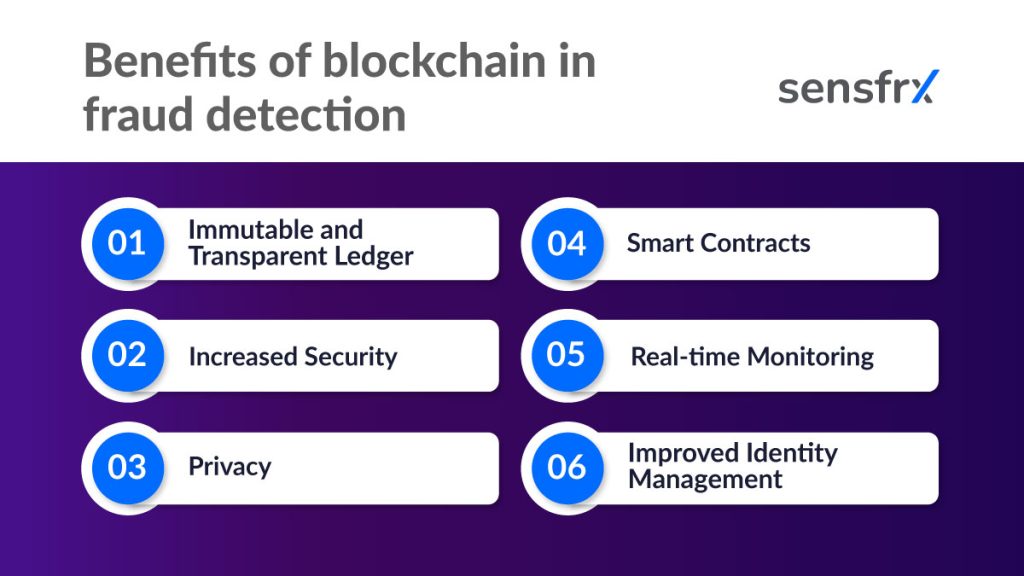
- An immutable, transparent ledger. Nothing is altered or deleted without a trace, which makes it a reliable record to investigate from.
- Security. Data on the chain is protected by strong cryptography, and with no central server there is no single point of failure for an attacker to aim at.
- Privacy. The transactions are visible on the shared ledger; the identities behind them are not. Only holders of the right keys can link a record to a person.
- Smart contracts. Once deployed, a contract's terms cannot be changed by either party. The code runs only when every condition is met, so nobody can quietly rewrite the deal.
- Real-time monitoring. Each block is written as it is confirmed, so an odd pattern can be flagged as it appears rather than in the next batch run, and no central operator can hide it.
- Identity management. Conventional identity systems keep personal data in central databases that get breached. A blockchain-based identity lets a person prove a claim with a cryptographic key without handing over the underlying data.
Challenges of blockchain in fraud prevention
Four problems come up in every deployment.
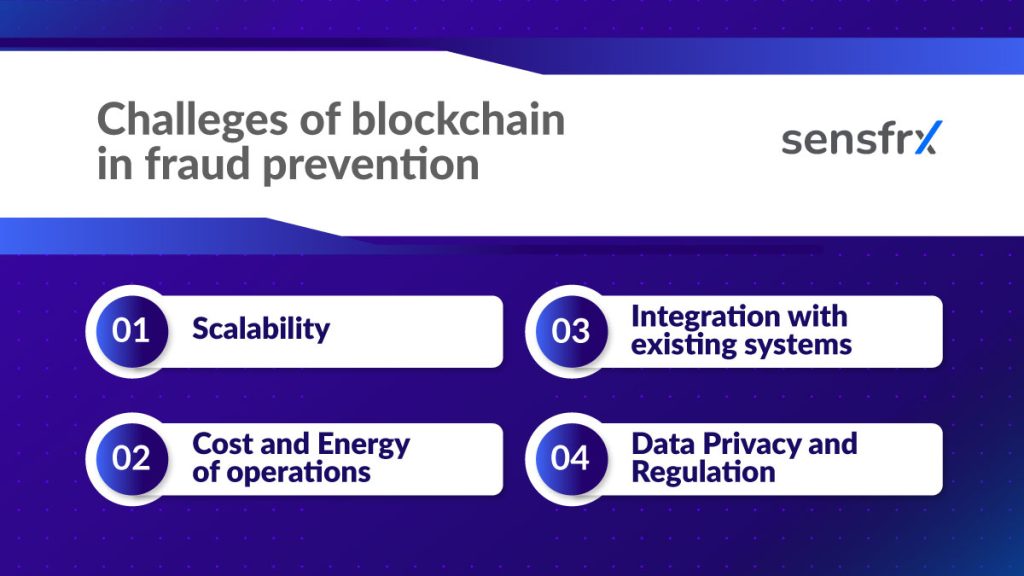
Scalability
The ledger only grows, and every node has to hold and verify it. More transactions mean slower confirmation and higher costs, and consensus gets harder as the network grows. Sharding and off-chain transactions are the usual workarounds, each with its own trade-offs.
Cost and energy
Validating blocks takes computing power and electricity, a great deal of it under Proof of Work. That shows up as operating cost and as an environmental problem.
Integration with existing systems
Most organizations already run transaction and fraud systems on conventional databases. Connecting those to a blockchain means bridging different protocols and data models, and the project is rarely small.
Data privacy and regulation
Immutability cuts both ways. Once personal data is on a chain it cannot be deleted or corrected, which collides with the right to erasure under the General Data Protection Regulation (GDPR) and similar laws. In practice personal data has to stay off the chain, with only hashes or references on it.
Real deployments of blockchain against fraud
Five named deployments, with where each stands now.
TradeLens: Maersk and IBM
Maersk, one of the world's largest shipping companies, built TradeLens with IBM as a blockchain platform for shipping documentation. An immutable record of each shipment and its paperwork cut document fraud and errors and gave participants real-time tracking. It did not reach commercial scale: Maersk and IBM announced its shutdown in late 2022 and took it offline in 2023.
Walmart's food traceability system
Walmart announced its partnership with IBM in 2018 to track food from farm to shelf on a blockchain. When a contamination problem appears, Walmart can trace the affected batch to its source fast, which limits the recall and the illness it is meant to prevent.
J.P. Morgan chase's Quorum
J.P. Morgan Chase developed Quorum, a permissioned, Ethereum-based blockchain with smart contracts, for payment security. Transactions are recorded on the ledger without exposing account numbers or amounts to parties with no right to see them, and settlement needs fewer intermediaries. J.P. Morgan handed Quorum to ConsenSys in 2020, where it continued as the open-source ConsenSys Quorum.
SecureKey technologies' Verified.Me
SecureKey Technologies built Verified.Me as a blockchain-based identity network. It joined several identity providers into one network so a user could prove who they are to a service without handing over more personal data than the check needs, which cuts both identity theft and the data that leaks when a service is breached.
Guardtime's KSI in healthcare
Guardtime's Keyless Signature Infrastructure (KSI) is used to protect electronic health records. Each record is anchored to the blockchain so any tampering or unauthorized change is detectable, which protects record integrity and makes medical identity theft harder to carry out unseen.
What blockchain does and does not fix
Blockchain fixes one class of fraud well: tampering with the record. A shared, append-only ledger with network consensus makes double-spending, back-dated edits and silent deletion detectable, and smart contracts remove the manual step where terms get bent.
Each deployment above protects a record against alteration: a shipment's documents, a food batch's origin, a payment, an identity claim, a health file.
It does not fix the fraud most online businesses see. A stolen card at checkout, a phished login, a bot creating accounts: each is a valid transaction by the wrong person, and an immutable ledger records it faithfully. Scalability, energy, integration and GDPR add their own costs. Use blockchain where record integrity is the problem, and something else where identity and intent are.
Where Sensfrx fits
Sensfrx is not a blockchain product and does not secure the ledger. It covers the layer a ledger cannot judge: whether the person behind a signup, login or payment is who they claim to be.
It scores each of those events in real time from device, network and behaviour signals, and your rules turn the score into allow, review or block.
For crypto exchanges and wallets the fraud that hurts is account takeover, bot-made accounts and purchases funded with stolen cards, all of it before anything touches the chain. See fraud prevention for crypto platforms and transaction fraud prevention.
Frequently asked questions (FAQs)
1. What is transaction fraud, and why does it matter to digital businesses?
Transaction fraud is any illegal or unauthorized digital transaction: card fraud, identity theft, phished payments. It costs money directly, damages reputation and ties up staff.
2. How does blockchain reduce the financial impact of transaction fraud?
By recording transactions on a shared ledger that no single party can alter, so tampered or back-dated records are visible to everyone. That removes one source of loss; it does not stop a valid transaction made by a fraudster.
3. What are the operational consequences of transaction fraud?
Resolving fraud cases pulls staff away from the product, slows delivery and service, and leaves customers waiting.
4. How does blockchain prevent digital payment fraud?
Each transaction is cryptographically linked to the previous ones and verified by the network before it is written, so records cannot be falsified or changed after the fact.
5. What are the limits of conventional fraud prevention, and how does blockchain address them?
Conventional controls rely on central databases, manual review and batch processing, so they can be breached, make mistakes and run late. Blockchain is distributed, automated through consensus and smart contracts, and writes each transaction as it happens.
6. How does blockchain improve identity verification?
A person proves a claim with a cryptographic key instead of handing over personal data, so there is less data to steal and less to leak when a service is breached.
7. What are some real-world examples of blockchain used against fraud?
TradeLens from Maersk and IBM for shipping documents, Walmart's food traceability system, J.P. Morgan Chase's Quorum for payments, SecureKey Technologies' Verified.Me for identity verification, and Guardtime's Keyless Signature Infrastructure (KSI) for electronic health records.