The top 5 transaction monitoring software in 2026
Sensfrx, SEON, SAS, ComplyAdvantage and SumSub compared on real-time detection, rule flexibility, scale and alert handling, plus how to choose.
 By 8 mins readPublished Updated
On this page
Transaction monitoring software watches payments as they happen and flags the ones that look like fraud or money laundering. Banks, fintechs and ecommerce companies run it for two reasons: to stop losses, and to meet Anti-Money Laundering (AML) and Know Your Customer (KYC) obligations. Below, five tools compared, and the checks to run before you choose one.
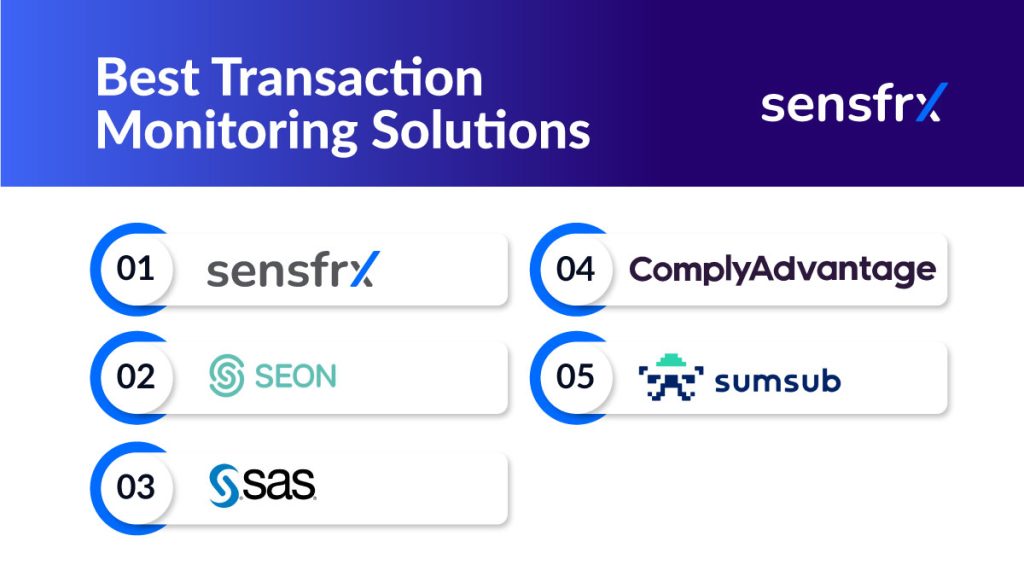
The best transaction monitoring solutions
Good transaction monitoring software does three things: it catches suspicious activity in real time, it produces the records regulators ask for, and it keeps the false positive rate low enough that the review queue stays workable.
The five below differ in where they sit: fraud-first scoring, data enrichment, enterprise analytics, or compliance screening.
Sensfrx
Sensfrx scores every payment in real time from device, network and behaviour signals and raises an alert the moment one looks wrong. Risk scores and a custom rules engine let each team set its own thresholds, and the interface is built for people who are not data scientists.
It suits fintechs, ecommerce companies and any team handling a high volume of transactions that wants to detect, analyse and act on suspicious activity without a long deployment.
Key features of Sensfrx
- Real-time monitoring. Each transaction is checked against your rules and the ML models as it happens, so an allow, review or block decision comes back before the payment settles.
- Anomaly detection. Machine learning models trained on large datasets pick up patterns that rules miss and keep learning as schemes change.
- Custom rules engine. You define what counts as suspicious, so monitoring matches your risk tolerance and your regulatory requirements.
- Risk scoring. Amount, frequency and deviation from the customer's usual behaviour feed a score that ranks alerts, so high-risk cases get looked at first.
- Integration. Connects to payment gateways and customer databases through the REST API, with plugins for WooCommerce, Shopify, WHMCS, Blesta and WISECP.
- Alerting and workflow. Suspicious transactions are routed for review automatically, with the context the reviewer needs to act.
Pricing, the free plan and the 14-day trial are on the pricing page. Questions the docs do not answer go through the contact form.
SEON
SEON scores each transaction with machine learning and behavioural analytics, drawing on millions of data points in real time. It adds multi-factor authentication options and connections to external databases, and its data enrichment gives a fuller picture of user behaviour and transaction patterns.
Key features
- Real-time data enrichment from email addresses, phone numbers, IP addresses and more, to judge whether a transaction is legitimate
- Machine learning that learns fraud patterns and improves detection over time
- API integration with existing systems for quick deployment
SAS
SAS is the enterprise option, used by some of the largest financial institutions. The suite includes risk-scoring algorithms, network analysis, anomaly detection and KYC and Customer Due Diligence (CDD) tooling, and its big data analytics and AI-driven visualisations handle large volumes.
Its roots are in analytics, and the transaction monitoring product is built for financial services, with machine learning for detecting and preventing financial crime.
Key features
- Statistical analysis and machine learning to find unusual transaction patterns
- Integration with the rest of the SAS stack for fraud detection and anti-money laundering in one place
- Customisable dashboards for real-time monitoring and reporting
ComplyAdvantage
ComplyAdvantage is a cloud compliance platform: sanctions screening against global watchlists, adverse media checks using natural language processing (NLP), and hidden email address identification. It runs in real time or in batch, with rules tuned to the regulations of each industry.
It is built for compliance teams first, pairing real-time analytics with broad data coverage so organisations can meet regulatory standards while managing transaction risk.
Key features
- Real-time transaction monitoring and risk screening, so suspicious activity is flagged as it happens
- Risk assessment from sanctions lists, politically exposed persons (PEP) lists and adverse media
- Integration that embeds monitoring inside existing workflows
SumSub
SumSub bundles Know Your Customer (KYC) and Anti-Money Laundering (AML) compliance into one platform. Its fraud detection models target money laundering, terrorist financing and related financial crime, alongside facial biometric verification, document authentication and risk assessment.
Transaction monitoring is one service among several. Identity verification and AML compliance are the core, which suits companies that want both from one vendor.
Key features
- Identity verification that confirms who the user is before a transaction is approved
- Anti-money laundering tooling: transaction monitoring, reporting and risk assessment
- An interface compliance teams can use to set up rules and workflows without engineering help
What to check before you choose a transaction monitoring solution
The wrong choice shows up as a review queue nobody can clear or a fraud pattern nobody saw. Four factors decide fit.
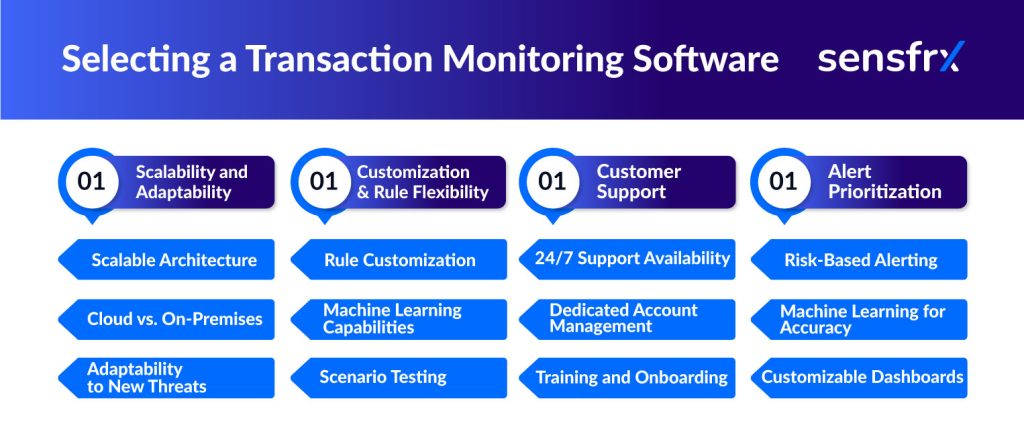
Scale and adaptability
Transaction volume grows, and regulations change. The software has to handle more load without slowing down, and absorb new fraud patterns and rule changes without a re-implementation.
What to check
- Can it take a larger transaction volume without infrastructure changes?
- Cloud or on-premises? Cloud scales faster and updates sooner
- How does it pick up new fraud patterns and regulatory updates?
Customisation and rule flexibility
Rigid rules produce false positives, and false positives burn analyst hours. You need to adjust parameters and tune alerts to your own risk profile.
What to check
- Custom rules by transaction type, customer behaviour or any criterion that matters to you
- Machine learning that refines rules from real outcomes
- A test environment, so rule changes are checked before they go live
Customer support
Support decides how fast you get live and how fast you fix what breaks.
What to check
- 24/7 availability, because transactions do not stop at 6pm
- A named account manager who knows your setup
- Training and onboarding for the team that will use it
Alert prioritisation
A monitoring system generates more alerts than any team can read. The useful ones rank them, so the suspicious cases rise and the noise sinks.
What to check
- Risk-based alerting that puts the highest-severity cases first
- Models that learn from past alert outcomes and cut irrelevant ones
- Dashboards your team can filter and sort to manage the workload
How Sensfrx compares on those four checks
Sensfrx is on the list because it covers all four checks and does so on a self-serve plan.
It scales from a startup's first transactions to enterprise volumes without a performance drop, and rule changes for a new regulation or a new market are made in the dashboard rather than in a change request.
The rules engine is the core: teams create, change and test rules without code or vendor support, which is what lets them react to a new fraud pattern the week it appears instead of the quarter after.
It integrates through a REST API and platform plugins, supports a broad set of data sources, and goes live without a long implementation.
Where to start
Sensfrx, SEON, SAS, ComplyAdvantage and SumSub each have a different centre: fraud scoring, data enrichment, enterprise analytics, sanctions screening and identity verification. The right one depends on whether your main problem is fraud loss, AML reporting or both.
Sensfrx fits teams whose main problem is fraud loss and who want a self-serve start. SAS and ComplyAdvantage fit regulated institutions with a compliance function to feed. SumSub fits companies that want KYC from the same vendor. SEON fits teams that want richer data on each user.
Score the candidates on scale, rule flexibility, support and alert prioritisation, then run one against a month of your own transactions. Sensfrx's free plan is built for that kind of trial.
Frequently asked questions
1. What is transaction monitoring software, and why does it matter?
Software that watches transactions in real time or in batches, flags suspicious activity, and produces the records that AML and KYC regulations require.
2. What features matter most in a transaction monitoring solution?
Scale, custom rules, responsive support and alert prioritisation. Scale keeps it working as volume grows, custom rules keep false positives down, and prioritisation keeps the review queue focused on the risky cases.
3. What makes Sensfrx stand out among transaction monitoring tools?
A rules engine teams can change without code, real-time scoring from device, network and behaviour signals, API and plugin integration, and a free plan to start on.
4. How does SEON detect fraudulent transactions?
With machine learning and behavioural analytics over millions of data points in real time, producing a risk score per transaction. It adds multi-factor authentication and external database lookups.
5. Why is SAS a reputable choice?
It is used by leading financial institutions and bundles risk scoring, network analysis, anomaly detection and KYC and Customer Due Diligence in one suite, with the analytics to handle large data volumes.
6. How does ComplyAdvantage help with compliance?
Sanctions screening against global watchlists, adverse media checks with NLP, and hidden email address identification, in real time or batch, with rules tuned to each industry's regulations.
7. What does SumSub offer for transaction monitoring?
KYC and AML in one platform: fraud detection models aimed at money laundering and terrorist financing, plus facial biometric verification, document authentication and risk assessment.
8. What should an organisation weigh when selecting a solution?
Whether it scales with your growth, lets you tune rules to your risk profile, backs you with support when something breaks, and ranks alerts so the team works the right ones.
9. Are cloud-based solutions better than on-premises?
Cloud scales faster and updates sooner. On-premises can still win on data residency or security policy. Decide on your regulatory and infrastructure constraints, not on principle.
10. How do machine learning and AI improve transaction monitoring?
They learn from past transactions, refine the rules, cut false positives over time and rank alerts by risk, so the team spends its hours on the cases that matter.