Account takeover, friendly fraud and card-not-present fraud: a stolen login, a disputed charge for food that arrived, and a stolen card number used without the card.
Food delivery fraud: The common scams and how to stop them
Account takeover, refund abuse, card-not-present fraud, promo abuse, GPS spoofing and phishing in food delivery: how each works, what it costs, how to stop it.
 By 13 mins readPublished Updated
On this page
- The common types of food delivery fraud
- Three scams that scale: Fraud-as-a-service, promo abuse and first-party fraud
- Scams at the door: Location spoofing, fake drivers and phishing
- What food delivery scams cost
- How to protect yourself from food delivery scams
- Spotting suspicious activity in food delivery
- Why the platform you choose matters
- Where Sensfrx fits
- Where to start
- Frequently asked questions
One survey found that 20% of food delivery customers had fallen for a phishing scam dressed up as their delivery app. Every order moves money, an address and a saved card through a phone, which is what makes the apps worth attacking.
Food delivery fraud covers stolen accounts, stolen cards, refund abuse by customers, promo abuse by fake accounts and GPS tricks by drivers. The customer loses money or data. The platform and the restaurant carry the chargebacks and the reputation damage.
The common types of food delivery fraud
Six patterns account for most of it. Each has a different fix, so it pays to know which one you are looking at.
Account takeover
Account takeover (ATO) is a scammer logging in to a real customer's delivery account with credentials taken by phishing, a data breach or a password guess. We compared the tools built to stop it in The best account takeover prevention tools.
Once in, they order food to another address, change the account details and read the saved personal data. Account takeover fraud rose 85% in the food and beverage sector in 2023.
- Phishing emails and texts that look like the delivery service and lead to a fake login page.
- Breached credentials from the platform or any other site, sold and replayed.
- Weak or reused passwords, which make the replay work.
Prevention: Passwords and multi-factor authentication
Two controls stop most account takeover.
Strong passwords
- At least 12 characters, mixing cases, numbers and symbols.
- No birthdays, names or anything else a scammer can read off a social profile.
Multi-factor authentication
- MFA asks for two or more factors: something you know (password), something you have (phone), something you are (fingerprint). A stolen password alone no longer opens the account.
- Use an authenticator app or SMS code rather than email alone.
Friendly fraud
Friendly fraud, or chargeback fraud, is a customer disputing a valid charge with their bank after the food arrived. Some disputes are honest confusion; the deliberate ones cost real money. In food delivery, refund abuse made up about 48% of consumer fraud and cost businesses an estimated $103 billion in 2024.
How to keep an honest dispute from becoming a fraud flag
For customers, three habits do it:
- Check the statement before you dispute. Many disputes start as a charge the customer did not recognise.
- Keep receipts, confirmation emails and delivery notifications.
- Take an order problem to the restaurant or platform first, not to the bank.
Card-not-present fraud
Card-not-present (CNP) fraud is paying with someone else's card number without holding the card. CNP fraud made up 73% of card fraud in ecommerce in 2022, and a delivery app is a card-not-present checkout with a short delivery window.
The same risk sits in phone orders and recurring billing. The cardholder sees the loss first. The platform sees it next as a chargeback, with the fee, the lost food and a mark with the processor attached.
Securing payment methods
Every order shares payment data, so the basics matter on both sides:
- Order through a well-known platform with a track record of protecting card data, rather than a restaurant site you have never seen.
- Keep phones, tablets and computers patched; old software is the easy way in.
Three scams that scale: Fraud-as-a-service, promo abuse and first-party fraud
Fraud-as-a-service
Fraud-as-a-service (FaaS) is the underground market for ready-made fraud tooling aimed at delivery platforms: stolen account credentials, fake ID generators, spoofing tools and bots that place orders in bulk. It lets a scammer with no technical skill run fraud at scale.
Example: a scammer rents a kit that automates account takeover or coupon abuse across several delivery apps at once.
What stops it: anomaly detection on signups, logins and orders, and security controls reviewed often enough to keep pace with the kits. See bot attack prevention.
Promo abuse
Promo abuse is one person claiming referral bonuses, discount codes or first-order deals many times through fake accounts or spoofed details. Bonus abuse: definition, prevention and more covers the pattern in depth.
Example: one user opens dozens of accounts to claim "first order free" again and again, or refers themselves for the credit.
What stops it: identity checks at signup and a cap on redemptions per payment method and per device. The same device opening its fifteenth account is the signal.
First-party fraud
First-party fraud is a real customer lying about an order, saying it was wrong, missing or spoiled, to get a refund or a free meal.
Example: a customer reports a delivered meal as missing and the platform refunds it or sends another.
What stops it: order tracking, photo confirmation at the door, and the customer's own history. A third "missing" order in a month is a pattern, not bad luck.
Scams at the door: Location spoofing, fake drivers and phishing
Fast growth and easy apps brought the fraudsters along. Three scams hit merchants and customers directly, and location spoofing is the one most platforms underestimate.
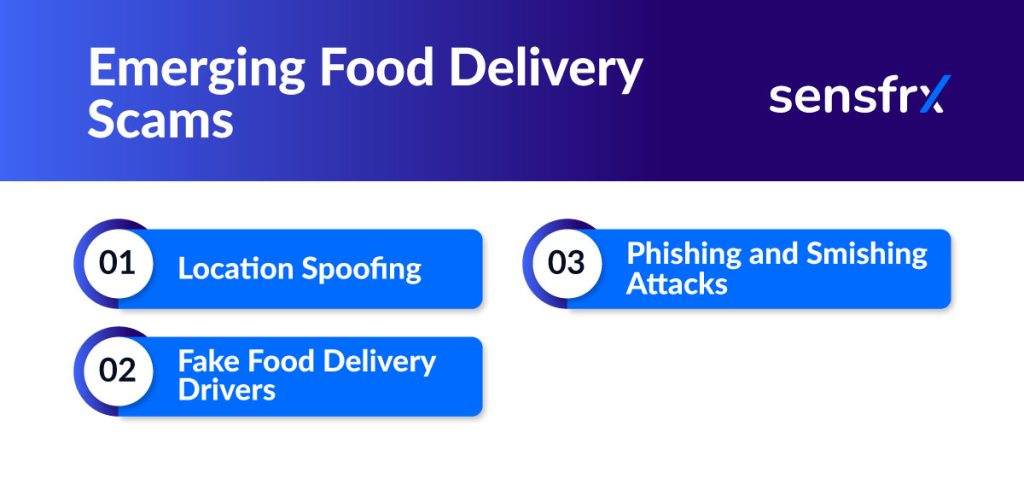
Location spoofing
Location spoofing is faking GPS data to fool the platform. The usual actor is a driver running spoofing software to:
- Get paid for deliveries they never made.
- Grab high-paying orders in busy areas while sitting somewhere else.
- Hit the delivery metrics for premium driver status.
What it does to customers and merchants
Customers:
- Orders arrive late or never, because the "delivered" tap was a lie.
- They pay for food they did not get, and wait while the dispute is sorted out.
- Service quality drops as spoofing drivers chase the fraud instead of the deliveries.
Merchants:
- They eat the cost of undelivered orders plus the chargeback fee when the customer disputes.
- Bad reviews from those customers land on the restaurant, not the driver.
On top of that, investigating each false claim takes staff time away from running the business.
Fake delivery drivers
Fake drivers pose as couriers for a real platform and use the role to scam customers.
The common route is phishing: emails or copycat websites that mimic the delivery service and collect logins. Once the scammer has your account, they order on your card and in your name.
How to identify a fake driver
The signs are visible at the door:
- No identification or branded gear when the platform's real drivers carry both.
- A vehicle that does not match the one shown in the app.
The app shows the driver's name, photo and vehicle in real time. Check them against the person who arrives before you hand anything over.
How to avoid scam deliveries
Four habits:
- Check the driver's name, photo and vehicle in the app before accepting the order.
- Pay in the app, never in cash at the door.
- Keep your phone number, address and card details inside the app.
- Report anything that feels wrong to the platform the same day.
Phishing and smishing
Phishing (email) and smishing (SMS) are the social engineering side of delivery fraud: messages that pose as the platform and ask for personal details or logins.
The message copies the platform's branding and carries an urgent request to update account information or verify a payment method.
How the information is taken
The techniques keep improving, so it is worth knowing the shape of the current ones.
A text or call announces a problem with an order or payment, then asks for card details or a password to "fix" it. Real platforms do not ask for either. If in doubt, hang up and call the platform through the number in the app; share details only on a call you started.
Examples of phishing scams in food delivery
Two patterns come up again and again:
- Fake order confirmation emails that look like the platform, claim a problem with a recent order and ask you to log in through the link provided.
- Account verification texts that cite "suspicious activity" and send you to a phishing page to confirm your details.
What food delivery scams cost
The cost lands on both sides of the order.
For the customer it is money first: an order paid for on a fake site and never delivered, or personal data taken along the way.
![Consequences of Food Delivery Scams]](/media/blog-2024-09-sensfrx-september-3-5-1024x506.jpg)
Financial losses for customers and businesses
The money goes in two directions.
Customers
- Pay for orders that never come or bear no resemblance to what was promised.
- May face bank fees when they dispute unauthorised charges.
Businesses
- Lose the revenue from fraudulent orders and pay the chargeback on top.
- Spend staff time and money investigating scams and adding controls, which would otherwise go into growth and service.
Long-term damage to trust and reputation
A customer who gets defrauded through your platform does not separate the scam from the brand. Trust goes, and it does not come back on the next discount.
Defrauded customers feel exposed and angry. Many stop ordering, and many tell friends, family and social media why.
Legal and liability issues
Both sides have rights and duties, and both should know them before an incident, not after.
When a compromised card is disputed, the delivery service takes the chargeback, loses the revenue and picks up a mark with its payment processor. When a fraudulent order goes through a real customer's account, the customer has to report the unauthorised charges and secure the account.
How to protect yourself from food delivery scams
The scams run from fake restaurants listed on delivery apps to fake drivers collecting card details at the door. The outcome is the same: lost money and exposed personal data.
Stick to delivery apps and sites with a track record on security, and look up a restaurant you do not know before ordering from it.
Security measures that work
Fraud reaches a restaurant as stolen card details and fake orders. Three measures cover most of it:
- Use secure payment methods, and never enter card details over public Wi-Fi or on an unsecured site.
- As a restaurant, partner with established delivery services that have real fraud controls.
- If you run your own delivery, train staff to spot the signs of a fraudulent order before it leaves the kitchen.
Multi-factor authentication, trusted apps and encryption
Three controls protect orders and personal data:
- Multi-factor authentication: two or more proofs of identity before the account opens.
- Trusted apps: install only the official app from the official store. Copycat apps are a phishing route.
- Encryption: the data between your phone and the platform is scrambled so nobody in between can read it. Check for it before entering a card.
Keeping up with new scams
Scam tactics change, so the types above are a starting point, not the whole list. Knowing the current patterns is most of the defence.
Phishing is the one that keeps mutating: fake sites and emails that copy the real service closely enough that the difference is hard to spot at a glance.
Spotting suspicious activity in food delivery
Fraud costs customers money and platforms their reputation, so both need to recognise a suspicious order when they see one.
Working with the delivery platform
For a restaurant, the delivery platform is the first filter on fraudulent orders.
The large platforms run detection across millions of orders and spot patterns a single restaurant cannot. Working with them means most fraudulent orders are flagged before they reach your kitchen, though not all of them.
Reporting scams and suspicious activity
Knowing what to do with a suspicious message matters as much as recognising it.
The usual tactics are fake emails or texts from a "popular platform" asking for personal details or logins, and fake customer-service agents asking for payment or gift card codes to "resolve" an order problem. Do not reply. Report it to the platform's support team, who can confirm whether it was them and take it down.
Why the platform you choose matters
An established platform brings its own protections with it.
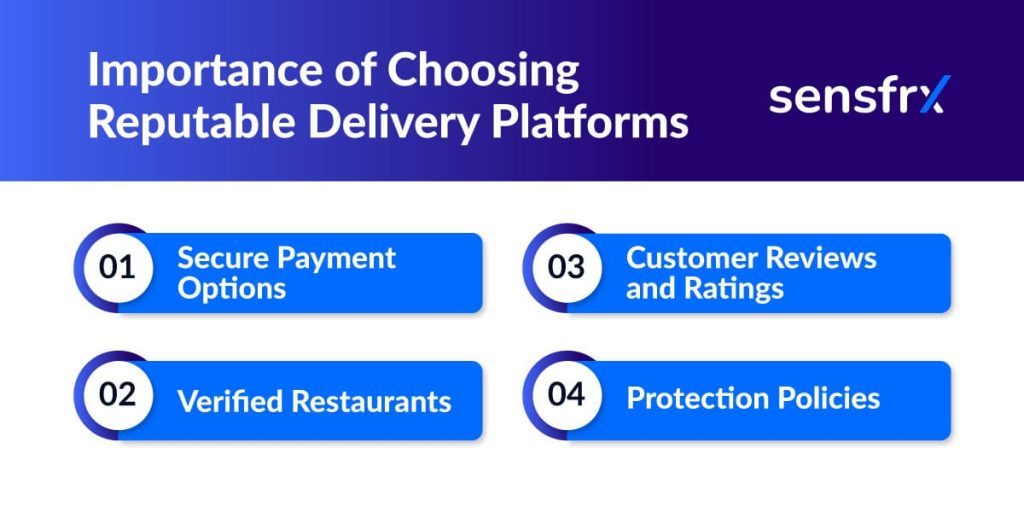
- Secure payment gateways, so your card details are not sitting on a restaurant's server.
- Verified, registered restaurants, so the food comes from a real kitchen.
- Reviews and ratings from other customers, which make scams and poor service easier to avoid.
- Protection policies: a way to report a problem order or suspected fraud and get help.
Where Sensfrx fits
Sensfrx scores three events on a delivery platform in real time: signups, logins and payments. Each gets a risk score from device, network and behaviour signals, and your rules turn the score into allow, review or block. Against the scams above:
- Account takeover: login scoring catches a known customer arriving from a new device and a new network at an odd hour, and routes the login to review before an order goes out. See account takeover protection.
- Promo abuse and fraud-as-a-service: signup scoring sees the same device or network opening its tenth account and blocks it before the promo code is claimed. See fake registration prevention.
- Card-not-present fraud: payment scoring flags the stolen card before the restaurant starts cooking, so the chargeback never happens.
It does not verify drivers, inspect GPS traces or scan your email and SMS channels for phishing. Those stay with the platform's operations and communications teams.
Where to start
Account takeover, phishing, refund abuse and fake drivers each need a different control, and the bill is growing. Juniper Research forecast that the global cost of food delivery fraud would pass $5 billion a year by 2026.
If you run a platform or a restaurant that takes orders online, start with the three events you control: score signups, logins and payments, and let your rules decide what to allow, review or block. Sensfrx does that from a free plan or a 14-day trial, with no sales call.
Questions about a specific setup, or a plugin you do not see listed, go through the contact page.
Frequently asked questions