Track fraudulent logins, account recovery cases, fraud losses and false positives before and after rollout. All four should fall.
The best account takeover prevention tools: A practical guide
Eight account takeover prevention tools compared, how ATO attacks get past passwords and CAPTCHAs, and what to check before you pick one.
 By 7 mins readPublished Updated
On this page
Account takeover (ATO) is the fraud that gets past your controls because the attacker has the right password. Stolen funds, fraudulent orders, data exposure, regulatory penalties and churn follow, and the login that caused all of it looked valid.
That is why teams are moving from authentication alone to dedicated ATO prevention tools that spot malicious behaviour when every credential checks out.
Below: how ATO works, why passwords and CAPTCHAs are not enough, what to check in a tool, and eight tools compared.
What an account takeover attack is
An account takeover attack is an unauthorised person logging in to a real user's account and using it for fraud. Modern ATO rarely trips an alert on the way in.
Once inside, the attacker can:
- Place fraudulent transactions
- Change the credentials and lock the owner out
- Steal personal or financial data
- Spend loyalty points or stored payment methods
- Use the account to attack others
The hard part is that all of this looks like a real user doing normal things.
How account takeover works in practice
With valid credentials and realistic session behaviour, the attacker passes basic checks and stays invisible until the misuse shows up.
Four common techniques
Credential stuffing. Usernames and passwords leaked in earlier breaches are replayed against your login, betting on password reuse. A low success rate still pays when the list has thousands of accounts on it.
Brute force and password spraying. Instead of many passwords against one account, a few common passwords against many accounts. That stays under lockout thresholds.
Phishing and social engineering. Fake emails, messages or look-alike login pages get the user to hand over the credentials. The weakness is trust, not code. See how to prevent phishing attacks.
Bot-driven login abuse. Bots run real browsers, move the mouse and pace their requests like people, which gets them past CAPTCHAs and simple rate limits. Since the password is right, a password check tells you nothing.
Why passwords, CAPTCHAs and static MFA are not enough
Most organisations still lean on:
- Password policies
- CAPTCHA challenges
- Static multi-factor authentication (MFA)
These matter, but they were not designed for automated attacks that mimic humans, rotate IPs and spread attempts across accounts. They fail in four ways.
They add friction for real users: password resets, repeated CAPTCHAs and MFA prompts nobody needed, and drop-offs go up. Advanced bots bypass them. They stop watching once the user is logged in, which is where most of the fraud happens. And at scale their rigid rules flag genuine users, which costs analyst time and customer goodwill.
ATO prevention tools fill that gap. They score behaviour, device and context in real time, so a correct password is one signal among many rather than the whole decision.
What to look for in an ATO prevention tool
Not every security product is built for ATO. The useful ones detect attack patterns rather than add more authentication steps.
Check for:
- Real-time detection, not alerts after the fact
- Behavioural analysis that flags abnormal activity
- Device and session intelligence
- Bot and automation detection
- Low false positives
- Scale for high-traffic logins
Judge the tools below against that list, not against their feature pages.
Top 8 account takeover prevention tools
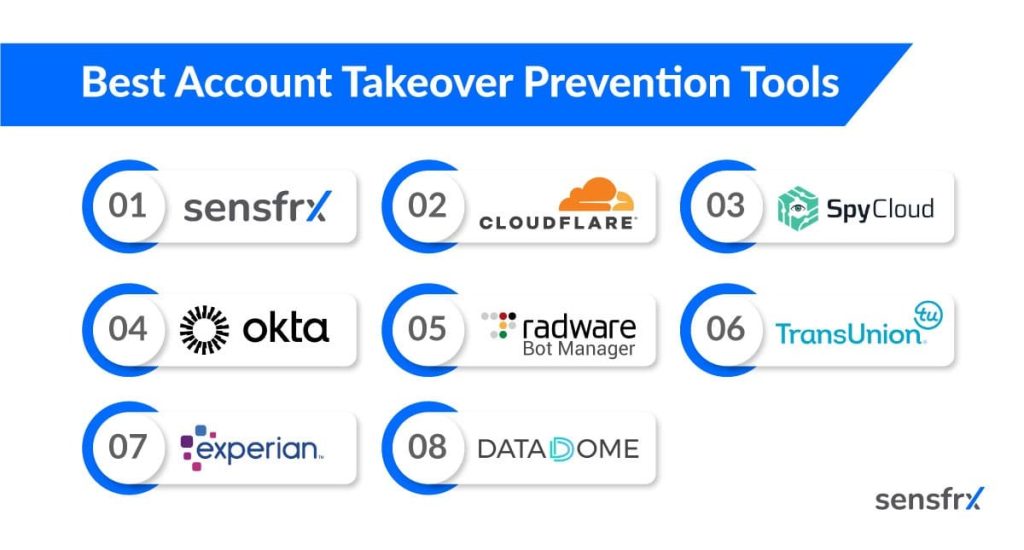
1. Sensfrx
Sensfrx detects credential abuse, bot-driven attacks and suspicious account behaviour in real time, and separates genuine users from attackers even when the credentials are valid.
It does not depend on static rules. Device signals, behaviour and session context are scored on every login, and your rules turn the score into allow, review or block. Details are on the account takeover protection page.
Key features
- Device fingerprinting
- Behavioural and session risk scoring
- Credential stuffing and brute-force detection
- Bot and automation identification
- Real-time response with low latency
Pros
- Catches both bots and human attackers
- High-accuracy fingerprinting
- Real-time analytics with no delay
- Integrates across platforms
- Fast decision, implementation and response time
- 99.9% uptime on APIs and services
- Low false-positive rate
2. Cloudflare
Cloudflare covers ATO as part of its bot management and application security platform. Its global traffic view lets it spot automated login abuse at the network edge.
Key features
- Network-level bot intelligence
- Behavioural anomaly detection
- Rate limiting and challenges
- WAF and CDN protection in the same stack
Pros
- Scales well
- Strong against high-volume automated attacks
- Easy to switch on for existing Cloudflare users
Cons
- Limited view of post-login behaviour
- Less specialised for subtle ATO
3. SpyCloud
SpyCloud works on credential exposure. It watches underground sources for stolen usernames, passwords and session data so you can act before those credentials are used against you.
Key features
- Dark web and breach monitoring
- Credential exposure alerts
- Automated remediation workflows
- Identity exposure analytics
Pros
- Stops attacks before they start
- Clear view of compromised identities
- Pairs well with a real-time detection tool
Cons
- Does not block attacks in real time
- Needs integration with IAM or SOC processes
4. Okta

Okta handles ATO through adaptive authentication and contextual access control. It scores login risk from behaviour, device and location and asks for MFA only when the risk warrants it.
Key features
- Risk-based MFA
- Device and location intelligence
- Login anomaly detection
- Centralised identity management
Pros
- Strong enterprise IAM
- Suits workforce and B2B environments
- Flexible access policies
Cons
- Not built for ATO prevention alone
5. Radware bot manager
Radware Bot Manager blocks automated attacks at scale and is strongest against credential stuffing and scripted login abuse.
Key features
- Bot behaviour fingerprinting
- Real-time bot mitigation
- Challenge-response controls
- Detailed attack analytics
Pros
- Strong automated attack protection
- Takes load off infrastructure
- Custom mitigation strategies
Cons
- Limited detection of human-driven fraud
6. TransUnion
TruValidate combines identity intelligence with behavioural analytics to score login and transaction risk. It is common in financial services and other regulated industries.
Key features
- Identity-based risk scoring
- Behavioural analytics
- Transaction monitoring
- Compliance-ready reporting
Pros
- Strong identity verification
- Fits regulated environments
- Covers login and transaction risk
Cons
- Complex integration
- Costly for smaller organisations
7. Experian
Experian uses identity and credit data to enrich fraud signals and score account access risk.
Key features
- Identity and credit intelligence
- Suspicious login detection
- Fraud scoring APIs
- Compliance support
Pros
- Strong trust signals
- Widely used in financial services
- Regulatory alignment
Cons
- Weaker against advanced bots
- Heavier operational overhead
8. DataDome

DataDome does real-time bot protection across web, mobile and APIs, and is effective against large-scale automated ATO attempts.
Key features
- AI-based bot detection
- Real-time blocking
- API and mobile app protection
- Attack dashboards and alerts
Pros
- High bot detection accuracy
- Easy to deploy
- Strong API protection
Cons
- Limited post-login behavioural insight
- Less focus on human-driven ATO
How to prevent account takeover in practice
The tool is half of it. The other half is how you run it.
Use risk-based MFA, not static challenges. Trigger MFA on device, location and behaviour signals, so friction lands on the suspicious login and nowhere else.
Watch the session after login. Account changes, transaction patterns and odd behaviour after authentication are where misuse shows up, and most controls have stopped looking by then.
Catch exposed credentials early by monitoring breach sources and preventing credential stuffing attacks before they are replayed against you.
Keep false positives low. Context, not rigid rules, is what lets you block attackers without blocking customers.
Layer bot detection, behaviour analysis and identity intelligence. Each catches what the others miss, across both automated and human-driven attacks.
Where to start
ATO is persistent, automated and built around valid credentials. Passwords, CAPTCHAs and static MFA on their own do not keep up.
What works is a layered setup: real-time detection, behavioural intelligence, bot mitigation and adaptive authentication, with no extra friction for the users who are who they say they are.
Start by putting a risk score on every login. Sensfrx has a free plan and a 14-day trial, so you can run it against your real login traffic before you change any policy.
Frequently asked questions