Any unauthorized transaction made through a digital wallet, whether by taking over a real account, enrolling a stolen card, opening a wallet under a fake identity or tricking the owner into handing over access.
Digital wallet fraud: Attacks, detection & prevention
What digital wallet fraud is, the six attacks behind it, what it costs merchants, and the device, login and transaction checks that stop it.
On this page
Digital wallets such as Apple Pay, Google Pay, PayPal, Amazon Pay and PhonePe handled nearly 50% of global ecommerce payment transactions in 2025, more than any other online payment method. A wallet payment reaches your checkout tokenized and marked as verified, and that is exactly what makes it useful to a fraudster.
The wallet's own security holds up well. What breaks is everything around it: stolen logins, hijacked accounts, fake identities and stolen cards enrolled into wallets the criminal controls. Payment authentication catches none of that, so merchants need real-time fraud checks on the signup, login and checkout that sit in front of the wallet.
What is digital wallet fraud?
Digital wallet fraud is any unauthorized purchase or transfer made through a stolen, hijacked or fabricated wallet account.
It takes one of four routes. The fraudster phishes or steals a customer's wallet login and spends the saved payment method as if they were the owner. Or they load stolen card details into a wallet they control and spend without ever holding the card.
Or they take over the whole account, change the recovery details and lock the real customer out. Or there is no real customer at all: the wallet was opened with a synthetic or stolen identity for the sole purpose of fraud.
Each route ends in the same place. The transaction passes the "verified user" and tokenized "card present" checks merchants trust, because the fraudster came in through a different door.
Why digital wallet fraud is growing
More wallets, faster checkouts and a steady supply of breached credentials. A one-tap payment leaves fewer moments where a manual check could catch a problem, and the convenience that lifts conversion lifts fraud with it.
Six things feed the growth:
- More wallet users means more accounts to attack.
- One-tap checkout skips the manual verification steps that used to slow fraud down.
- Logins leaked in data breaches are sold and replayed against wallet providers.
- Mobile commerce keeps growing, and most wallet payments start on a phone.
- Criminals use AI to write phishing emails, texts and clone sites that read as genuine.
- Merchants that rely on payment authentication alone miss the suspicious device, the hijacked account and the odd behaviour that come before the payment.
None of these trends is reversing. The checks have to run in real time, on every transaction.
Common types of digital wallet fraud
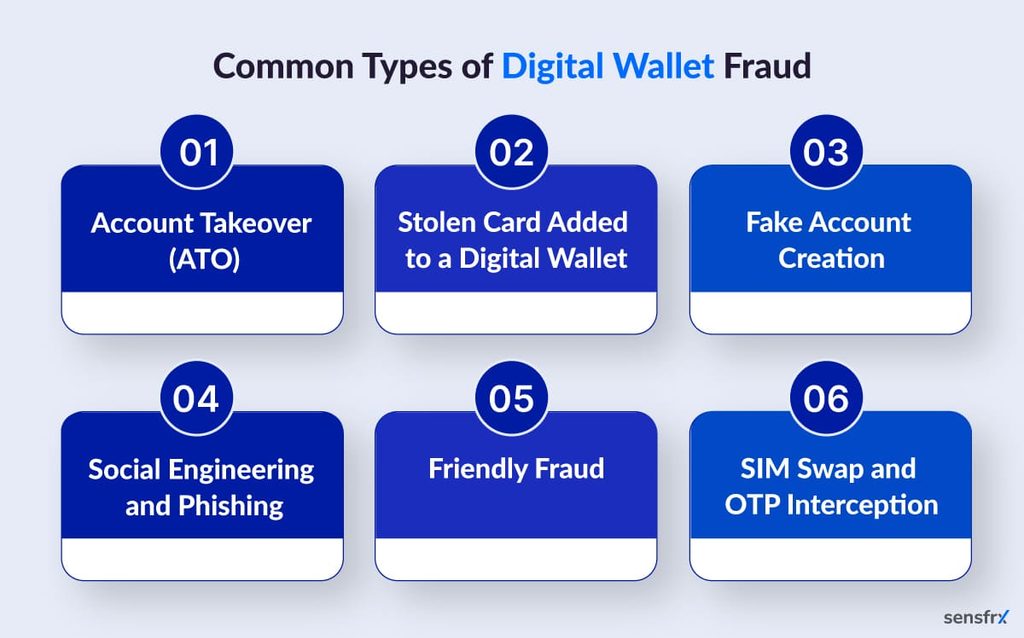
1. Account takeover (ATO)
Account takeover starts with a stolen username, password or one-time password (OTP). Once in, the attacker pays with whatever payment method the customer saved.
Credential stuffing is the usual way in. Bots replay email and password pairs from old breaches against wallet logins, and because customers reuse passwords, a fraction of them work. The attack runs at scale and shows up in your logs as bursts of failed logins, login volumes far above normal and other signs of automation. Watch for those and you stop the stuffing run before any account falls.
Example: A phishing email captures a customer's PayPal login. The attacker signs in and orders high-value electronics on the saved card.
Business Impact
- Chargebacks and refund requests
- Customer complaints
- Lost customer trust
2. Stolen card added to a digital wallet
The criminal buys stolen card details and enrolls the card in Apple Pay or Google Pay. Enrollment tokenizes the card: the wallet then pays with a device-bound token, and the card number (PAN) never appears in later transactions.
The attacker does not need to break tokenization. They need to get through enrollment. Once the stolen card is enrolled, the token is a working payment credential, and it keeps working until the cardholder or issuer notices. Card verification and risk scoring at the moment of enrollment is the control point that matters.
Example: A fraudster enrolls stolen card details in Apple Pay and places several orders with one online store.
Business Impact
- Fraudulent orders
- Payment disputes and chargebacks
- Lost revenue
3. Fake account creation
Fraudsters open wallet or customer accounts with fake or stolen identities, then use them to farm discounts, signup bonuses and loyalty rewards, or to hide other fraud behind a clean-looking profile.
Example: One fraudster opens dozens of accounts to claim a "₹500 off your first purchase" offer again and again.
Business Impact
- Abused promotions and loyalty programs
- A customer base padded with fake accounts
- Revenue lost to the abused offers
4. Social engineering and phishing
Fake emails, texts, calls and websites trick customers into handing over wallet logins or OTPs. The fraudster then spends from the account.
Example: A customer gets a text saying their wallet needs verification, enters their login on a clone site, and the attacker starts buying within minutes.
Business Impact
- Unauthorized transactions
- Customer complaints
- Lost customer confidence
5. Friendly fraud
The customer makes a real purchase, then disputes it as unauthorized or claims the order never arrived. Sometimes it is deliberate, sometimes a family member used the wallet, sometimes the customer did not recognise the statement entry.
Example: A customer receives an item paid for with Google Pay, then files a chargeback claiming they never approved the payment.
Business Impact
- Chargebacks
- Lost revenue
- Staff time spent investigating disputes
6. SIM swap and OTP interception
The fraudster talks a mobile carrier into moving the victim's number onto a SIM they hold, using stolen personal details or plain persuasion. Every OTP the wallet sends now lands on the fraudster's phone, so logins and transfers pass authentication. Mobile-first wallets such as PhonePe and Google Pay, where SMS OTP is often the main check, are the main target.
Example: A fraudster swaps a victim's SIM, receives the next PhonePe login OTP and empties the wallet balance before the victim notices their phone has no signal.
Business Impact
- Authentication bypassed even though the OTP check "passed"
- Disputes that are hard to trace, because the transaction looks fully authenticated
- Closer scrutiny from payment processors if the pattern repeats
How digital wallet fraud affects ecommerce businesses
One fraudulent transaction is never the whole bill. The cost spreads into fees, staff time, lost customers and the terms your processor gives you.
Financial losses
Each fraudulent order brings a chargeback, a refund, lost goods and processing fees, and on high-value orders those stack up fast. The indirect costs usually exceed the order itself: LexisNexis's 2025 fraud multiplier study put the merchant cost at more than $5 for every $1 of direct fraud loss.
Higher operational costs
Someone has to review the flagged orders, answer the complaints, investigate the cases and work the chargebacks. Mastercard puts the average cost of a chargeback at $128 once third-party fees and internal handling are counted.
Poor customer experience
Controls that are too tight block real customers. False declines and extra verification steps cost you carts, and a customer declined once rarely comes back. Winning a new customer costs more than keeping the one you just declined.
Brand reputation
Customers expect payments to be safe. Repeated fraud incidents turn into negative reviews and fewer repeat purchases.
Increased payment risk
A rising chargeback ratio draws scrutiny from your processor, then higher fees, then limits on which payments you can accept. The pressure is growing: Mastercard expects the global number of chargebacks to rise 37% between 2025 and 2029.
What to do if you suspect digital wallet fraud
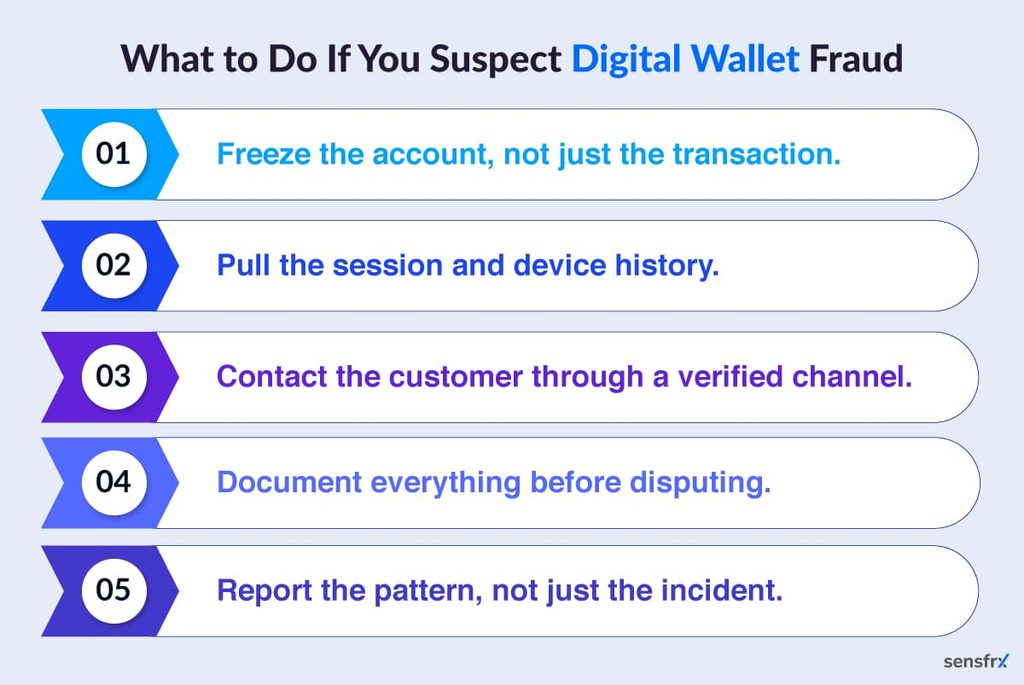
Some fraud will get through the best controls. What your team does in the first few hours decides how much it costs.
- Freeze the account, not just the order. One fraudulent order means the account may be compromised. Pause everything on it while you look.
- Pull the session and device history. Compare the flagged transaction's device, IP and login pattern with the customer's normal behaviour. That tells you whether you are looking at account takeover, a stolen card or friendly fraud.
- Contact the customer on a channel you trust. Use the phone number or email that was on file before the suspicious activity, never the contact details that came with the flagged order.
- Record the evidence before you dispute. Device fingerprints, IP logs and login timestamps win chargeback representments.
- Turn the incident into a rule. Repeated attempts from one device or IP range belong in your fraud rules, so the next attempt is blocked by the system rather than caught by a person.
How to prevent digital wallet fraud
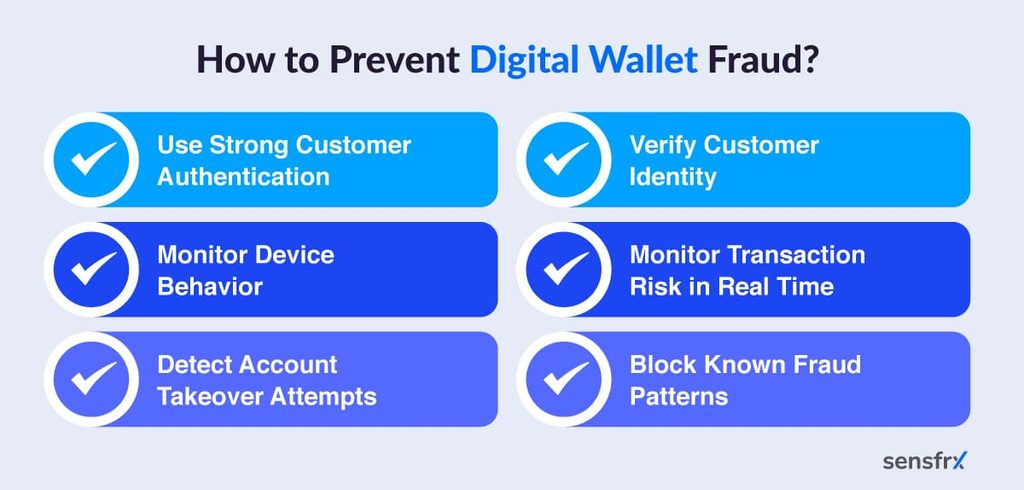
No single check stops this. Payment authentication proves a wallet credential is valid; it says nothing about who is holding the phone. Watch the user, the device and the transaction from signup through checkout, and act before the payment completes.
Use strong customer authentication
Make the person paying prove they are the account owner:
- Turn on multi-factor authentication (MFA) for customer accounts.
- Support fingerprint or face biometrics where the device offers them.
- Use an authenticator app or push approval for high-risk logins and payments instead of SMS OTP alone. A SIM swap captures SMS; it does not capture a device-bound authenticator.
Monitor device behavior
Fraudsters rotate devices and hide where they are. The device gives them away before the payment is made.
Look for:
- Device fingerprints that change between sessions
- Emulators and virtual devices running automated fraud
- Rooted or jailbroken devices with security controls disabled
- Browser or device settings that do not match a normal customer
Detect account takeover attempts
Account takeover is the most common digital wallet attack, and it announces itself at the login, before any money moves.
Monitor for:
- Logins from unfamiliar devices or locations
- Impossible travel, where one account logs in from two distant places within minutes
- Repeated failed logins
- Frequent password resets or account recovery requests
Verify customer identity
Check that new and existing customers are who they claim to be, at account creation and again before high-risk transactions:
- Email verification
- Phone number verification
- Identity verification for high-value purchases or suspicious activity
Monitor transaction risk in real time
Score every transaction on several signals, not just on whether the payment was approved:
- Device risk
- IP reputation and geolocation
- Velocity, such as several purchases in a few minutes
- Customer behaviour, such as spending or checkout patterns that break from the account's history
A score in the flow stops the fraudulent transaction before it completes and lets everyone else pay without an extra step.
Block known fraud patterns
Most attempts reuse the same tells, and rules catch them without any human review.
Block or flag transactions that involve:
- Disposable or temporary email addresses
- VPNs, proxies and Tor exit nodes
- IP addresses with a history of abuse
- Bot traffic
- Devices already linked to confirmed fraud
Rules handle the known patterns; real-time scoring handles the new ones. Together they cut wallet fraud without slowing honest checkouts.
Where to start
Put device, behaviour and IP signals in front of every signup, login and checkout, and let a risk score decide when to add a step. Begin with the two attacks that cost the most: credential stuffing at the login and stolen cards at wallet enrollment.
Sensfrx scores signups, logins and payments in real time, and your rules turn the score into allow, review or block. Start on the free plan; setup questions go through the contact page.