Page jacking: What it is, the risks and how to prevent it
What page jacking is, how cloned sites steal traffic and data, the warning signs, how to prevent it, and what to do when your pages are copied.
 By 5 mins readPublished Updated
On this page
Page jacking is old and still works: a fraudster copies your site page by page, gets the clone indexed, and takes your visitors with it. Some of those visitors hand the clone their login or their card.
You lose traffic and revenue. Your visitors lose data, or pick up malware. Stopping it takes technical controls on your side, monitoring for copies, and a plan for the day one appears.
What page jacking is
Page jacking is online fraud in which visitors are redirected to an illegitimate website without their knowledge. The attacker builds a clone of your site from your own images, text and other assets, without permission, and puts it in front of your audience.
How page jacking works
The attacker registers a domain or URL that looks like yours, then submits the cloned pages to search engines so they get indexed and start pulling visitors. Once someone lands on the clone, mouse trapping keeps them there even if they arrived by accident.
Some attackers keep watching the original. When you add or change a page, they mirror the change so the clone stays current and looks more legitimate over time.
The usual aim is to rank for your search terms by copying you, and to pull visitors who meant to reach you onto the clone. What they do with those visitors varies: take the sale, harvest logins and card details, or push malware.
Warning signs of page jacking
From the visitor's side, a jacked page often gives itself away: domain errors, a design that looks slightly off next to the real site, grammatical mistakes, too many ads, redirects nobody asked for, and pop-ups that will not close.
From the owner's side, watch for:
- A drop in search rankings with no change on your side.
- Traffic spikes or dips arriving from a site you do not recognize.
- Backlinks pointing at duplicate copies of your pages.
- Revenue or conversions falling with no other explanation.
Who is at risk
Any site can be cloned, but the ones worth cloning rank well and carry traffic. The higher the ranking and the revenue, the more a copy is worth to the attacker.
What page jacking does to a site owner
The term also covers the case where attackers take over one of your real pages through code injection or an unpatched vulnerability, rather than cloning it elsewhere. Either way, the damage looks like this.
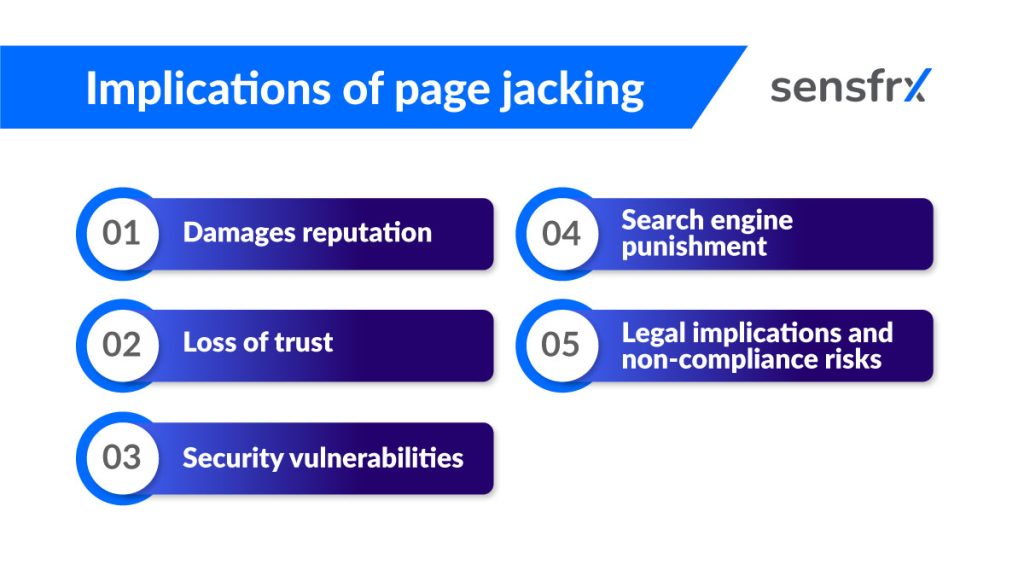
- Reputation. Changed content, structure or behavior on a page in your name can put harmful material in front of your visitors. New customers do not arrive and existing ones leave.
- Trust. Visitors who hit a hijacked page stop trusting the brand. Bounce rates climb.
- Credential theft. These attacks get in through a hole in the web server or the site code, and the same hole lets the attacker intercept user credentials.
- Search penalties. Search engines flag sites that keep serving harmful content as unsafe, and rankings and organic traffic drop with them.
- Legal exposure. Depending on what was hijacked, you can face claims under data retention or intellectual property rules.
How to prevent page jacking
No single measure covers it. Work through these.
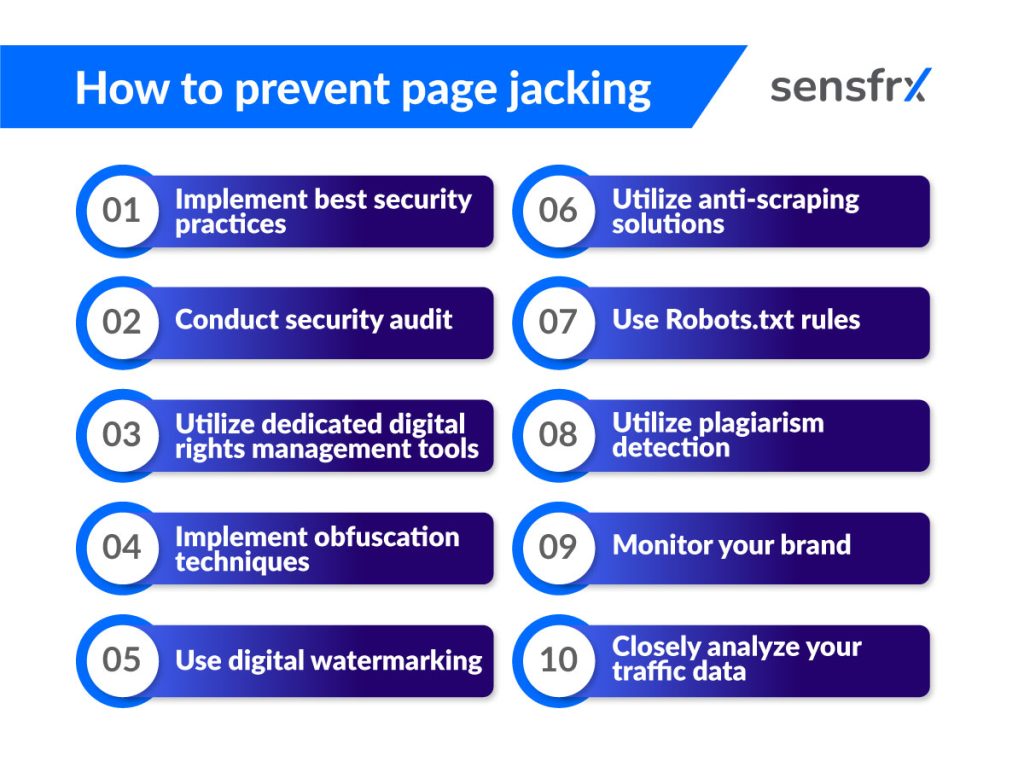
- Fix the hole first. Find the vulnerability that let the attack in, then set X-Frame-Options headers, frame-busting code and a content security policy so your pages cannot be framed or injected.
- Audit the rest of the site for backdoors left behind.
- Use digital rights management tools to control where your assets can be distributed.
- Obfuscate source code. Encode it and rename variables and methods so scrapers get less out of it.
- Watermark images, visibly or invisibly, so copies can be traced back to you.
- Add anti-scraping controls: IP blocking, CAPTCHA and rate limiting against automated copying.
- Set robots.txt rules so crawlers index only what you intend.
- Run plagiarism checkers to find copies of your content.
- Set Google Alerts for your brand names and URLs.
- Watch your traffic data with a fraud detection tool that flags anomalies.
What to do if your page gets jacked
A cloned site is copyright and intellectual property theft. Your design and content are protected assets, and legal action against the operator is the main remedy.
As soon as you find the copy, save a dated record of it: screenshots, a saved copy of the page, and any cached or archived version a search engine or web archive holds, since those carry the URL and the date the copy was taken. That is your evidence in court.
Collect anything else that documents the copy, video included, then report it to the hosting provider, the domain registrar and law enforcement.
How Sensfrx helps
A clone cannot be blocked from your side; it lives on someone else's server. What you control is what happens when the data it harvests comes back to you, and that is where [Sensfrx](/) works.
A cloned site is a harvesting front. It collects logins and card details, and the operator then replays them against your real site. That replay is the step Sensfrx sees.
Every signup, login and payment on your site is scored from device, network and behavior signals, and your rules turn the score into allow, review or block. In practice:
Device fingerprinting. A credential harvested by the clone comes back from the fraudster's device, not the customer's. The device mismatch raises the score.
Behavior signals. Navigation, typing and session patterns that do not match the account's history raise it further.
Network signals. Logins and payments arriving through VPNs, proxies or hosting ranges rather than the customer's usual network stand out.
Rules. You set the threshold at which a login or payment goes to review or gets blocked, and you can block a device or network outright.
Where to start
Patch the hole, set the headers, and set up alerts for your brand and URLs so you find copies early. Then score every login and payment on the real site so harvested credentials and cards fail when they come back. Start a free trial or contact us.