Claiming promotional offers such as welcome bonuses or top-up rewards through fake or duplicate accounts for financial gain.
Bonus abuse: Detection and prevention for risk teams
How fraudsters farm sign-up, referral and deposit bonuses with fake accounts, bots and rings, the signals that give them away, and the controls that stop them.
 By 19 mins readPublished Updated
On this page
- What is bonus abuse?
- Why it is more than a marketing loophole
- Sectors most affected by bonus abuse
- Anatomy of a bonus abuse attack
- Abuse methods
- Abuse scenarios across high-risk industries
- Signals and red flags for bonus abuse
- Detection and prevention tactics
- Operational strategies for risk teams
- Tooling: What helps you detect bonus abuse?
- Where to start
- Frequently asked questions
An online store runs a "Buy One, Get One Free" offer for first-time shoppers. One customer takes it under their real name, then opens account after account with new emails and phone numbers and takes it again. Regular customers get the deal once; this person gets it ten times. That is bonus abuse, and it is more common than it sounds. According to reports, PayPal closed 4.5 million accounts that had exploited its sign-up bonus program, and the news hurt its stock price.
What is bonus abuse?
Bonus abuse is the repeated claiming of a promotional offer (a sign-up bonus, cashback, a referral reward) through fake accounts, bots or manipulated identities. It hits e-commerce, gaming and fintech hardest. An offer meant to bring in new users becomes a payout channel for fraudsters, and it costs real money and corrupts the marketing data on top.
Why it is more than a marketing loophole
It looks like users gaming the system. The costs say otherwise.
- Money. Every abused bonus is a direct loss, and thousands of fake claims drain the budget meant for real customers.
- Analytics. Fake users inflate conversion rates, so marketing cannot tell which campaigns work or what real customers do.
- Operations. Investigating the accounts, processing the fake transactions and cleaning the data all land on fraud and support teams.
- Trust. Real users disengage when promotions look easy to exploit and unfair to the people who play straight.
Left alone, it also opens the door to more serious exploitation of the same gaps.
Sectors most affected by bonus abuse
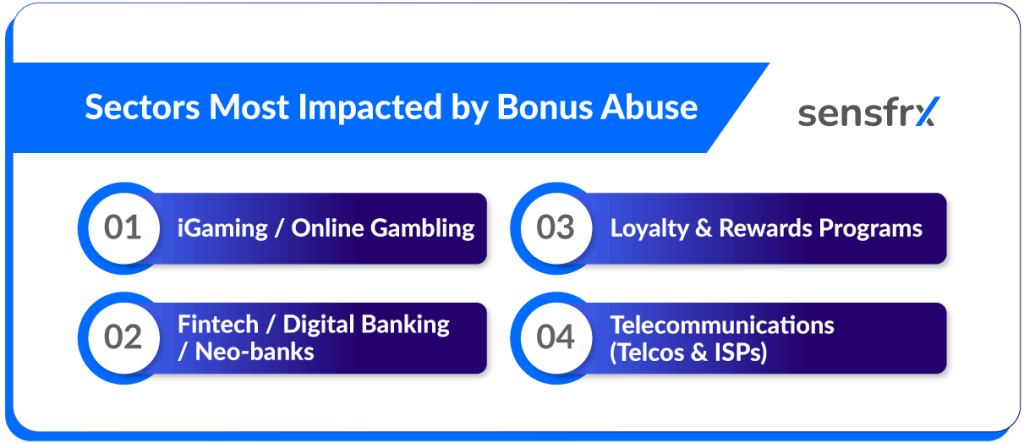
Bonus abuse follows the incentives, so it appears wherever promotions do. Four sectors see the most of it because of how they acquire customers.
IGaming and online gambling
Sign-up bonuses, free spins and deposit matches draw players in, and fraudsters claim them repeatedly through fake accounts built on synthetic identities or stolen credentials. The abuse skews player analytics and drains marketing spend, and it can cover money laundering or other fraud. The risk team's recurring problem is separating a legitimate high-volume player from a coordinated ring.
Fintech, digital banking and neobanks
Referral bonuses, cashback on account opening and promotional interest rates get farmed with fraudulent accounts and borrowed identities, often by bots.
These are regulated businesses, so the cost is more than the bonus. A promotion that lets someone through without proper KYC and AML checks is a compliance failure, and the risk team owns it.
Loyalty and rewards programs
Points, discounts and freebies usually sit behind weak identity checks. Fraudsters register under several identities or exploit return policies to collect points on purchases they never kept.
That dilutes the value of rewards for real customers and blows the program budget. Spotting the pattern across accounts is the analyst's job.
Telecommunications (telcos and ISPs)
Free data, talk time and device discounts for new customers and referrals get collected many times over with burner devices and SIMs. Subscriber numbers inflate, network resources go to non-customers, and churn rises. Weak verification, easy account creation, VPNs and device spoofing make it cheap to do.
The fix is the same combination as elsewhere: strong KYC, IP and device checks, behavioral analytics, clear terms and ongoing monitoring.
Abuse that starts as one person with ten accounts becomes an organized ring if nobody stops it. Knowing where it happens is the start of a defense.
Anatomy of a bonus abuse attack
An attack has two parts: the bonus chosen and the method used to claim it many times.
Common types of bonuses targeted
Fraudsters pick bonuses with immediate, extractable value, and they scale the claim with fake identities, bots or social engineering.
1. Sign-up rewards
An incentive for registering (say ₹500 for new users). Easy to replicate with fake accounts or stolen identities, and often farmed in bulk by bots or identity farms.
2. Referral bonuses
A reward for bringing in another user (say ₹100 each for referrer and referee). The fraudster creates both accounts and pays themself the bonus.
3. Deposit matches and top-up rewards
A match on the first deposit or top-up (say 100% up to ₹2,000). The fraudster makes small deposits across many fake accounts, takes the match, and withdraws it or spends it on further fraud.
4. Cashback and loyalty point exploits
Rewards tied to spending or repeat use. The abuser triggers fake transactions, or buys and refunds while keeping the points or cashback.
Abuse methods
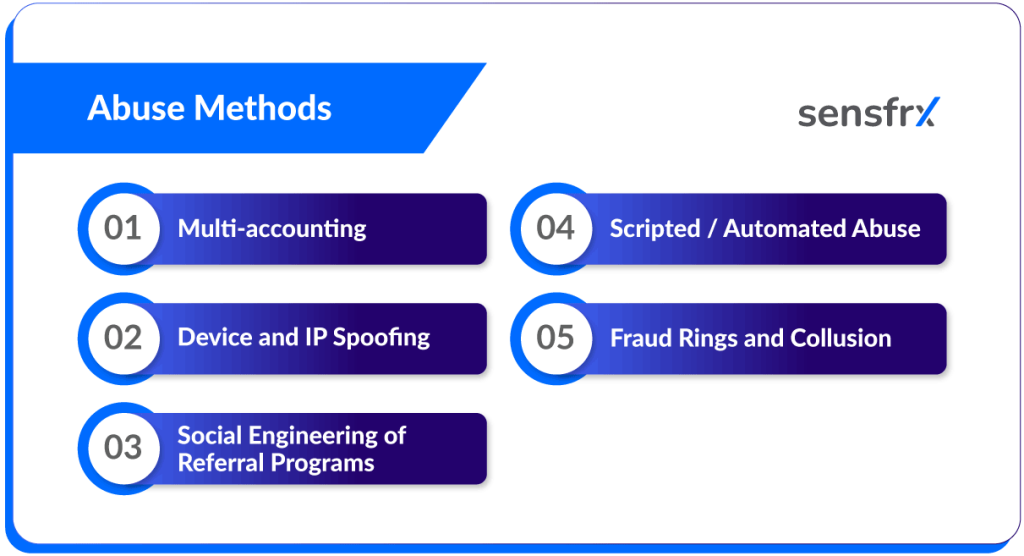
1. Multi-accounting
With a target bonus chosen, fraudsters layer technical and behavioral tricks to avoid raising flags. Multi-accounting is the base layer.
The fraudster creates many accounts under fake identities, stolen personal details from data breaches, or synthetic identities (fabricated details that pass basic checks).
Each account claims the welcome bonus, the first-deposit match, the free spins or credits. One person harvests a dozen bonuses by posing as a dozen users.
It is hard to detect because each account has its own name, email and mobile number, and may arrive from a different IP and device. Without identity verification (such as eKYC) or behavioral analytics, the accounts look like ordinary users.
Example: A fraudster uses stolen PAN cards or fake Aadhaar details to open 20 accounts on a gaming platform. Each gets ₹1,000 in free play credits. They play the minimum and cash out through different payment gateways, taking ₹20,000+ in value.
Read more on multi-accounting: what it is and how to prevent it
2. Device and IP spoofing
The fraudster hides the real device and location: VPNs or proxies to rotate IP addresses, emulators or spoofing tools to change the device fingerprint, cleared cookies or incognito sessions.
The point is to look like a new, unique user each time and get past any control that limits accounts per source.
It is hard to detect because the IPs appear to come from different cities or countries, many platforms have no device-level fraud controls, and accounts that look technically distinct are hard to link.
Example: A fraud ring uses mobile device emulators and proxy servers so each account looks like a different person in a different geography. The system keeps seeing "new" users and keeps paying them, unaware it is one group.
3. Social engineering of referral programs
The fraudster recruits real users into a referral scheme through WhatsApp or Telegram groups, with promises of quick money ("Refer this and get ₹500 each!") or a cut of the payout for signing up with their code.
It works because real people are involved, so the behavior looks genuine; the referral chain is built on semi-legitimate activity; and the fraudster can afford to pay each recruit a small amount.
It is hard to detect because the users are real and the behavior sits in a gray area, not quite fraud and not quite clean.
Example: A fraudster posts their referral link in a Telegram group and promises ₹200 to anyone who signs up and deposits ₹1,000. 50 people do. The fraudster earns ₹25,000 in referral bonuses, pays ₹10,000 to the participants and keeps the rest.
4. Scripted and automated abuse
Bots, scripts and automation tools fill in forms and create accounts, claim bonuses and complete any required steps, and simulate activity such as logging in or playing games.
Automation scales the abuse to hundreds or thousands of accounts, costs the fraudster almost no effort and walks past weak anti-bot systems.
It is hard to detect because scripts can mimic human behavior, CAPTCHA and basic bot checks are often weak or missing, and the result looks like fast but normal user activity.
Example: A bot registers 500 accounts overnight with a script that fills in fake details and rotates IP addresses. It clicks the verification links, logs in and claims a signup bonus on each. The fraudster is asleep the whole time.
5. Fraud rings and collusion
Fraud rings are organized networks that trade compromised data, evasion techniques and automation tools, and coordinate their actions to get past controls at scale. The collusion is what makes them hard to stop: resources are shared and the work is split.
They do it to run large-scale abuse across platforms, to make tracing and attribution hard, and to keep the operation profitable for as long as possible before it is caught.
It is hard to detect because the activity is spread across many accounts and devices, the collusion may include insiders or users helping each other, and the data moves through underground markets that are hard to see into.
Example: A ring targets 5 gambling platforms with the same methods (multi-accounting, spoofing, automation), spread across 100 members who each handle a portion. The total loss across the platforms passes ₹50 lakhs before anyone sees the pattern.
Bonus abuse follows a pattern. Teams that know which offers get abused, and how, can catch it at signup rather than at payout.
Abuse scenarios across high-risk industries
The tactic bends to the sector's weak point.
1. Gambling and igaming
Generous promotions make gambling and iGaming the prime target. Multi-accounting, fake identities and syndicates go after welcome bonuses, deposit matches and referral rewards.
- Welcome bonus multi-accounting: many fake accounts, each claiming the sign-up bonus.
- Fake KYC to cash out promotional winnings: stolen or synthetic identities get past Know Your Customer checks so the winnings can be withdrawn.
- Syndicated rings abuse tournaments or deposit promos: coordinated groups steer tournament prizes or high-value deposit matches to accounts they control.
2. Fintech and neobanks
- Wallet top-up bonuses drained by fake signups: bots or human farms create users who collect the top-up incentive and withdraw it at once, or push it through a laundering chain.
3. Loyalty programs (retail and travel)
- Referral loops, discount sharing and rewards fraud: users self-refer or pass discounts around a network, inflating reward balances with no legitimate purchase behind them.
4. E-commerce
- Promo stacking with affiliate and referral arbitrage: discount codes, cashback deals and referral bonuses combined in ways the company never intended, until the product is free, near free or a source of profit.
Say a company offers:
- ₹500 off with a promo code
- 10% cashback via a payment partner
- ₹300 bonus for every referral
The fraudster:
- Refers themself from a fake account and earns the ₹300.
- Uses the promo code on the same purchase.
- Pays through the cashback offer and gets 10% back.
And possibly buys through a coupon site carrying their own affiliate link, earning commission on their own order.
5. Telecom
- Free SIM registrations through fake identities or burner numbers: fake KYC documents or disposable numbers collect multiple free SIMs, which then serve OTP bypass or spam campaigns.
Signals and red flags for bonus abuse
Abusers leave traces in behavior, device data and network patterns. These are the ones worth alerting on.
1. Behavioral signals
- Velocity of account creation. Dozens of new accounts from one device or location within minutes. 50 sign-ups from one neighborhood or IP in under 10 minutes is not organic.
- Identical session replays. Many users who log in, click through the same pages and finish the same tasks at the same speed are one script, not many people.
2. Device and environment signals
- Device fingerprint mismatches. Real users come back on the same or similar devices. A fingerprint (OS, browser version, screen size) that jumps from a Windows laptop to an Android emulator between sessions deserves a look.
- Emulators and jailbroken devices. Both mask identity and make apps easy to manipulate. Their presence at sign-up is a warning on its own.
- Browser spoofing and headless automation. A browser missing common features, or running in headless mode with no visual interface, is a bot more often than not.
3. Identity and network patterns
- Reused KYC and PII details. Rings recycle the same date of birth, ID number or name across accounts with small changes (John Smith, then J. Smith) to slip past duplicate checks.
- Disposable emails and phone numbers. Temporary addresses and burner numbers let the abuser open accounts fast and disappear once the reward is claimed.
- IP clusters and proxies. Many accounts from one IP, or from ranges known for VPNs, proxies and anonymizers, point to one actor hiding their location or dodging geo-restrictions.
Any one of these can have an innocent explanation. Several together mean the same person is claiming the bonus many times, and catching that early is what keeps the losses small.
Detection and prevention tactics
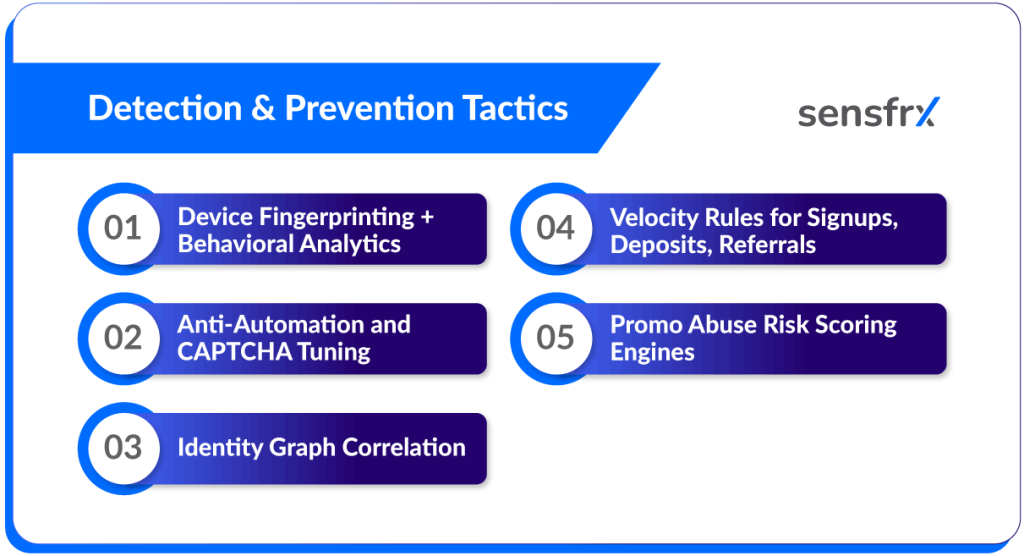
No single control holds. The six below layer, and each has a concrete setup.
1. Device fingerprinting with behavioral analytics
Device fingerprinting collects technical detail (OS, screen size, browser, fonts, time zone) to identify a device across sessions. Paired with behavioral analytics (typing speed, mouse movement, click patterns), it separates real users from bots and repeat abusers.
How to implement:
- Add a device intelligence service (Sensfrx, for example) to track fingerprints across sessions.
- Correlate it with behavioral analytics that read session patterns in real time.
- Alert on anomalies: high device churn, several accounts on one fingerprint, robotic browsing.
2. Anti-automation and CAPTCHA tuning
CAPTCHAs and bot mitigation stop the scripted attacks and headless browsers behind mass bonus abuse.
How to implement:
- Use an adaptive CAPTCHA (Google reCAPTCHA v3 or hCaptcha) that raises difficulty with risk.
- Put bot protection such as Cloudflare Bot Management or PerimeterX on signup, login and bonus claim.
- Watch CAPTCHA pass rates and tune thresholds so real users are not blocked.
3. Identity graph correlation
An identity graph links accounts through shared or near-identical data: phone numbers, emails, devices, payment instruments, IP addresses. It shows collusion and multi-accounting as one picture rather than many separate accounts.
How to implement:
- Build an identity graph engine or buy one (Ekata, Alloy and Deduce offer it as a service).
- Flag accounts that share several weak signals (same DOB plus device plus IP) or repeat PII patterns.
- Investigate clusters visually and turn what you find into rules.
4. Velocity rules for signups, deposits and referrals
Velocity checks count how often an action happens from a source in a window (signups per location per hour, for instance) and catch the bursts.
How to implement:
- Set baselines from historical traffic: "max 5 signups per IP per hour", "max 2 referrals from the same phone in 24 hours".
- Put the rules in your fraud engine so excess is flagged or blocked without a human in the loop.
- Retune for seasonal peaks and campaign periods, or the false positives will climb.
5. Promo abuse risk scoring engines
A scoring engine gives each user or session a score built from device, behavior, identity, velocity and IP reputation signals. High scores go to manual review or an automatic block.
How to implement:
- Build the model in house or integrate a third party (Kount, Riskified, or custom models on Snowflake with ML tools).
- Weight the factors (burner email +15, reused device +20) and set the thresholds for intervention.
- Retrain on the outcomes of fraud investigations so the model keeps up.
6. Adaptive bonus eligibility logic
Stop paying bonuses blindly. Make eligibility conditional on trust level, activity history or risk score.
How to implement:
- Tier the eligibility. Low risk: full bonus at once. Medium risk: partial bonus with conditions such as a verified deposit or KYC. High risk: no bonus, or a delayed one pending manual verification.
- Wire the logic into the promotions backend so it pulls live risk signals when deciding.
- A/B test it so engagement among real users does not take a hit.
Operational strategies for risk teams
Tools do half the job. The other half is how the risk team works with product, engineering and support, because many bonus loopholes are designed in before they are exploited.
1. Align product and fraud ops to validate bonus logic
Many bonus abuse problems start with promotional rules that are too broad or weakly enforced in code. When product and fraud teams do not design the promo together, the loophole ships.
How to implement:
- Put a fraud review in the campaign approval process, with a checklist: are the conditions defined (one per user, device, IP)? Can the system catch repeat claims across variants such as email and phone mismatches? Are thresholds for suspicious activity set (max claims per day per location)?
- Run pre-launch simulations with test accounts to probe the abuse paths.
- Enforce bonus limits in the backend. Frontend-only limits get bypassed.
2. Manual review workflows for flagged cases
Not every flagged account deserves a ban. Borderline cases, where the account shows both real and suspicious behavior, need a person.
How to implement:
- Set up a case queue in your fraud management platform (Sift, Arkose or an internal dashboard).
- Order the queue by risk score, transaction value and campaign impact.
- Give analysts a standard checklist: device and IP history, recycled PII, referral relationships, unusual claim patterns.
- Train them on the final decisions: approve, restrict or escalate.
3. Cross-platform abuse detection (web and mobile)
Fraudsters switch between web and mobile to dodge detection that watches only one. You need one view across both.
How to implement:
- Centralize detection so device IDs, session history and signup data from both platforms land in one system.
- Normalize identifiers across platforms, matching a mobile device ID to a browser fingerprint.
- Share blocklists so an account flagged on web is restricted on mobile at the same moment, and the reverse.
- Track behavior (click paths, timing) the same way on both so the analysis compares like with like.
4. Honeypot bonuses to trap abusers
A honeypot bonus is a fake or unattractive offer that real users ignore and abusers, who try every promo, take.
How to implement:
- Show a low-value or hidden bonus only to users who already match suspicious patterns (disposable email, emulator use).
- Flag anyone who redeems it for review or escalation.
- Tag the devices and accounts that touched it for future scoring.
- Do not mislead real users. Trigger honeypots selectively; never advertise them.
5. Using AI to spot coordinated referral rings
Referral abuse runs in rings: groups of accounts referring each other in loops to claim the bonus again and again. Machine learning finds the relationships a rule cannot.
How to implement:
- Use clustering or graph models (Neo4j, or Snowflake with ML pipelines) to map account connections through shared devices, IPs or KYC data, referral code reuse, and the timing of sign-ups and logins.
- Train the models to flag unnatural chains, such as 10 accounts joining within an hour on the same referral code from a known bad actor.
- Feed the output into case management for review or automatic blocking.
Done this way, fraud detection stops being an afterthought bolted onto the product. Risk, product, engineering and data science design the incentive together, and it ships harder to abuse.
Tooling: What helps you detect bonus abuse?
The tool market is crowded. These are the categories that matter and where each fits.
1. Digital footprinting
Digital footprinting tools collect what a user's device and behavior reveal: the phone or computer, the browser, the location, how they move through the site. If someone signs up 10 times with 10 email addresses from one device, or all 10 accounts behave the same way, footprinting catches it even though the names and emails differ.
How to use it:
- Plug it into signup and login.
- Track IP address, device fingerprint, screen size and language settings.
- Flag reused devices and bots posing as people.
2. Referral program abuse detection vendors
These tools exist to catch referral gaming: self-referrals from fake accounts, invented "friends", loops. They look at device history, IP overlaps and timing patterns that basic tools miss.
How to use it:
- Pick a vendor that fits your stack (Tremendous, Aampe, or a fraud platform with referral abuse features).
- Set rules such as "one reward per device" and "no reward if KYC fails".
- Watch for clusters of users referring each other in circles or sharing contact details.
3. In-house rules engines vs third-party intelligence feeds
You can write your own fraud rules or buy external feeds of fraud signals.
In-house rules engine:
- You define the rules: block sign-ups after 5 attempts from one IP, say.
- Good for specific cases and fast changes, but someone has to maintain it.
Third-party feeds:
- Real-time signals such as known bad IPs, burner emails and stolen IDs.
- Easy to use, less room to customize.
How to choose:
- In-house rules for logic specific to you: promo eligibility, behavioral limits.
- Third-party feeds to block known threats from the wider web at once.
- Both together is the best case.
4. Limits of relying on CAPTCHA or OTPs alone
CAPTCHAs and one-time passwords stop some bots and fake accounts. On their own they are not enough:
- Bots and cheap human labor solve CAPTCHAs.
- Fake numbers and automation get past OTPs.
- Virtual phone numbers let one fraudster open thousands of accounts.
What to do instead:
- Treat CAPTCHA and OTP as a first filter, not a wall.
- Pair them with device fingerprinting, IP tracking and behavioral analytics every time.
- Review repeated OTP requests and OTPs sent to burner numbers.
Think of the tooling as layers of a security system:
- CAPTCHA and OTP are the front gate.
- Fingerprinting and behavior tracking are the motion sensors.
- Referral detection and intelligence feeds are the cameras watching for a coordinated job.
Together they give the risk team the visibility to stop abuse before the damage is done.
Where to start
Bonus abuse is multi-accounting, loophole exploitation, bonus stacking and fake identities aimed at your promotions. It costs money, corrupts the marketing data and, in gambling and gaming, erodes the trust of the players who play fair.
Start at signup: strict KYC and AML checks, device fingerprinting and a velocity rule on account creation. Then make bonus eligibility conditional on a risk score so high-risk accounts never see the full offer.
Expect the tactics to change, the rules on KYC, AML and data protection to tighten, and some pushback from players when terms get stricter. Build the review loop so your controls can move with them.
Sensfrx reads thousands of signals in real time to flag fake signups, collusion and bonus abuse before the reward is paid. Start a free trial and run it against your next campaign.
Frequently asked questions