Layer the signals: cookies and local storage, IP address and geolocation, device fingerprinting, and email and phone checks. One match is a hint; three matches across accounts is a cluster worth reviewing.
Multi-accounting: What it is and how to prevent it in 2026
What multi-accounting is, the four schemes behind it (promo abuse, fake reviews, affiliate and bonus abuse), how to detect linked accounts and how to stop them.
 By 6 mins readPublished Updated
On this page
Multi-accounting is one person running many accounts on your platform: five to claim a signup bonus five times, five hundred to farm referral rewards. Gaming, gambling, fintech and ecommerce see the most of it. You pay twice: in payouts to accounts that should not exist, and in real customers who notice the system is rigged.
What multi-accounting is
One user, several accounts, on a platform that expects one per person. The aim is to take a promotion more than once, or to tilt rankings, votes and referral programs that assume one account equals one person.
The tools are cheap: a fresh email or phone number per account, a VPN to rotate the IP address, spare devices or emulators, and small edits to the name or address so records do not match.
Four schemes built on multi-accounting
Each one depends on the platform failing to link accounts that belong to the same person.
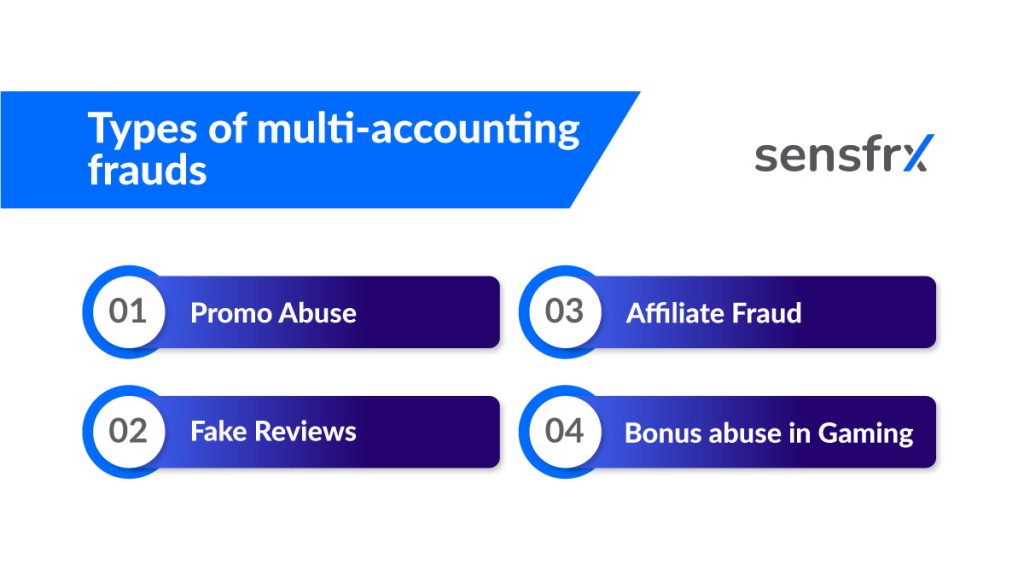
Promo abuse
One person signs up again and again to collect a welcome offer, signup bonus or referral reward each time.
How promo abuse works
A different email address and phone number for each claim, a varied name or address so duplicates do not match, and a VPN plus a device emulator to hide that every signup comes from the same chair.
Fake reviews
One person uses many accounts to post five-star reviews on their own products or one-star reviews on a competitor's, moving the ratings other buyers trust.
How fake-review fraud works
Each account gets its own name, location and device so the reviews look independent. Enough of them lift a listing in search and sales rank, or drag a rival's down.
Affiliate fraud
Fraudsters create accounts to generate fake clicks, signups or sales inside an affiliate program and collect the commission.
How affiliate fraud works
Fake traffic, cookie stuffing, click injection and look-alike domains all make the affiliate look like the source of clicks and sales that were never real, and the merchant pays commission on all of it.
Traffic pattern analysis, fraud detection tools and a careful choice of affiliate networks are the standard defences.
Bonus abuse in gaming
Fraudsters open many accounts at online casinos and sportsbooks to collect the welcome bonus on each one; gaming calls this bonus abuse.
How bonus abuse works
The accounts are built with:
- Synthetic identities that mix real and invented details
- VPNs or Tor to hide the IP address and appear to be in another country
- Bots, virtual machines, emulators and rented residential IPs to create accounts at volume
What multi-accounting costs
Three costs, in the order most businesses feel them:
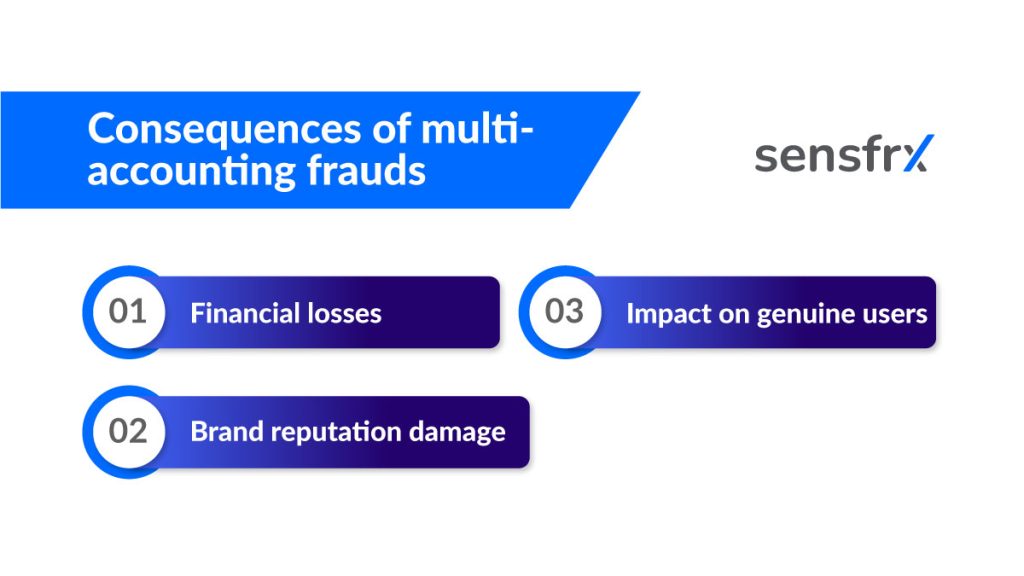
Money. Every bonus or reward paid to a duplicate account is a direct loss; the promotion meant to win new customers funds one abuser instead.
Trust. Players, sellers and buyers notice rigged leaderboards, reviews and referral contests, and stop believing the platform is fair.
Friction for real users. The usual reaction is heavier verification for everyone or promotions pulled altogether, so honest customers pay a second time.
How to detect multi-accounting
No single signal is enough; each has an innocent explanation such as shared Wi-Fi or a family on one device. The eight methods below work when you combine them and score the overlap.
| Detection Method | Description | How It Works | Limitations |
| IP Address Tracking | This involves monitoring IP addresses used to create and access accounts. | – Log IP addresses during account registration and logins. – Analyze geographical locations for unusual patterns (e.g., multiple accounts from the same IP). | Users may share IP addresses (e.g., public Wi-Fi), necessitating additional verification methods. |
| Device Fingerprinting | This refers to collecting unique device characteristics to identify users. | – Gather device-specific data during account creation and login. – Use algorithms to compare fingerprints of new accounts with existing ones. | Users can change device settings or use different devices, complicating detection. |
| Behavioral Analysis | This analyzes user behavior patterns to identify anomalies. | – Monitor metrics like session duration, transaction history, and interaction patterns. – Use statistical models to detect deviations from normal behavior. | Sophisticated users may mimic normal behavior, making detection challenging. |
| Email Analysis | Email analysis involves examining email addresses for signs of fraud. | – Filter known disposable email domains. – Look for patterns in email addresses that suggest they belong to the same user. | Legitimate users may also use similar email patterns, requiring additional context for interpretation. |
| Biometric Verification | The process uses biological characteristics to authenticate users. | – Require biometric data during account creation or verification. – Use biometric data to check for links between multiple accounts. | Privacy concerns and the need for specialized hardware can limit adoption. |
| Machine Learning and AI | It involves analyzing data to identify patterns and anomalies. | – Train models on historical data to recognize typical user behavior. – Deploy models for real-time monitoring to flag suspicious activities. | Requires significant data and expertise; models need regular updates to remain effective. |
| Cross-Referencing Data | It’s about comparing various data points to identify links between accounts. | – Collect and store relevant data points for all accounts. – Use algorithms to identify connections based on shared data attributes. | Legitimate reasons for shared data (e.g., family members) can complicate interpretations. |
| User Reporting | This encourages users to report suspicious activity. | – Provide tools for users to report suspected fraud. – Consider offering rewards for valid reports of fraud. | Relies on user vigilance and may not capture all instances of fraud. |
What stops it
Four controls cover most of it:
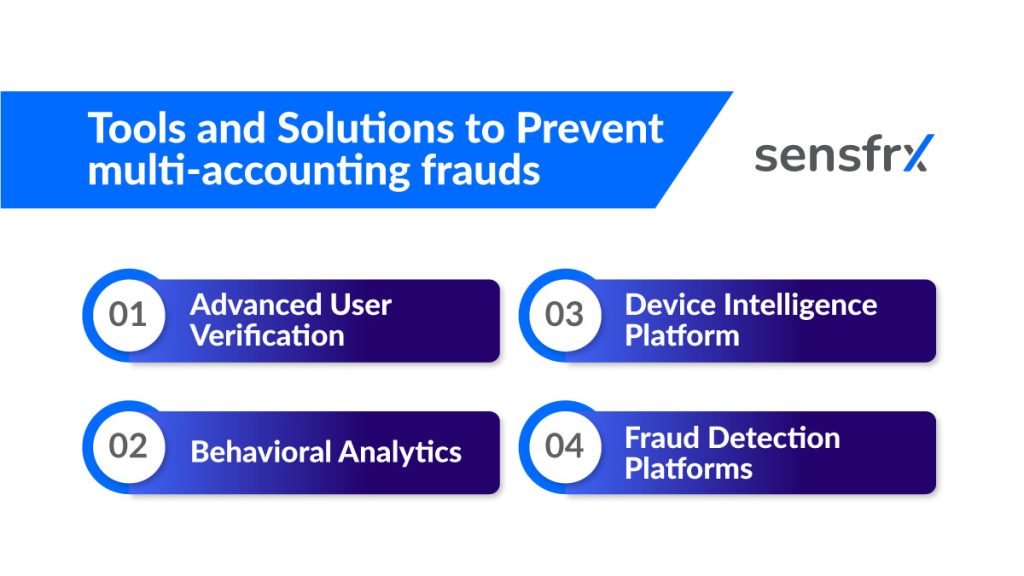
1. Stronger verification at signup
Two-factor authentication (2FA) and, where the risk justifies it, biometric checks raise the cost of each extra account. A phone that must receive a code is harder to fake at volume than an email address.
2. Behavioral analytics
Machine learning models look for the traces one person leaves across many accounts: creation in quick succession, odd purchase sequences, logins from places that do not fit the stated address.
Inputs are login times, device usage, typing rhythm and other behavioral biometrics, plus shared IP addresses, device IDs and payment details. Clustered, these show which accounts one individual controls, and the models flag them while the accounts are still being created.
3. Device intelligence
A device fingerprint is a stable identifier built from a device's configuration, settings and usage. Fingerprints plus IP history link accounts opened from the same machine, the most common giveaway.
4. A fraud detection platform
A fraud detection platform combines the three controls above, scores every signup, login and transaction in real time, and lets your rules decide what is allowed, reviewed or blocked. It adjusts as fraudsters change method.
Where to start
Start at signup. Fingerprint the device, check the email and phone number against disposable providers, and link each new account to anything on file that shares its device, IP address or payment method. Duplicates caught there cost nothing; the ones caught after a payout cost the payout.
[Sensfrx](/) runs these checks on every registration and login; the free plan is enough to start.
Frequently asked questions