Account takeover in cryptocurrency: How it happens and how to stop it
How attackers take over crypto exchange and wallet accounts, the signs to watch for, and the controls that stop them at the login.
 By 13 mins readPublished Updated
On this page
Account takeover (ATO) in cryptocurrency is when an attacker gets into a user's exchange or wallet account and moves the funds out. The route in is usually a phished password, a credential stuffing bot, malware on the user's device or a SIM swap that captures the 2FA code. Once the coins leave the account there is no chargeback and no bank to call: a confirmed blockchain transaction cannot be reversed, so most victims never recover what was taken.
Why crypto accounts draw attackers
Bitcoin, Ethereum and Litecoin put a liquid, transferable asset behind an email address and a password. That is a better target than a bank login for four reasons.
- Regulation is thin. Many exchanges run without the fraud controls, reimbursement rules and oversight that banks are held to, so a stolen account is easier to empty and the loss stays with the victim.
- Nobody can stop a transfer. There is no central party to freeze or recall a transaction once it is confirmed, so the attacker only has to win once.
- The balances are worth the effort. As prices and adoption rose, so did the skill of the crews going after exchange accounts.
- The model is proven. Several high-profile exchange breaches have cost users millions of dollars, and each one shows the next crew that it works.
What the attacker gets
A bank account takeover gives the attacker money. A crypto account takeover gives them more than that.
- The balance. The usual move is to transfer everything to a wallet the attacker controls, then change the password and recovery email so the owner is locked out while the withdrawal confirms.
- The transaction history. Every deposit, trade and withdrawal is visible, including the addresses the victim has sent to and received from. That data feeds the next scam.
- The personal data behind the account, which is enough to run identity theft or a convincing follow-up call.
- Your reputation, if you run the platform. Each publicised takeover wave makes new customers hesitate, and the support cost of the cleanup lands on you.
The short version of prevention
The attacks are phishing, social engineering, malware, credential stuffing and SIM swaps. The defences are the same five every time.
- Know where you are weak: reused passwords, logins over public Wi-Fi, a phone number used as the second factor.
- Use a long, unique password for every exchange and wallet, held in a password manager.
- Turn on 2FA with an authenticator app or hardware key, not SMS.
- Treat every email, message or call that asks for credentials or a code as hostile until proved otherwise.
- If you run the platform, score each login on device, network and behavior so a stolen password on its own is not enough to get in. That is the part Sensfrx does.
How a crypto account gets taken over
Attackers do not break the blockchain. They break the account that sits in front of it: the exchange login, the wallet app, and the email address and phone number used for recovery.
The three entry points
Most takeovers start with one of three techniques.
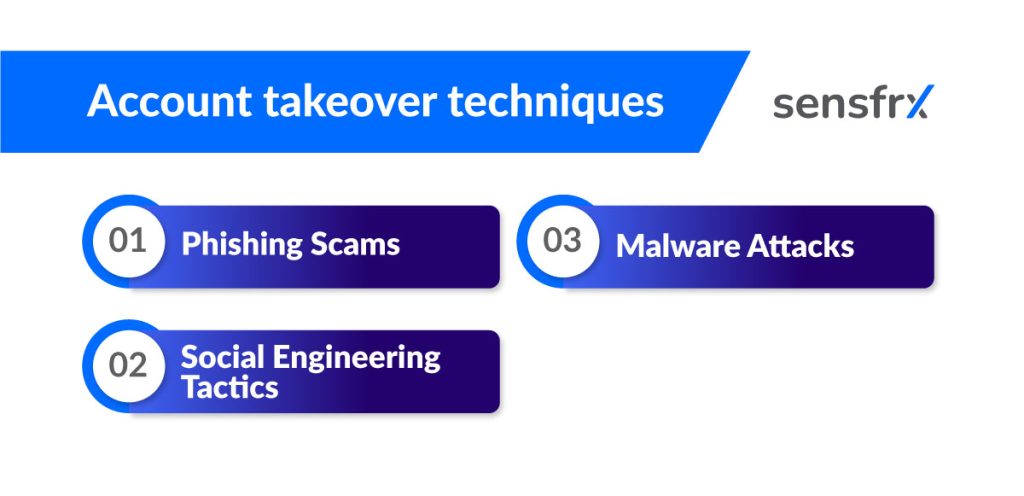
- Phishing. A fake email, text or site that looks like the exchange or wallet provider asks the user to log in or "verify" the account. The credentials go straight to the attacker.
- Social engineering. Someone calls or messages posing as support, cites a made-up problem with the account and asks for a password, a 2FA code or a seed phrase to "fix" it.
- Malware. An infected attachment or download installs software that reads saved passwords or captures them as they are typed, on a computer or a phone.
What it costs the victim
Three things follow a successful takeover.
- The funds are gone. There is no reimbursement scheme and no reversal, so a drained wallet usually stays drained.
- Transactions are made in the victim's name. Transfers to the attacker's wallets and purchases through the account all look legitimate to the platform until the owner complains.
- Identity theft follows. The attacker now holds the login details, personal information and sometimes private keys, and those get reused for fraud elsewhere.
Why prevention is the only real control
Because recovery is close to impossible, the work has to happen before the login succeeds.
- Hardware wallets, 2FA on an authenticator app and prompt security updates stop most opportunistic attacks before they start.
- Strong, unique passwords and a sceptical eye for phishing keep the personal data in the account out of the attacker's hands.
- Checking the recipient address before every transfer and reviewing account activity catches an unauthorized transaction while the platform can still act on it.
- Securing the account also stops unauthorized trades. An attacker who cannot withdraw can still dump the holdings at a bad price, and that loss is not recoverable either.
Four techniques account for most crypto account takeovers.
- Phishing for keys. Beyond passwords, crypto phishing goes after private keys and seed phrases, because a seed phrase gives full control of the wallet with no login step at all.
- Malware. Infostealers lift credentials saved in browsers and wallet apps, or capture them in transit.
- Credential stuffing. Bots replay username and password pairs leaked from other sites against exchange logins. Anyone who reused a password is exposed.
- SIM swapping. The attacker talks a mobile carrier into moving the victim's number to a SIM they hold. Every SMS 2FA code and password reset link now lands with them, and no device had to be stolen.
Why stolen crypto is so hard to get back
The design that makes crypto useful also makes recovery hard: no central authority, pseudonymous addresses, and a patchwork of law.
- Decentralization. Bitcoin and Ethereum validate transactions on a peer-to-peer ledger with no bank or processor in the middle. That cuts cost and delay, and it also means nobody has the power to reverse a transfer.
- Pseudonymity. Every transaction is public, but addresses are not names. Linking an address to a person takes forensic tracing and, usually, cooperation from an exchange that holds identity records for the cash-out account.
- Law. Countries regulate crypto differently and many have no rules at all for asset recovery, so a cross-border case can stall for years.
- Technical limits. Access is controlled by cryptographic keys. Lose them, or have them stolen, and there is no reset button.
Where bots come in
Almost no crypto account takeover is done by hand. Bots find the working credentials, bots test them, and botnets hide the traffic.
- What a bot is. Software that automates a task online: scraping, messaging, trading, logging in. The tooling that runs a trading bot also runs a login attack.
- Scraper bots. These pull data from exchange sites and related pages, including anything that helps build a target list or harvest credentials.
- Credential stuffing bots. These take username and password dumps from old breaches and fire them at exchange logins at machine speed. Even a tiny hit rate pays when the list runs to millions of pairs.
- Botnets. Networks of compromised machines ("zombies") under one operator, the bot herder. Spread across thousands of residential IPs, their login attempts look like ordinary traffic, and the same network runs DDoS or spam between campaigns.
- Bots plus social engineering. Automation gets the password. A phone call or email that tricks the victim into reading out a 2FA code gets the rest.
How bots get past the controls
- Getting around 2FA. A bot that holds a valid password triggers the 2FA prompt. A SIM swap, or a phishing page that asks the victim for the code, supplies the second factor.
- Credential stuffing at scale. Leaked pairs from other sites are replayed against exchanges and wallet services, with the traffic spread across proxies so no single IP trips a rate limit.
- The steps after login. Bots also automate the cash-out: change the recovery email, add a withdrawal address, move the funds.
Why bot traffic is hard to spot
Current bots imitate people well enough to pass most checks that were designed for the old kind.
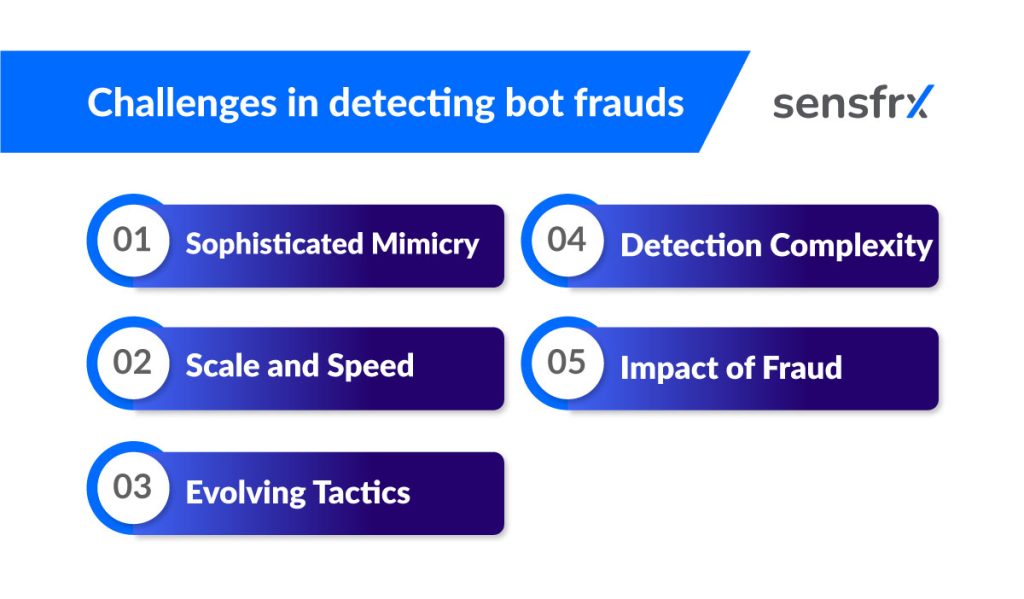
- They look human. Mouse movement, typing cadence and plausible browser fingerprints are all scripted now.
- They are fast and wide. A credential stuffing run or a DDoS is finished before a manual review would start.
- They adapt. When a defence goes up, the operators tune the bot, and machine learning on their side is used to find the gaps.
- Detection needs behavior, not just rules. Telling automation from a person takes analysis of how the session behaves over time, not a single IP or user-agent check.
- The damage is broad. Drained accounts, breached data and a support queue full of locked-out customers.
What works against them
- Stronger authentication: adaptive checks that step up when the risk is high, and biometrics or hardware keys where the platform supports them.
- Behavioral analysis: models that learn what a normal session looks like for each account and flag the ones that do not match, in real time.
- Continuous monitoring of traffic and login patterns, so a stuffing run is caught in its first minutes rather than from the complaints.
- User education on phishing and password reuse, which removes the raw material the bots run on.
- Shared threat intelligence, so an IP range or device cluster burned on one platform is blocked on the next.
Spotting and stopping a takeover
An exchange or wallet account is a high-value target behind a standard login. The signs of a takeover are visible if someone, or something, is watching for them.
Signs an account has been taken over
Three signals show up in most cases.
- Settings change without the owner asking: a new contact email, a new withdrawal address, a different 2FA method.
- Transactions break pattern: a large withdrawal, a transfer to a wallet never used before, trades at odd hours for that account.
- Logins arrive from devices or locations the account has never used.
Act on the first signal
Catch any one of those early and the account can still be saved: change the password, re-enroll 2FA on a new factor, and tell the exchange so it can hold withdrawals while it checks.
How to keep an account from being taken
Five habits close off most of the attacks above.
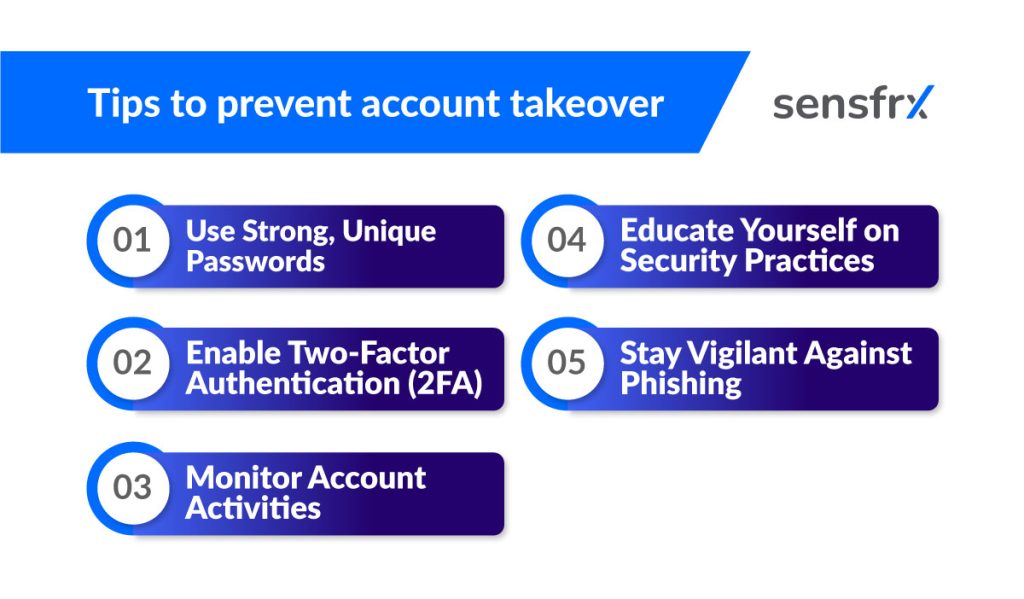
- One long, unique password per account, stored in a password manager. No birthdays, no dictionary words, no reuse from other sites.
- 2FA on every exchange and wallet that offers it, using an authenticator app or hardware token. SMS codes can be intercepted by a SIM swap.
- A regular look at statements and transaction history, with anything unfamiliar reported to the provider the same day.
- Current knowledge of how the attacks work, so a new phishing lure is recognized for what it is.
- A default of suspicion toward any unsolicited email, message or call asking for credentials. Check through the provider's own site or app before responding.
Where Sensfrx fits
Those habits cover the user's side. The platform still has to decide, on every login, whether the person holding a valid password is the account owner. That is what Sensfrx does.
Sensfrx scores each signup, login and payment in real time from device, network and behavior signals: is this a device the account has used before, is the IP a residential proxy or a datacenter, does the session behave like a person or a script. A stolen password arriving on a new device, through a fresh proxy, in a bot-like session scores high.
Your rules turn that score into a decision: allow, review or block. The credential stuffing run gets blocked; the owner logging in from their usual phone gets allowed without friction.
How Sensfrx handles a crypto login
For an exchange, a wallet provider or any platform holding customer balances, the goal is to stop the login that uses stolen credentials without slowing down the ones that do not. Sensfrx does this with a risk score on every login and rules you control.
Scoring the login
Every login attempt is scored on the device it comes from, the network behind it and how the session behaves, and the score comes back in real time so the decision is made before a session is issued. Patterns that mark a takeover, such as many accounts tried from one device cluster or a known account arriving from a new device over an anonymizing network, push the score up.
Allow, review or block
Rules you write decide what each score means. Low risk is allowed through. A middling score can be sent to review, where your team or your own step-up flow takes a second look before the session goes ahead. High risk is blocked outright. The thresholds are yours, so a platform holding customer balances can set them tighter than a content site would.
Where to start
For users: a unique password per account, 2FA on an authenticator app or hardware key, and a regular look at the transaction history. For platforms: score every login on device, network and behavior, and block the ones that look like a stuffing run.
Recovery after a crypto takeover is rare, so the budget belongs at the login, not in the incident response.
If you run the platform, the next step is a risk score in front of the login. Sensfrx does that on the free plan, with a 14-day trial of the full product.
Frequently asked questions
Q. What is account takeover (ATO) in cryptocurrency?
A. An attacker gains control of a user's exchange or wallet account, usually with a stolen password or a hijacked 2FA factor, and transfers the funds out. Because the transfer cannot be reversed, the loss is usually permanent.
Q. What are the signs of a crypto account takeover?
A. Withdrawals or transfers the owner did not make, changed contact details or withdrawal addresses, and logins from devices or locations the account has never used.
Q. How do I prevent account takeover on my crypto accounts?
- Use a unique password for each account and keep it in a password manager.
- Turn on 2FA with an authenticator app or hardware key, not SMS.
- Check the transaction history and account settings regularly and report anything unfamiliar.
Q. Why does 2FA matter so much for crypto?
A. A password alone is easy to steal through phishing or a breach elsewhere. A second factor on a device the attacker does not hold stops the login, as long as that factor is not an SMS code a SIM swap can capture.
Q. What should I do if I think my account has been compromised?
A. Change the password, remove any devices or sessions you do not recognize, re-enroll 2FA, and report it to the exchange or wallet provider at once so they can hold withdrawals while they investigate.
Q. How do I keep up with crypto security threats?
A. Follow the security notices from the exchanges and wallets you use, plus a few security news sources and communities where current phishing lures and attack methods get shared.
Q. Is it safe to keep large balances on an exchange or in an online wallet?
A. Exchanges and hot wallets are the most attacked targets. Keep what you trade there and move the rest to a hardware wallet or other cold storage that is not reachable from the internet.
Q. How much does user education help?
A. A lot, because most takeovers begin with a user handing over a password, a code or a seed phrase. Someone who knows what a phishing lure and a fake support call look like removes the easiest route in.
Q. How do I judge an exchange or wallet provider's security?
A. Look for 2FA with authenticator and hardware-key options, cold storage for customer funds, published security audits, and a record of telling users about incidents quickly. Independent reviews help too.