IP tracking identifies the network location, which changes often. Device fingerprinting reads device-level attributes that stay stable and are harder to fake.
Device fingerprinting in fraud prevention: How it works and where it pays off
What device fingerprinting is, why cookies and IPs no longer identify a fraudster, the hardware, software and behavior signals that do, and where to use it.
On this page
Fraud is more automated than it was: 41% of attacks are now AI-driven. Account takeovers, fake identities and bot attacks run as organized, scripted operations, and the old identifiers fail against them. IPs rotate, cookies get cleared, and authentication gets bypassed.
What is left is the device. Device fingerprinting recognizes a suspicious device early, before the first fraudulent account becomes fifty.
Not as a marketing tool, and not as user tracking. As device-level intelligence that shows intent before the fraud scales.
What device fingerprinting is, past the definition
Device fingerprinting builds a unique identifier for a device from its hardware characteristics, software configuration and behavioral signals. That definition is the easy part.
In fraud prevention it answers one question:
Is this device trustworthy?
Every device that touches your platform leaves signals: screen resolution, CPU architecture, operating system, browser configuration, installed plugins, timezone, language settings, emulator indicators and interaction patterns. On their own, none of them means much.
Take a signup from a new email address. A few minutes later another account appears, then another. Each one arrives from a different IP with cookies cleared, so every session looks like a new user.
Put the signals together and they form a distinctive profile.
The fraudster keeps changing the visible identifiers, but the device characteristics stay the same: same screen size, same OS version, same browser quirks, same interaction patterns. The system can see that all the accounts come from one device.
That is where the fraud pattern shows.
Why session-based identification no longer works alone
Fraud detection used to rely on session signals.
Cookies tracked repeat visitors, IP addresses flagged suspicious locations, and a username and password counted as proof of identity.
Fraud does not work that way now.
Fraudsters route through residential proxy networks to look legitimate, run anti-detect browsers that imitate real environments, automate credential stuffing at scale, and use virtualization to create many accounts from one physical device.
The short version:
- Session-based methods identify sessions.
- Fraud operates at the device level.
Ten accounts created from one device with different IPs, cookies and email addresses can get past session-based detection. Device intelligence sees one device.
How device fingerprinting works inside fraud prevention
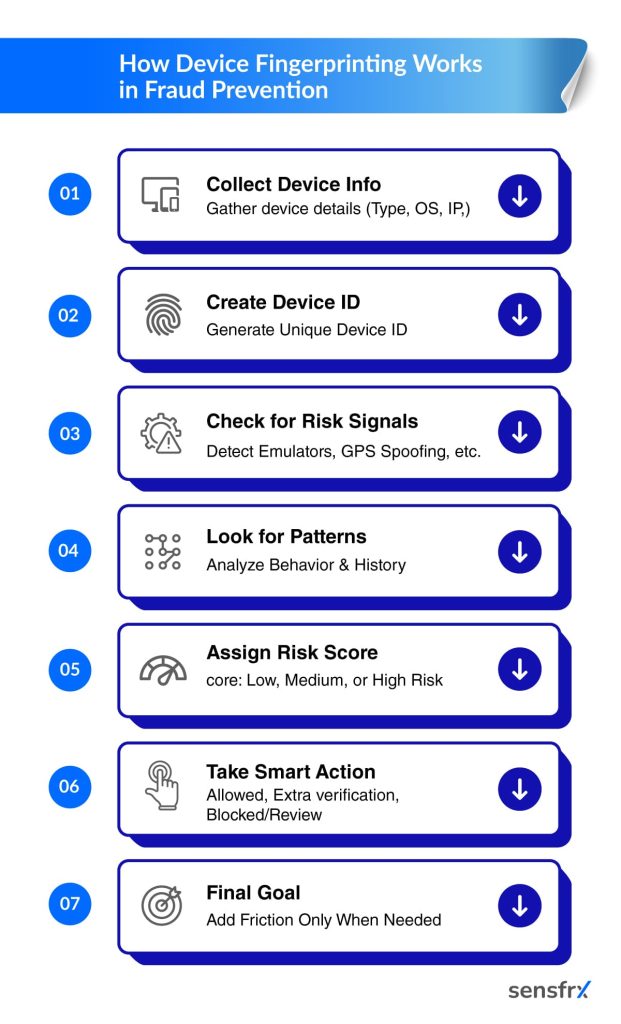
Fingerprinting is not one step. It is one part of a wider risk evaluation.
Stage one is identification. A unique alphanumeric device ID is generated from a combination of attributes, and it stays stable across sessions even when the surface data changes.
Stage two is risk signal detection. The system checks the device for signs of manipulation: emulator environments, rooted or jailbroken status, app cloning frameworks, GPS spoofing tools, automation scripts and abnormal configurations.
No single signal confirms fraud. Fraud shows in patterns.
Stage three is dynamic risk scoring. The device gets a score from its historical associations, the number of accounts linked to it, behavioral anomalies and the severity of the signals found.
The score drives the decision:
- Allow low-risk interactions without friction
- Step up authentication for medium risk
- Review or block high-risk devices at once
The goal is not to block hard. The goal is to put friction where the risk is.
The three layers of device intelligence
Fingerprinting gets strong when several layers of evidence agree.
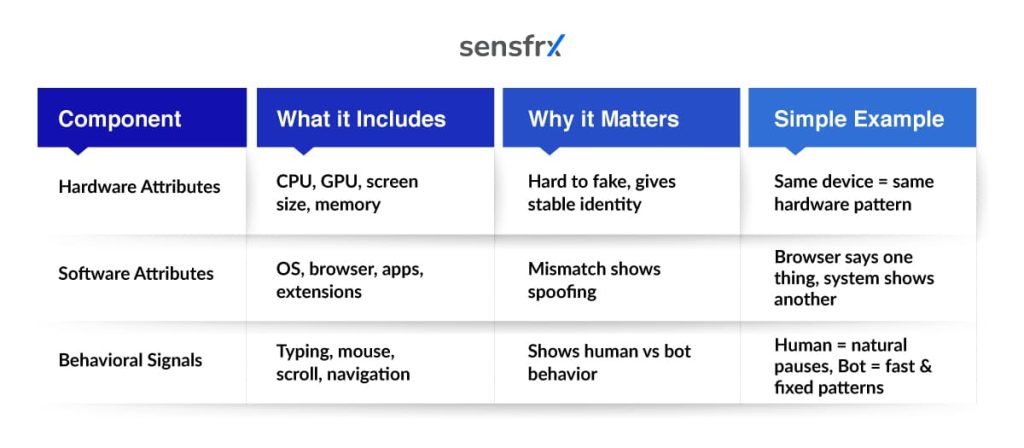
1. Hardware attributes
CPU type, GPU configuration, screen dimensions and memory give the fingerprint its stable core. Changing them means changing the physical device.
Spoofing an IP address is easy. Reproducing a whole hardware environment consistently is not.
2. Software attributes
Operating system version, browser type, installed extensions and application builds add context. A mismatch between the hardware layer and the software layer is a common sign of spoofing or automation.
A browser that claims one configuration while running inside a virtualized environment is an immediate red flag.
3. Behavioral signals
Typing cadence, mouse movement, interaction timing, scroll patterns and navigation separate people from automation.
A person types with uneven pauses, moves the mouse in wobbly curves and scrolls at varying speeds. A bot types instantly, clicks in fixed patterns and moves through pages with mechanical precision.
Scripts can imitate clicks and basic actions. They are bad at reproducing those rhythms.
Combined with the hardware and software layers, behavior makes detection far more reliable. A login from a known device where the typing is too fast and the navigation too perfect points to automation or account takeover.
Types of device fingerprinting
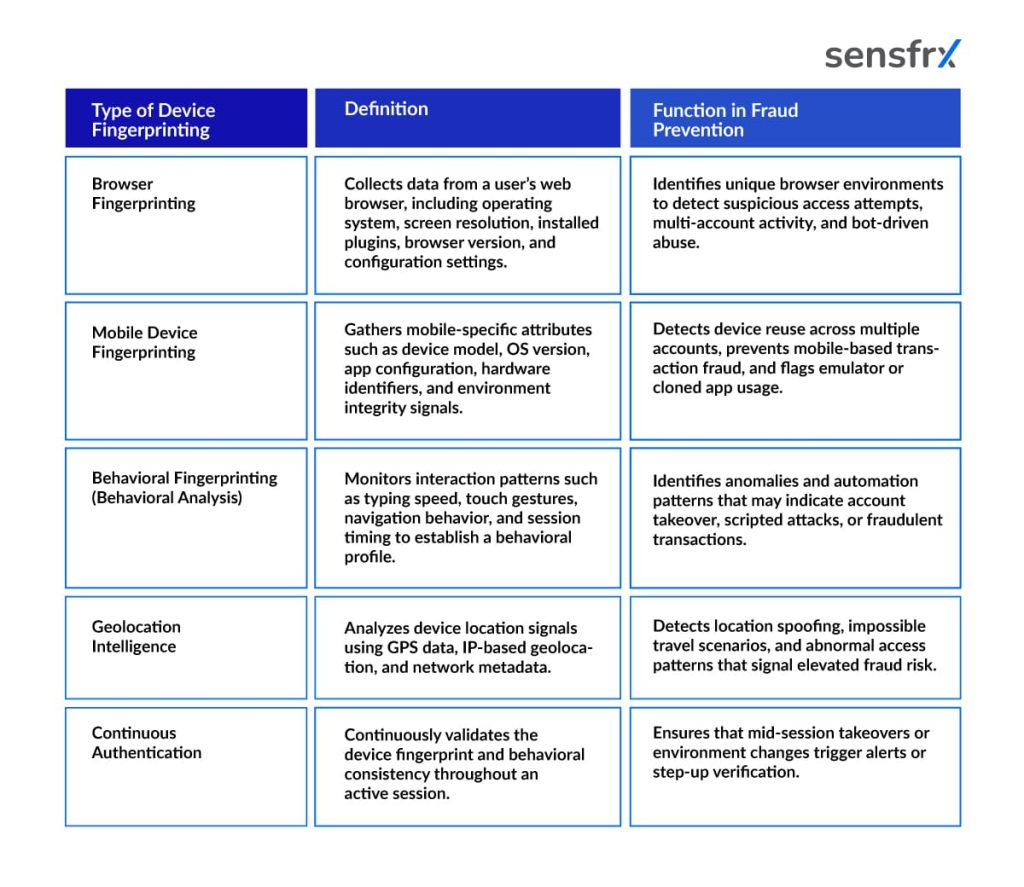
Fingerprinting is several techniques, each catching a different dimension of the device and the session.
Some work on browser attributes. Some read mobile-specific signals. Fuller implementations add behavioral monitoring and keep validating through the session.
Knowing the types tells you how deep to integrate device intelligence into your fraud controls.
Where device fingerprinting pays off
- At registration, it links the accounts created from one device. One device signs up with five emails to claim a signup bonus.
- At login, it flags an unfamiliar or high-risk device on a known account. A user who always logs in from Pune suddenly shows up on a new device with a different setup. This is the core of account takeover protection.
- At payment, device reputation feeds the real-time risk decision. A payment starts from a device previously tied to failed or fraudulent transactions.
- In BNPL, it stops repeat installment abuse. One device creates several identities to get around credit limits.
- In online gaming and promotions, it blocks multi-accounting and bonus abuse. One player, one device, many accounts, repeated rewards.
- On crypto and trading platforms, it finds coordinated activity across linked accounts. Several accounts place similar trades from the same device pattern.
The value is in continuous monitoring, not one checkpoint.
Privacy, compliance and responsible implementation
Device fingerprinting has to be deployed with care.
GDPR requires transparency, purpose limitation and data minimization. Collect device data for security and nothing else, and store it securely.
Encryption, retention limits and a clear privacy policy are the minimum. The purpose is fraud prevention, not surveillance.
With governance and accountability in place, fingerprinting adds security without a compliance problem.
Implementation challenges
Fingerprinting has limits.
Skilled fraudsters use anti-detect browsers and device spoofing tools. A static fingerprint model also decays as device configurations change in normal use.
So the fingerprinting has to adapt.
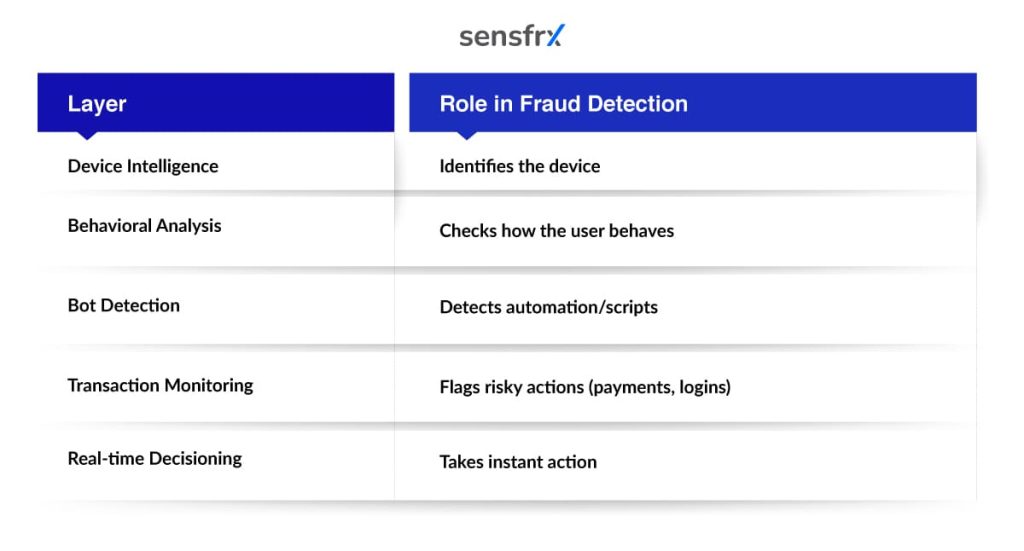
Risk models need regular recalibration, and device intelligence needs to feed behavioral analytics, bot detection, transaction monitoring and real-time decisioning rather than sit beside them.
Treated as a standalone product, fingerprinting underdelivers. It works as one layer of a layered fraud prevention strategy.
How Sensfrx uses device-level intelligence
In Sensfrx, device fingerprinting is one input to a real-time risk engine.
The platform reads device attributes alongside behavioral signals, transaction context and historical activity, rather than stopping at identification.
That lets you:
- Catch high-risk devices before the transaction completes
- Stop account takeover attempts early
- Cut chargebacks tied to repeat device abuse
- Block bot-driven registrations and automation
- Reduce false positives through adaptive scoring
Fraud prevention is not about collecting more data. It is about reading the signals you have.
Where to start
Fraud is device-driven, automated and coordinated across accounts and touchpoints. Stolen credentials and odd transactions are only part of it.
IP tracking, cookies and static rules leave gaps. You need to know not just who is on the platform but from which device and with what intent.
Device fingerprinting is that persistent layer. With behavioral analysis and dynamic risk scoring on top, it catches patterns early, stops repeat abuse and cuts losses without getting in the way of real users.
If you still decide on IP alone, start by asking how many of last month's fraudulent accounts shared a device.
Start on the free plan and see device signals on your own traffic.