The process of finding, assessing and reducing the risks tied to an individual's or organization's identities, including personal information such as name, address, date of birth, social security number and bank account details.
Identity risk management: What it is and how to do it
Identity risk management covers governance, authentication, authorization and monitoring. How to run an IAM risk assessment and what to fix first.
 By 9 mins readPublished Updated
On this page
- What identity risk management covers
- Identity and access management risk assessment
- Common threats to identity management
- Identity risk management practices that work
- Techniques beyond the basics
- Where identity risk management is heading
- The challenges coming, and what answers them
- Where to start
- Frequently asked questions
Identity risk management (IRM) is the work of making sure only the right people can reach the right resources, and of catching them when an account is misused. It covers the processes and tools that govern identities, verify them, limit what they can do and watch what they do.
The identities in scope are both the organization's own users and the personal data it holds on customers: names, addresses, dates of birth, social security numbers, bank details. A breach of either is an identity breach.
What identity risk management covers
IRM manages the risk that comes with user identities and their access to organizational resources. The aim is that only authorized users hold access, that the access matches their role, and that their activity is watched closely enough to catch misuse before it becomes a breach. It is also how an organization meets data-protection law and keeps its security standing.
Four components
- Identity governance: define roles and responsibilities, review privileges on a schedule and enforce the policy.
- Authentication: verify that the person logging in is who they claim to be, with passwords at minimum and multi-factor methods such as biometrics or security tokens where the risk warrants.
- Authorization: decide what a verified identity may do. Someone in finance sees different data from a manager, and both see less than an administrator.
- Monitoring: watch user activity on the network for the behavior that precedes a breach or the misuse of personal data.
Objectives
The first objective is to keep personal information out of the wrong hands. Three more follow from it.
- Compliance. GDPR, CCPA and HIPAA require organizations to protect customer data, and the fines for failing to do so are large.
- Lower financial loss. A breach costs money in fines and in reputation. IRM lowers the odds of one and limits the damage when one happens.
- Customer trust. Customers expect the companies holding their data to protect it, and a visible IRM program is part of how a company shows it does.
Identity and access management risk assessment
An IAM risk assessment finds the gaps in how identities and access are managed before an attacker does. It lists what you hold, who can reach it, what could go wrong and which fixes come first. It is also the evidence auditors ask for.
How to run an IAM risk assessment
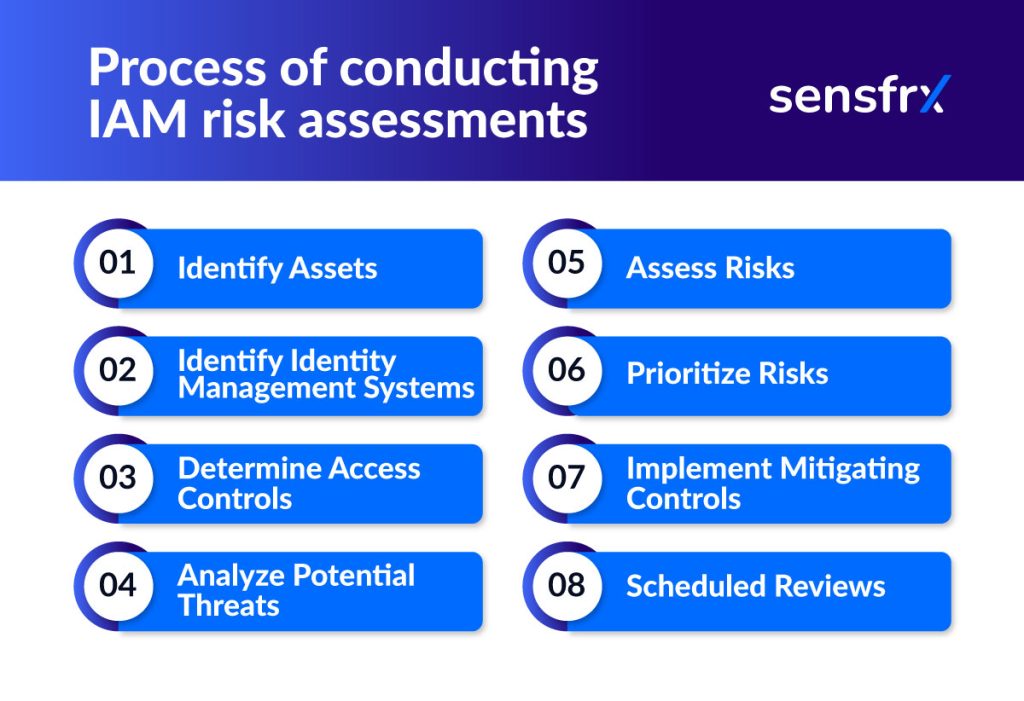
Eight steps, in order.
- Identify assets. List every digital asset: internal databases, servers and applications, and external cloud services and third-party software.
- Identify identity systems. List the single sign-on tools, multi-factor authentication services and directories that control access to those assets.
- Map access. For each system, record who holds which role and which permissions. Expect surprises.
- Analyze threats. Work out who or what could abuse that access: outside attackers, insiders, plain human error.
- Assess risk. Rate each threat by how likely it is and how much damage it would do.
- Prioritize. Order the risks by severity so the worst ones get fixed first.
- Mitigate. Put controls in place for the top risks, on a timeline.
- Review. Repeat on a schedule. Controls drift, people change roles and new systems appear.
Tools and methods
Vulnerability scanners, penetration testing, role engineering, access certification and compliance management tools all feed an IAM risk assessment. They find weaknesses in the environment and suggest how to close them.
- Data gathering tools collect and analyze user data such as access permissions and account information.
- Vulnerability scanners find weaknesses in the IT environment that an attacker could use to gain access.
- Penetration testing tools simulate real attacks on the organization's systems to show which weaknesses can be exploited.
ISO 27001, the NIST Framework and the CIS Controls give the assessment a structure and a checklist of controls to test against.
Common threats to identity management
These are the threats that show up most often in identity breaches, followed by four cases that show what they cost.
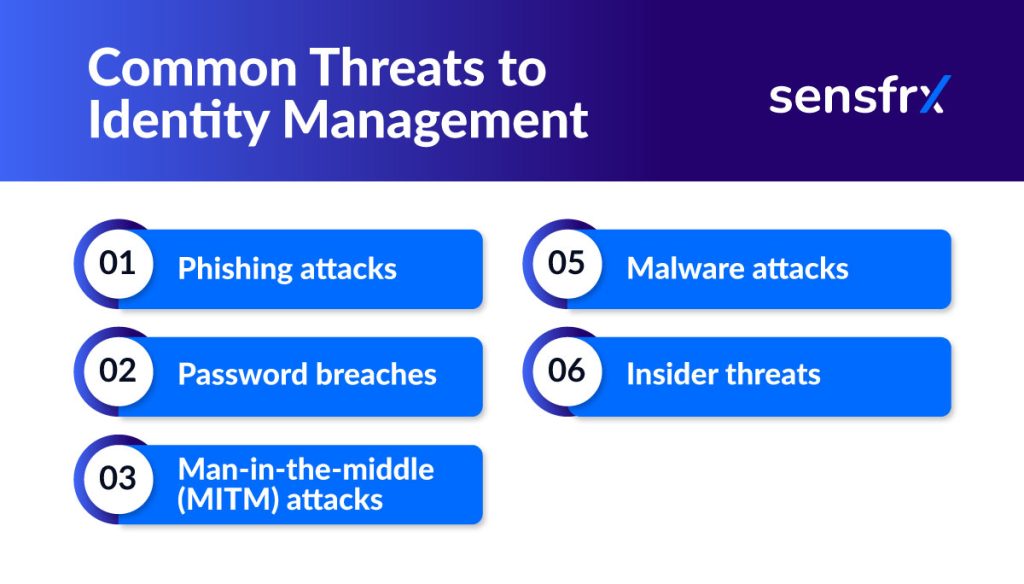
- Phishing. The attacker impersonates a trusted party and gets the victim to hand over credentials or personal data, which then opens financial accounts and other services.
- Password breaches. Weak passwords, reused passwords and passwords stored in plain sight give an attacker entry to one account and then to every account that shares the credential.
- Man-in-the-middle attacks intercept traffic between two parties and lift login credentials or financial details from it.
- Malware. Viruses, trojans and spyware sit on a device and send data out without the user knowing.
- Insiders. Employees with legitimate access can misuse it for gain or out of malice, and no perimeter control stops them.
Four identity breaches and what they exposed
- Equifax (2017): attackers got into Equifax's database and took personal information on over 147 million people, including names, social security numbers, birth dates, addresses and driver's license numbers.
- Anthem Inc. (2015): attackers reached a database of 80 million customer records including names and social security numbers, leaving those customers exposed to fraud.
- Zappos (2012): attackers breached the shoe retailer's server and exposed nearly 24 million users' email addresses, names and hashed passwords.
- Marriott International (2018): attackers got into the guest reservation database and took names, addresses, dates of birth and passport numbers for over 500 million guests.
Identity risk management practices that work
Four practices do most of the work.
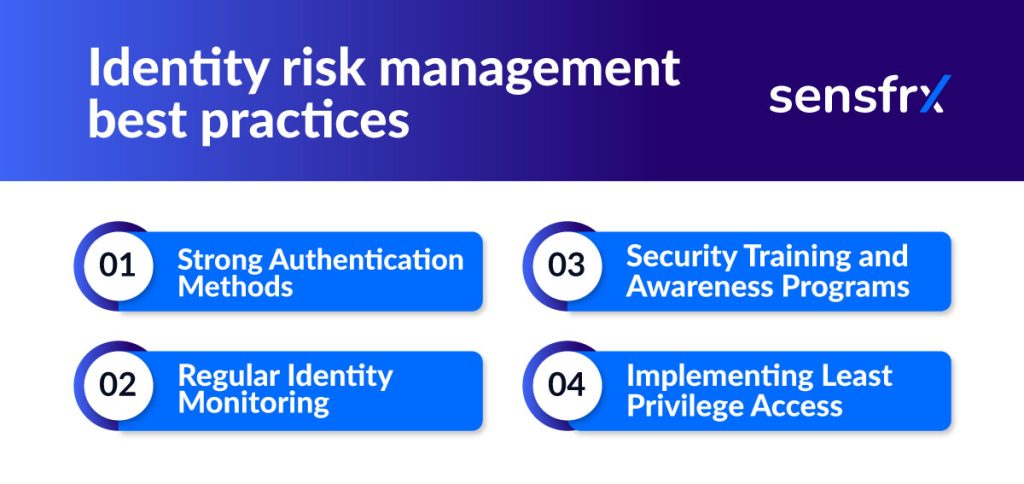
Strong authentication
Passwords alone do not hold. Require a second factor before granting access to sensitive systems: something the user knows (a password), something they have (a security token) or something they are (a biometric). With two of the three in place, an attacker holding only a stolen password gets nowhere.
Regular identity monitoring
Watch for changes you did not make. For individuals that means checking credit reports, bank and card statements and social media profiles for activity that is not theirs, keeping physical documents such as passports and driver's licenses out of reach, and shredding old ones. For an organization it means the same discipline applied to accounts, roles and permissions.
Security training and awareness
Train staff to recognize phishing and to secure company devices and networks when working remotely. Repeat the training on a schedule; one session does not stick. Encourage people to follow current threats through webinars and reputable sources.
Least privilege
Give each user the minimum access their job needs and nothing more. When an account is compromised or an insider turns, the damage is bounded by what that account could reach.
Techniques beyond the basics
Once the basics are in place, three techniques raise the ceiling.
AI and machine learning
Machine learning models read large volumes of identity and access data in real time and flag the activity patterns that point to a breach. They can act on their own as well: block the access, raise the alert, open the ticket. That takes the slow, error-prone part out of the analyst's hands and leaves the judgment.
Identity threat intelligence
Identity threat intelligence (ITI) gathers signals from dark web forums, social networks and threat feeds about who is targeting your organization's identities and how. Security teams act on it before the attack lands: reset the exposed credentials, watch the named accounts, block the known infrastructure.
Integration with other controls
None of this stands alone. Tie identity controls to multi-factor authentication, encryption and network monitoring so that when one layer fails the next one catches it.
Where identity risk management is heading
Three technologies are changing how identities are verified, and each brings its own risk.
Emerging technologies and their impact
- AI. Real-time verification through facial recognition, voice recognition and behavior analysis catches fraud that document checks miss, and the models keep improving.
- Blockchain. A decentralized, tamper-evident ledger for identity data, difficult to alter or falsify once written, which makes it a candidate for storing personal information while preserving privacy.
- Biometrics. Fingerprints, retina scans, facial recognition and palm vein analysis are hard to copy and easy for the user, and they reduce dependence on passwords and PINs.
The challenges coming, and what answers them
Breaches keep getting more frequent and identity theft rises with them. Three challenges stand out.
- AI in the attacker's hands. Attacks run at larger scale and with more precision, which puts small businesses and individuals in reach of campaigns that used to target only large firms.
- Biometric data at risk. Biometrics look secure, but biometric databases have been breached and the data stolen, and a fingerprint cannot be rotated the way a password can.
- Privacy regulation. Governments keep tightening data-protection rules. Organizations have to adapt, and the penalty for not doing so is fines and lost public trust.
Four responses cover most of it:
- Run risk assessments on a schedule and fix the gaps before an attacker finds them.
- Require multi-factor authentication, so a stolen password alone is not enough.
- Train employees to spot suspicious emails and links, use strong passwords and be careful what they share on social media.
- Use AI on your own side: flag unusual activity and anomalies that point to a fraud attempt.
Where to start
Start with the access map. List your systems, list who can reach each one, and remove every permission that no job needs. That one exercise bounds the damage of any breach that follows.
Then enforce multi-factor authentication on everything that holds personal data, and put monitoring on the accounts and roles that matter most. AI, threat intelligence and biometrics come after those are solid.
Fake and synthetic identities arriving at signup are the same risk from the outside. Score registrations before they become accounts.
Frequently asked questions