Dynamic risk scoring: What it is and how it works
How dynamic risk scoring rates every signup, login and payment in real time from device, behavior, location and transaction data, and where it pays off.
 By 7 mins readPublished Updated
On this page
- Where fraudsters attack
- What dynamic risk scoring does about it
- Customer touchpoints and how fraudsters use them
- How a dynamic risk score is built
- How dynamic risk scoring works in a session
- What dynamic risk scoring changes
- Which businesses need dynamic risk scoring
- How Sensfrx uses dynamic risk scoring
- Where to start
Dynamic risk scoring gives every signup, login and payment a risk number at the moment it happens. The number comes from device, behavior, location and transaction data, and it keeps moving as the session goes on.
The number drives the decision: allow, ask for another authentication factor, send to review, or block. A static rule gives every customer the same answer. A dynamic score gives the same action a different answer depending on who is doing it and how.
Industry reports from research firms such as Gartner and Forrester have put the reduction in fraud losses at businesses using dynamic risk scoring at up to 40%.
The saving in chargebacks is the visible part. The good customers you stop blocking are the other part.
Where fraudsters attack
Fraudsters work the customer touchpoints: online transactions, account logins and customer service contacts.
They get in through social engineering, phishing and malware, and use what they take to get unauthorized access or to run fraudulent transactions.
What dynamic risk scoring does about it
It evaluates the risk of each interaction as it happens, from user behavior, transaction patterns, device attributes and location.
Anomalies show up as a higher score.
The response matches the score: flag suspicious transactions for manual review, ask for another authentication factor, or block the action outright.
Customer touchpoints and how fraudsters use them
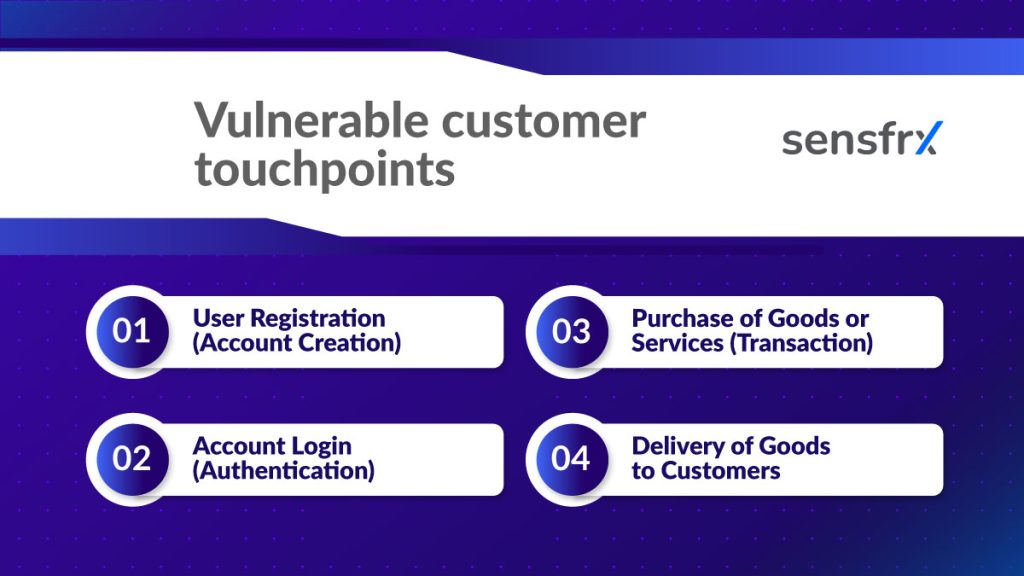
Four touchpoints carry most of the risk.
Registration
Registration collects an email address, a phone number and a password, and the business uses them to authenticate the user from then on.
Fraudsters target account creation with identities stolen in breaches or invented from scratch, to get accounts they can use later.
The checks that catch them at signup are email and phone verification, CAPTCHA challenges and, in some cases, biometric verification.
Login
Login is where a username and password turn into access to the account.
Credentials come from phishing, from brute force tools that guess passwords, and from passwords leaked in breaches of other sites.
Multi-factor authentication (MFA) or biometric authentication closes most of the gap, and account takeover protection scores the login itself.
MFA asks for a second proof, such as a one-time code sent to the user's phone, so a stolen password alone is not enough.
Payment
Payment is where money changes hands, and where stolen data is cashed out.
Card details from breaches or dark web markets pay for unauthorized purchases. Stolen identities open accounts that buy in someone else's name.
Gaps in payment processing logic get used to route around the checks.
Real-time transaction monitoring, anomaly detection and address verification catch most of it before the order is approved.
Delivery
After the payment, the goods have to reach the customer, and that step is attacked too.
Fraudsters change the shipping address after the order or reroute the package in transit.
"Friendly fraud" is the customer claiming the order never arrived, to get a refund or a replacement. Package tracking, signature on delivery and delivery verification are the controls.
Pattern detection on delivery and refund data finds the repeat claimants.
How a dynamic risk score is built
Five steps.
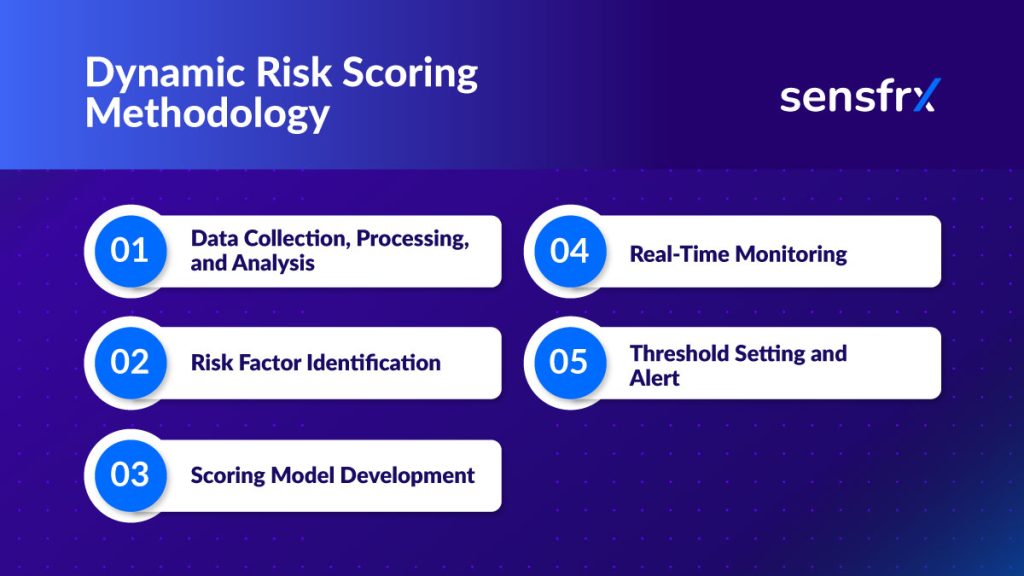
Data collection, processing and analysis
Data comes from user interactions, transaction records and external threat intelligence feeds. It is cleaned and analyzed for patterns and anomalies.
Risk factor identification
The analysis picks out the risk factors for each activity: unusual transaction patterns, out-of-character user behavior, unexpected changes in system parameters.
Scoring model development
A scoring model specific to the business assigns a numerical value to the likelihood and severity of each risk.
Calibration against known outcomes turns the model into a tool for ranking responses and allocating analyst time.
Real-time monitoring
Scores update as new data arrives, so a threat shows up as it emerges rather than in the monthly report.
Thresholds and alerts
The business sets thresholds for its risk scores: the level above which an interaction needs attention.
Crossing a threshold triggers an automated alert and the response that goes with it, before the risk becomes a loss.
How dynamic risk scoring works in a session
It watches user activity in real time and scores it on several factors.
Real-time user data collection
Four kinds of data go into the picture.
- Device data: the device type, operating system and version, and whether location services are on. Desktop, smartphone or tablet.
- User behavior: logins, pages visited, items added to a cart, forms submitted.
- Location, from IP address or GPS, which shows a login from a place the user has never been.
- Transaction volume: the amount and frequency of transactions, which shows spending that does not match the account's history.
Real-time data monitoring
Every action is captured as it happens: login attempts, browsing, and transactions such as purchases or fund transfers.
Real-time risk scoring
Each interaction point gets a score, and the score is compared with the account's historical risk profile. The same action can be normal for one user and a red flag for another.
Alerting on the score
The score moves as the user acts. A change in behavior shows in the score at once, so the response can be immediate.
Actions when the score crosses a threshold
Above the threshold, the system acts: it logs the user out to stop further access and alerts the security team or fraud analysts to investigate.
What dynamic risk scoring changes
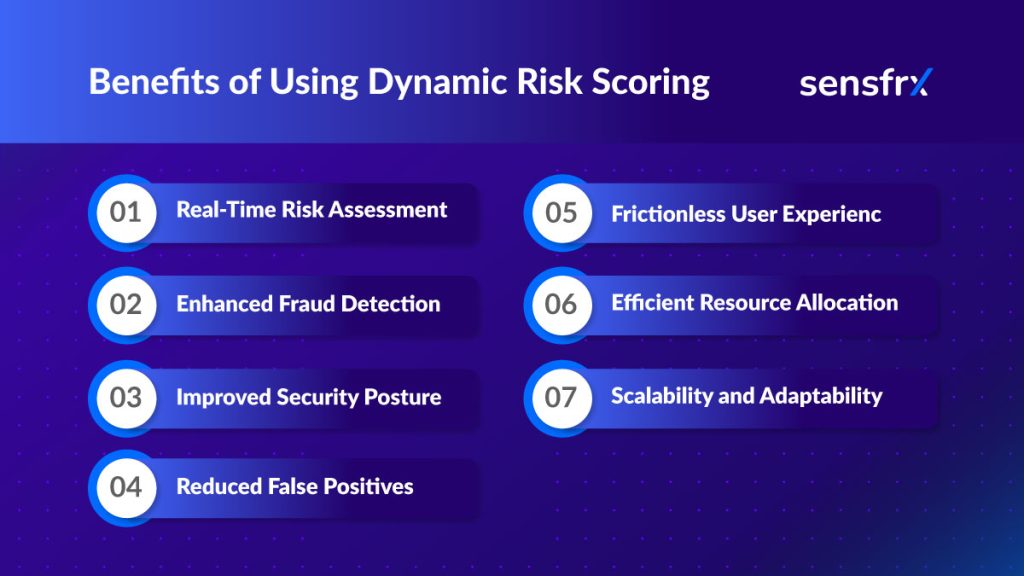
Seven things, in rough order of how soon you notice them.
1. Risk assessed in real time
Threats are caught as they happen, which is what cuts breaches and losses.
2. Better fraud detection
Continuous monitoring of interactions and patterns finds suspicious activity with more accuracy than periodic review.
3. A clearer view of exposure
The scores show where the vulnerabilities and threats are, so fixes go to the right place.
4. Fewer false positives
Compared with static rules, a dynamic score blocks fewer good customers, which means fewer disruptions and false alarms.
5. Less friction for good users
Risk levels adjust to behavior, so a trusted user sees fewer authentication challenges.
6. Better use of analyst time
Responses are ranked by severity and impact, so effort goes to the high-risk cases.
7. Scale
The same model handles swings in user activity and new attack types without a rebuild.
Which businesses need dynamic risk scoring
Any business that takes signups, logins or payments at volume. Nine examples.
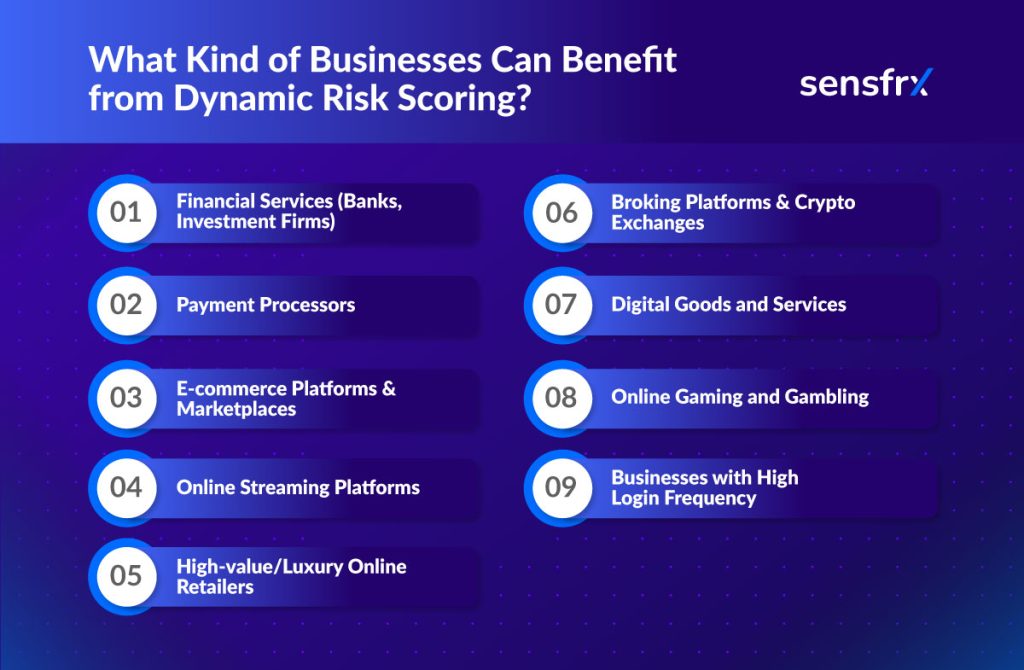
1. Financial services (banks, investment firms)
Sensitive transactions and client data make them prime targets. Real-time scoring catches the fraud and keeps the regulator satisfied.
2. Payment processors
High transaction volumes mean payment fraud and chargebacks at scale. Scoring each transaction cuts the losses for the processor and for the merchants behind it.
3. Ecommerce platforms and marketplaces
Many buyers and sellers means account takeovers and payment fraud. Scoring keeps the transactions clean on both sides.
4. Online streaming platforms
Account sharing and piracy cost revenue. Scoring logins finds the unauthorized access.
5. High-value and luxury online retailers
Large order values attract payment fraud and identity theft. Scoring each transaction in real time stops the fraudulent purchases before they ship.
6. Broking platforms and crypto exchanges
Funds move fast and irreversibly, so the scoring has to be fast too. It is what keeps user funds and platform trust intact.
7. Digital goods and services
Software companies and content providers lose to account takeover and piracy. Scoring the login protects the IP and the revenue.
8. Online gaming and gambling
Large user bases, money in and out, and an incentive to cheat. Scoring spots the suspicious behavior and keeps play fair.
9. Businesses with high login frequency
Social platforms and SaaS companies see account takeover attempts every day. Scoring each login finds the anomalies.
How Sensfrx uses dynamic risk scoring
Sensfrx scores each transaction in real time from transaction history, user behavior and device attributes, so the high-risk transactions sit at the top of the queue and the response is fast.
What the platform does:
- Encrypts sensitive data in transit and at rest.
- Tracks user behavior across devices to spot suspicious actions and fraudulent transactions.
- Learns normal behavior and transaction patterns per user, so unusual activity stands out.
- Scores each transaction on historical data, user behavior and device characteristics, so you look at the risky ones first.
- Runs validators that flag the signs of friendly fraud, so only legitimate chargeback requests go through.
Where to start
Sensfrx covers the fraud types above with one risk score per signup, login and payment, and your rules decide what happens at each threshold.
Pick the touchpoint that costs you most, usually payments or logins, and turn on scoring there first.
[Start on the free plan](/) and see your first scores the same day.