It analyses large volumes of data for unusual patterns, behaviour and anomalies that indicate fraud, usually in real time.
AI in fraud detection: Techniques, use cases and future trends
How AI fraud detection works: supervised and unsupervised models, behavioural biometrics, graph intelligence, explainability, and the risks to manage.
 By 15 mins readPublished Updated
On this page
Rule-based fraud detection is losing to automation, AI tooling and a steady supply of breached data. Analysts projected online payment fraud losses would pass $206 billion by 2025, and ecommerce merchants lose about 2.9% of global revenue to fraud. GDPR and PSD2 add regulatory pressure on top.
So businesses are moving to AI-based fraud detection, which scores behaviour and transactions in real time and adapts to new tactics as they appear.
Why legacy systems fall short
Legacy fraud systems run on static rules and manual review, and neither keeps pace. In an Experian report, 72% of business leaders expected AI-driven fraud and deepfakes to be significant challenges by 2026.
Rule systems produce too many false positives, slow the user down, and need constant human edits to the ruleset. That leaves the business reacting after the loss. Teams that do not modernise struggle to protect users, meet compliance standards and hold on to revenue.
What AI adds
Machine learning changes four things:
- Real-time detection, so fraud is stopped as it happens
- Fewer false positives, so fewer good customers are blocked
- Continuous learning, so new attack patterns are picked up without a rule change
- Scale, with millions of data points across sessions, locations, devices and behaviour
What makes AI useful in fraud detection
AI finds subtle signals across large datasets and acts in real time, including when every individual field passes a rule check.
Five things set it apart.
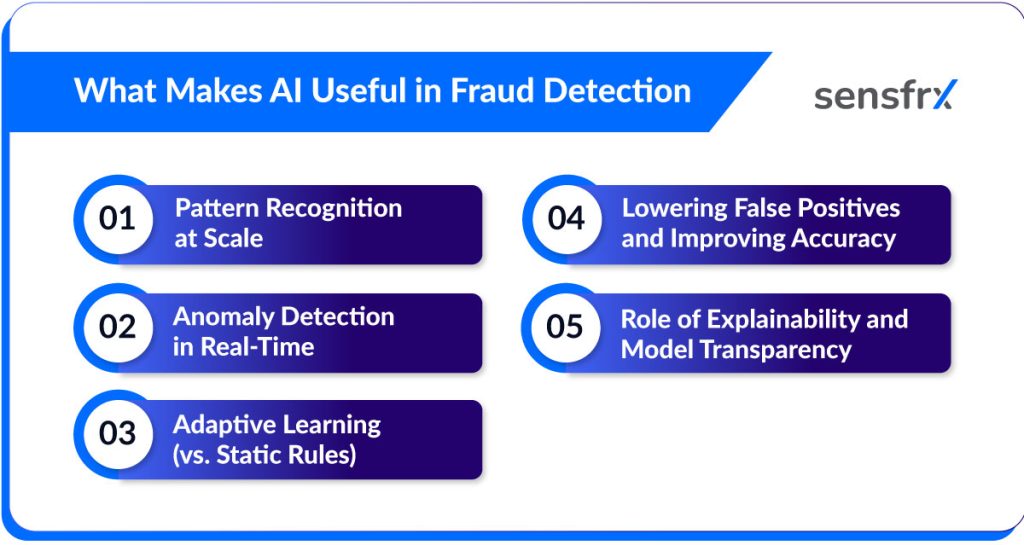
Pattern recognition at scale
A model can process millions of transactions and behavioural signals and spot patterns too complex or too rare for a rule. One example: account creation behaviour that matches a known fraud ring, which a human analyst or a simple rule engine would miss.
Anomaly detection in real time
Location mismatches, spending spikes and device anomalies are flagged within milliseconds, which leaves time for an OTP challenge or a block before the transaction completes.
Adaptive learning against static rules
Static rules need manual updates and lag new tactics. Machine learning models learn from new data as it arrives and adjust to seasonal shifts, changing fraud patterns and sudden attack spikes without anyone touching a rule.
Take the rule "flag every transaction over ₹50,000". During a festive sale many legitimate customers spend more than that, the rule fires on all of them, and the fraud team drowns in false alarms.
A model that has seen previous sales seasons knows higher spending is normal in that period and adjusts its risk scoring on its own.
Fewer false positives, higher accuracy
Fixed criteria flag too many legitimate users. AI reads behavioural context, device fingerprint and session history, so fewer good customers are challenged and the fraud team's queue is shorter. A research paper puts the reduction in false positives at 40 to 60% compared with rule-based systems.
Explainability and model transparency
The common objection to AI in fraud detection is the black box: it flags a transaction or blocks a user and does not say why. In banking, fintech and insurance that is a real problem, because someone has to defend the decision.
It does not have to be that way. Explainable AI (XAI) shows risk teams and compliance officers why a decision was made, which is what regulators, auditors and your own analysts need before they trust the system.
Key techniques used in AI-based fraud detection
AI fraud detection combines several machine learning techniques. Which ones carry the load depends on the use case, the data you have and the sophistication you need.
Supervised learning (classification models)
These models learn from past cases already labelled fraud or not fraud, and use that to judge new ones.
Example: a model trained on historical chargebacks learns what fraud looked like and predicts, in real time, which new transactions are likely to end the same way.
Unsupervised learning (clustering and outlier detection)
Useful when you have no labels. These models group similar behaviour and surface what stands out, such as one account behaving unlike every other, and queue it for review.
Example: many accounts logging in at the same time, from similar IP addresses, making the same kind of transaction. The model clusters them and flags a likely fraud ring.
Neural networks and deep learning for high-volume data
Neural networks learn patterns from data with little human guidance. They are the reason image recognition and language translation work as well as they do, and they do the same job on fraud signals.
Example: a deep learning model reads mouse movement, typing speed and screen size and decides whether the user is a person or a bot.
Behavioural biometrics and user profiling
The system builds a profile of how each user interacts: keystroke rhythm, device motion, navigation habits. That catches account takeover and synthetic identities when the credentials are correct.
Example: a fraudster in a hijacked account types the right password but moves through the app differently from its owner, and the risk score rises.
More on this in Behavioural Fraud Detection: Techniques and Use Cases.
Detectors across the fraud lifecycle
Fraud tools run specialised detectors at three stages: transaction time, registration, and account takeover (ATO).
Transaction-risk detectors combine supervised learning (trained on past fraud) with unsupervised outlier detection to catch unusual purchase times, amounts or locations. The Abnormal Amount Detector, for instance, flags a purchase 10× a user's typical basket size and matches it against known fraud patterns.
Registration-risk detectors cluster email domains, device characteristics and registration patterns with unsupervised learning, backed by behavioural biometrics on how the form was filled. The Disposable-Email Detector flags signups from temporary mail services such as 10minutemail.com.
ATO-risk detectors watch login behaviour and device characteristics with behavioural biometrics and deep learning. The Bot-Trajectory Detector picks out unnatural mouse movement, such as perfect straight lines, and separates bots from people.
Common use cases of AI in fraud prevention
The same techniques apply across ecommerce, banking and corporate systems. Four cases:
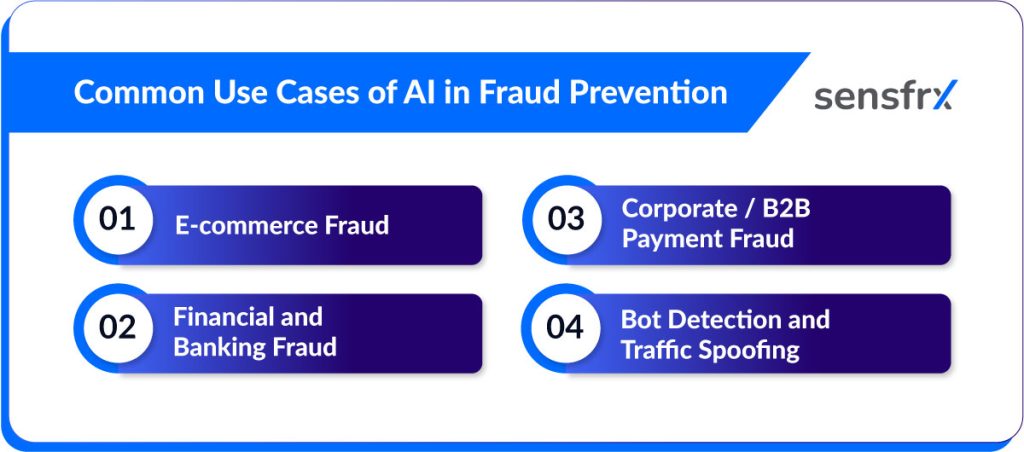
1. Ecommerce fraud
Ecommerce is exposed by design: instant account creation, global reach, fast transactions and almost no human contact. Fraudsters work the gaps in identity verification, payment validation and checkout security. AI closes them by flagging suspicious behaviour in real time without blocking the real customers.
An article by Clickpost says ecommerce companies run at least five different fraud detection tools, many of which now rely on AI and behavioural analytics for real-time detection.
Coverage has to run from signup through login to checkout. Sensfrx scores each of those steps.
- Fake account creation: patterns in email domains, IPs, device fingerprints and behaviour reveal automated or fake registrations, the raw material for promo abuse and refund fraud
- Stolen credentials and checkout abuse: login and checkout behaviour is compared against the user's history, and a mismatch stops the account takeover or checkout manipulation in real time
2. Financial and banking fraud
Banks need speed and accuracy at once. An IBM article reports that American Express improved its fraud detection by 6% and PayPal improved real-time detection by 10% with AI systems that run continuously worldwide.
The cost of missing fraud is regulatory penalties plus churn: Altexsoft reports that 1 in 5 customers switch banks after falling victim to a scam.
- Credit card fraud detection: transaction size, merchant category, location, time and frequency together expose card-not-present fraud, stolen card use and triangulation schemes
- Account takeover prevention: anomaly detection and user profiling catch logins from unusual devices or places, signalling a possible ATO, and trigger step-up authentication before the damage is done
3. Corporate and B2B payment fraud
Businesses are targeted with planned social engineering and invoice fraud.
- Vendor impersonation: a change to payment or banking details is checked against the vendor's history and communication patterns before it is accepted
- Business email compromise (BEC): natural language processing and metadata analysis catch spoofed domains, language anomalies and timing irregularities in executive-targeted email scams
4. Bot detection and traffic spoofing
Bots run credential stuffing, fake traffic and loyalty point harvesting. Digital fingerprinting and behaviour analysis (mouse movement, typing cadence, time on page) separate humans from bots even after a CAPTCHA has been beaten. AI-based bot detection cuts false positives by 50 to 80% compared with rule-based or CAPTCHA-only systems, so real users see less friction.
Limitations and risks of using AI
1. Black-box risk and lack of explainability
AI systems have blind spots of their own.
Some models, deep learning in particular, make decisions nobody can trace. In banking or insurance that collides with regulators who require a clear reason for every flagged transaction or blocked customer. A system that cannot give one creates compliance problems and loses user trust.
The table below lists ways to mitigate the lack of explainability:
| Mitigation Approach | Description | Benefits |
|---|---|---|
| Explainable AI Tools | LIME, SHAP, interpretable model use | Makes AI decisions understandable |
| Audit Trail & Documentation | Logging data, versioning, governance | Enables traceability and regulatory compliance |
| Human-in-the-Loop | Analyst review of AI decisions | Combines AI efficiency with human judgment |
| Regulatory Alignment | Compliance frameworks and documentation | Meets legal requirements and standards |
| Stakeholder Education | Training and transparent communication | Builds trust and smoother operations |
2. Overfitting to historical data
A model learns from past data. If it fits that data too closely, it misses what is new. A model trained mostly on card fraud from five years ago will not recognise this year's schemes. That is overfitting, and it makes the model brittle in production.
How to detect overfitting in fraud models
- Performance gap: excellent on training data, poor on validation or test data
- Learning curves: training loss keeps falling while validation loss plateaus or worsens, which means the model is memorising
- Cross-validation: inconsistent results across data subsets
- Live monitoring: detection rates fall or false positives rise once the model is deployed
How to prevent or manage overfitting
| Strategy | Description & Benefits |
|---|---|
| Use More and Diverse Data | Incorporate large, varied, and recent datasets covering multiple fraud types and customer behaviors for training. Helps models generalize across scenarios rather than memorize narrow patterns. |
| Feature Selection & Engineering | Remove irrelevant or noisy features that do not correlate strongly with fraud. Use domain expertise to focus on meaningful signals, reducing model complexity and noise fitting. |
| Regular Model Retraining | Continually retrain models on fresh data, including newly detected fraud and legitimate transactions, to adapt to evolving tactics and maintain relevance. |
| Cross-Validation & Robust Evaluation | Employ k-fold cross-validation and separate test sets to evaluate generalization performance rigorously before deployment. |
| Simplify Model Architecture | Use simpler models if data is limited. Avoid overly complex neural networks where unnecessary to reduce risk of memorization. |
| Early Stopping During Training | Stop training once validation performance deteriorates, preventing over-optimization on training data. |
| Data Augmentation & Synthetic Data | Generate synthetic fraud examples to diversify training samples and improve model robustness. |
| Ensemble Models | Combine predictions from multiple models to reduce variance and generalize better. |
| Monitoring & Feedback Loops | Implement real-time model monitoring and incorporate feedback from fraud analysts to quickly detect performance degradation and adjust models. |
3. Model drift and fraud evolution
Model drift is the loss of accuracy over time as live data moves away from the data the model was trained on. In fraud detection it is a standing risk, because the tactics keep changing.
How to mitigate model drift
Watch the key metrics (false positive and false negative rates, fraud loss, approval rate) in real time and alert on unusual change. Retrain on a schedule with the latest data, including confirmed fraud cases and analyst feedback. Keep expert investigators in the loop, since their verdicts on new cases are the best training data you have.
Add drift detection to the ML pipeline, such as a Kolmogorov-Smirnov test on input features or prediction probabilities. And stress-test the model with simulated new fraud types built from synthetic data before an attacker runs the real thing.
4. Adversarial attacks on AI models
Fraudsters also attack the model itself. An adversarial attack makes small, often imperceptible changes to inputs such as transaction amount, timing, device info or behaviour so that a fraudulent transaction is classified as legitimate.
A bot that varies its login times and device details just enough to look normal is doing exactly this, and the fraud slips through.
How to defend against adversarial attacks
| Strategy | Description | Benefits |
|---|---|---|
| Adversarial Training | Incorporate adversarial examples into training data so the AI learns to recognize manipulated inputs. | Improves model robustness and reduces vulnerability. |
| Model Ensemble Techniques | Use multiple models or algorithms together to cross-verify suspicious transactions. | Increases detection accuracy and reduces false negatives. |
| Input Preprocessing & Validation | Sanitize inputs to detect and normalize anomalous or suspicious data before model processing. | Filters out suspicious adversarial manipulations early. |
| Continuous Monitoring & Feedback Loops | Track model performance and update with new fraud patterns and feedback from fraud analysts. | Detects model degradation and evolving attacks promptly. |
| Robust Feature Engineering | Use features that are hard to manipulate or combine multiple behavioral signals for analysis. | Makes evasion more difficult for attackers. |
| Explainable AI Tools | Implement XAI to understand why models flag or accept transactions, aiding compliance and debugging. | Builds trust and identifies weak points in models. |
| Regular Stress Testing | Simulate adversarial scenarios internally to evaluate model resilience and refine defenses. | Proactively identifies vulnerabilities before they’re exploited. |
| Human-in-the-Loop (HITL) | Maintain human oversight for flagged borderline cases to prevent automation errors from adversarial inputs. | Balances automation benefits with human judgment. |
5. Overreliance on automation in sensitive decisions
AI speeds decisions up. For high-stakes ones, such as blocking an account or declining a payment, full automation can backfire: a false positive blocks a good customer, and a wrong accusation damages your reputation. Keep a human in the loop wherever the decision lands on a customer directly.
Trends shaping the future of AI in fraud detection
Five developments are changing how AI is used against fraud.
LLMs for contextual anomaly detection
Large language models such as GPT read the context around an action, not just the numbers. A fraud system can interpret logs, support tickets, emails and behavioural narratives and find signals that follow no fixed rule. An LLM can read a customer complaint and spot inconsistencies that point to synthetic identity fraud even when the transaction data is clean.
Federated learning for secure model training
Federated learning trains one model across several organisations' datasets without anyone sharing customer data. Each party (a bank, a merchant) trains locally and shares only the model updates.
That gives you:
- User privacy preserved, which matters for GDPR and HIPAA
- Collaborative fraud detection without pooling risk data in one place
- Lower breach risk during training
Example: banks in different regions train a shared fraud model without ever exposing their customer records.
Synthetic data to make models more resilient
Synthetic data is generated data that mimics real fraud scenarios. It trains models when real fraud data is scarce, imbalanced or too sensitive to share.
What it fixes:
- Models see rare or emerging fraud patterns
- Training data is balanced, so the "too few fraud cases" problem goes away
- Customer data stays private
Example: a fintech that has not yet seen deepfake KYC fraud simulates it with synthetic data and trains for it before it arrives.
Fraud graph intelligence
Graph analytics and machine learning (graph neural networks, GNNs) map the connections between accounts, transactions, devices and users, and find the fraud rings that event-by-event systems cannot see.
Why graphs beat event-level analysis
A traditional system scores each event on its own. A graph looks at how data points connect, which is where fraud rings, fake identities and collusion show up.
A GNN treats those connections as a web. An account that looks fine in isolation gets flagged when it is tightly linked to accounts already known for fraud.
What you get:
- Multi-accounting and organised fraud identified
- Detection that works when each account looks clean on its own
- Temporal and behavioural patterns captured across users
Cross-industry fraud intelligence sharing
A technique used against gaming or ecommerce today shows up in banking tomorrow. So platforms and consortia are forming to share signals across sectors.
Their aims:
- Share fraud signals and attack patterns across industries
- Detect new threats faster
- Standardise fraud taxonomies
Example: a telco that detects SIM-swap fraud shares indicators such as rapid number porting with fintechs, who use them to block account takeover attempts in real time.
Where to start
AI does not end fraud, but used well it cuts risk, saves analyst time and shortens the response to new threats. The best results come from AI that supports human judgement rather than replacing it, most of all in complex or high-impact cases.
Build in explainability and feedback loops from day one. That is what keeps the model improving and keeps your team trusting it.
Sensfrx puts these techniques and detectors into one system:
- Data collection: user, device and behavioural data at signup, login and checkout
- Risk scoring: a 0 to 100 score per event
- Automated actions: allow, step up with an OTP, or block
- Continuous learning: models updated with new fraud patterns
It uses supervised and unsupervised learning, neural networks and behavioural biometrics, and adapts as the fraud does. Start a free trial and run it against your own traffic.
FAQs