It is the analysis of how users interact with a site or app (typing speed, mouse movement, click patterns, session flow) to spot abnormal activity. It matters because IP and device ID can be spoofed and behavior is much harder to fake, so it catches account takeover and bot attacks that pass static checks.
Behavioral fraud detection: Techniques & use cases
How behavioral analytics and biometrics catch account takeover, bots and synthetic signups that IP and device checks miss, plus what to check in a tool.
 By 13 mins readPublished Updated
On this page
Static fraud signals are cheap to fake. An IP address costs a proxy, a device fingerprint costs a spoofing kit, and the password was stolen before the attacker arrived. Behavior is the signal that is hard to fake: how a person types, moves a mouse, and walks through your checkout.
Here is the session that gets through everything else. A login from a known device, a clean IP, the right password, no flags. Within minutes the account settings change, the stored value is cashed out, and a chargeback follows. By the time a rule fires, the money is gone.
That is how it played out at a digital wallet provider. Stolen credentials plus a spoofed device fingerprint passed every static check. Behavioral analytics running in the background saw erratic mouse movements and navigation the account had never shown, scored the session high risk, and the account was frozen before further loss.
Static signals still matter, but attackers spoof, recycle and rotate them at scale. Behavior, how someone types, moves and interacts with your app, is far harder to copy, and it gives you a second layer that works in real time.
What is behavioral fraud detection?
Behavioral fraud detection scores sessions on what users do: mouse movement, typing, the pages they visit, the device they hold and the network they arrive from.
It looks for behavior that does not fit, such as account takeover, fake signups or suspicious payments. Each session gets a risk score, and the score drives an action: block, step up to multi-factor authentication, or send to a fraud analyst. The stakes keep rising; one industry roundup put the rise in global ecommerce fraud losses at 16% in a single year.
Repeated failed logins or a sudden burst of transactions reads as a brute-force or carding attempt. Joining behavior across channels, mobile app and website, gives a fuller picture and a more accurate model.
Behavioral analytics vs behavioral biometrics
Behavioral analytics tracks what users do in a session.
It answers: which pages did they visit, how long did they stay, what did they click, and did they follow the normal purchase flow?
A customer who usually views the homepage, two product pages and then carts one item instead logs in and carts five items in 30 seconds without opening a product page. That is the anomaly analytics catches.
Behavioral biometrics tracks how users physically handle the device.
Typing speed and rhythm, key pressure, how the mouse moves or the finger swipes, how the phone is held or tilted.
A fraudster with stolen credentials passes the device, IP and password checks, but types faster, with a different rhythm, and moves the mouse in a pattern the account has never produced. That alone raises the flag. Together, the two build a profile of normal for each user, and anything far from it stands out.
Examples of behavioral signals used in fraud detection
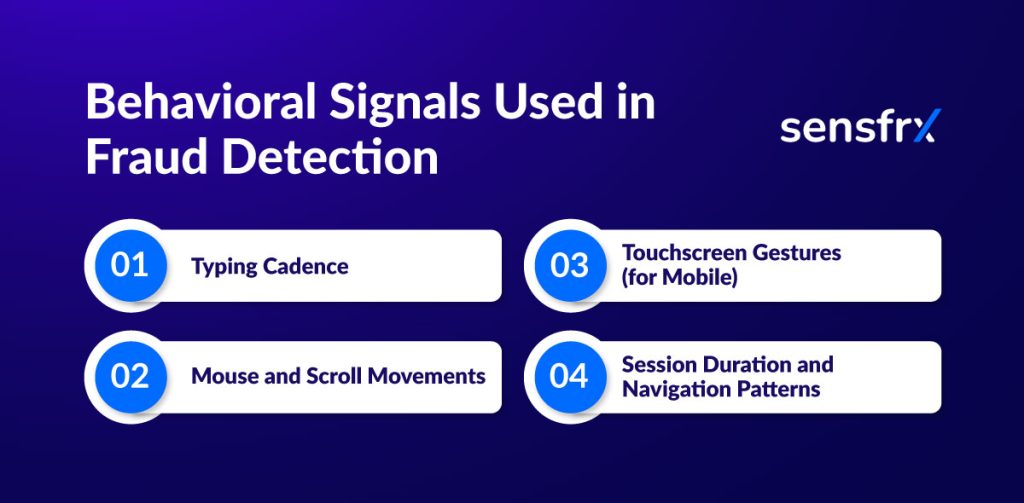
1. Typing cadence
How fast and how evenly someone types. Bots type instantly or too evenly; people pause and make mistakes.
2. Mouse and scroll movements
People move the mouse in curves and scroll at uneven speeds. Bots move in straight lines and click without scrolling.
3. Touchscreen gestures (for mobile)
On phones, how a user taps, swipes and holds the device. A bot taps the same pixel every time; a person never does.
4. Session duration and navigation patterns
A few seconds on checkout, or steps taken out of order, points to automation. Real customers follow a slower, messier path.
Why behavioral signals are hard to spoof
Faking an IP or using a stolen card is cheap. Copying how a specific person moves, types and behaves is not. The patterns are individual and near impossible to automate well, which makes behavior the signal attackers struggle with most.
Key benefits over traditional detection (IP, device, geo)
- Catches fraud when every other signal looks fine.
- Adds friction only when something looks wrong.
- Fewer false positives, so fewer real customers blocked.
- Stronger against bots, which cannot imitate human motion well.
Common use cases
Where behavioral detection earns its keep:
Account takeover (ATO)
Account takeover is a fraudster inside a real customer's account on stolen credentials. The behavioral tell is the sequence: new device, immediate password change, new shipping address.
A customer who always logs in from Delhi appears from Russia and changes delivery details within seconds. That sequence gets flagged as an ATO attempt.
Synthetic identity fraud
Synthetic identity fraud mixes real and fake details, say a real phone number with a fake name and address. At signup the behavior gives it away: inconsistent typing speed, odd navigation, every field pasted from a clipboard.
Perfect data entered at inhuman speed is a bot building a synthetic identity, and the signup gets held.
Bot activity and automated abuse
Bots flood sites with fake logins, fake signups and spam transactions. Their motion is too perfect, too fast and too repetitive.
A script that opens 100 accounts in 10 minutes without a single mouse movement or scroll does not look like any human, and the system says so.
Promotion and bonus abuse in ecommerce/gaming
Fraudsters open many accounts to claim welcome offers, discounts or referral rewards again and again. Behavioral tools link the accounts through shared device patterns and the speed at which the same actions repeat.
Three new users on one IP claim a gaming sign-up bonus within seconds of each other along near-identical navigation paths. That is one person.
Insider misuse in corporate settings
Fraud is not always external. Behavioral monitoring also catches an employee who starts downloading sensitive files or reaching systems outside working hours. Someone who logs in during office hours and then opens admin dashboards at 2 a.m. to export customer data gets the security team paged.
Behavioral signal collection techniques
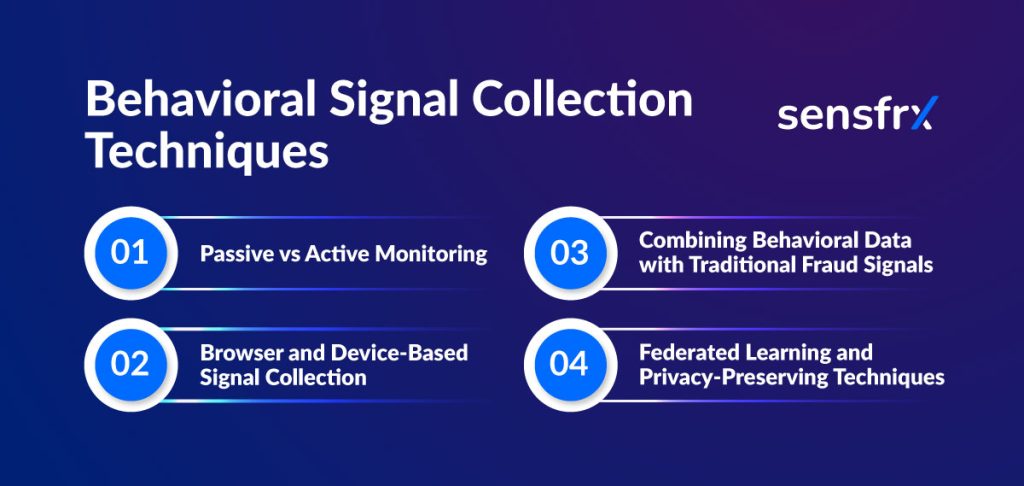
How users behave on your platform tells you as much as what they buy. Collecting the signals well is what lets you catch what rules miss.
1. Passive vs active monitoring
Passive monitoring collects behavior in the background (mouse movement, typing speed, session length) without interrupting the user. Active monitoring asks for something: a multi-step verification or a behavioral test triggered by a suspicious action.
A real user scrolls and hesitates before buying; a scripted bot skips all of that. Passive tracking flags the difference without the user knowing.
2. Browser and device-based signal collection
Browser fingerprint, screen resolution, device orientation, installed plugins, even battery status, combined into a profile for each session.
A customer who always logs in from an iPhone in India arriving from a Linux desktop in Eastern Europe raises the flag.
3. Combining behavioral data with traditional fraud signals
Behavior works best next to rule-based indicators such as velocity checks and IP reputation.
A transaction can pass every rule and still get flagged because the typing pattern is nothing like the account's previous logins.
4. Federated learning and privacy-preserving techniques
Federated learning trains a fraud model across many devices without pooling personal data in one place. Paired with differential privacy, it lets you detect fraud without holding the raw behavior.
A model learns from login behavior across 100 retail apps without the underlying data ever leaving each app.
Modeling and detection approaches
Knowing what runs under the hood helps you pick a tool. The main methods:
1. Rule-based pattern detection
If-then rules for known patterns. Several orders within minutes to the same address under different emails trips a rule and the orders get blocked. Rules are quick to set up and miss whatever is new.
2. Machine learning models (anomaly detection, user clustering)
Models learn what normal looks like across many users and flag what stands out. If most shoppers browse for a few minutes and cart one or two items, the one who goes straight to checkout with 10 expensive items in 30 seconds is an outlier. Models are how you catch the fraud you have no rule for.
3. Risk scoring frameworks
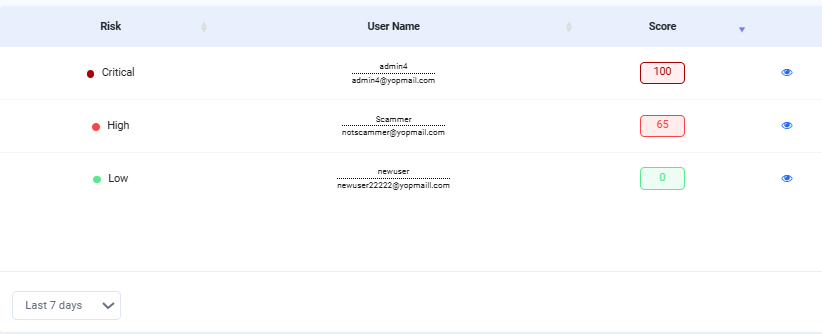
Every action gets a score, and the running total decides allow, flag or block. A login from a new country, then a fast checkout with a saved card and a different shipping address, pushes the total over the limit and triggers a verification step or an order hold.
This is what the risk score looks like in the Sensfrx dashboard:
4. Continuous authentication vs point-in-time detection
Point-in-time tools check at login or payment. Continuous tools watch the whole session. Someone who logs in cleanly and then changes the email, resets the password and adds an address inside a minute is caught mid-session by the second kind and missed by the first.
5. Feedback loops: Analyst review + auto-labeling
The system improves on what your team labels. Confirm a flagged order as fraud and the pattern is learned, so the next one like it is caught without a manual check. Over time that cuts false positives and raises accuracy.
Challenges in behavioral fraud detection
Behavioral signals are strong, but using them well has costs.
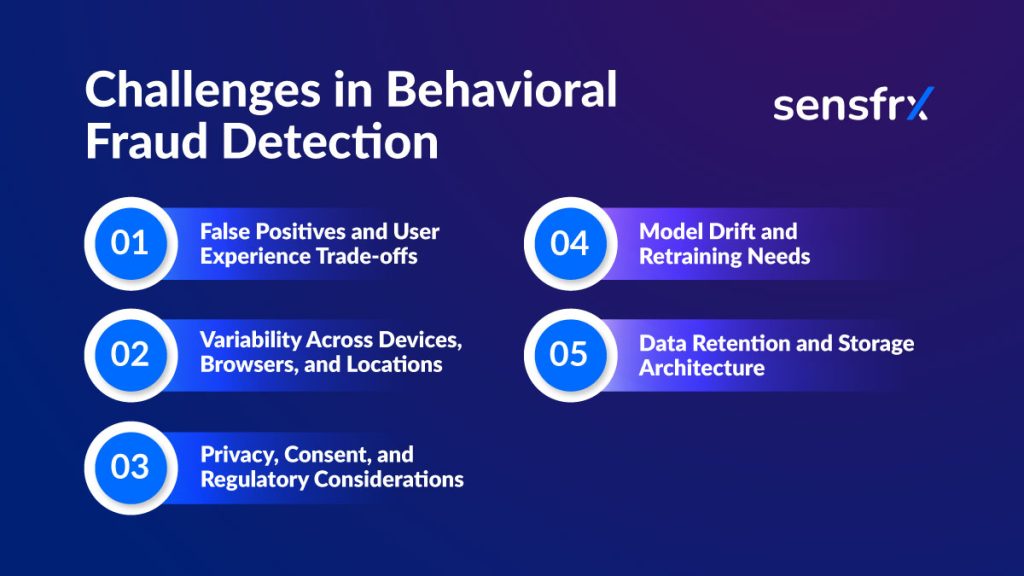
1. False positives and user experience trade-offs
A false positive is a real customer treated as a suspect. Too many, and the extra verification steps drive people away.
The regular customer logging in from a new device on a trip is the classic case.
2. Variability across devices, browsers, and locations
The same person behaves differently by device, browser and location, which makes a stable model hard to build.
Slow scrolling on a phone and fast scrolling on a laptop are both normal and look nothing alike to the model.
3. Privacy, consent, and regulatory considerations
Recording how someone types or moves a mouse is personal data. You need clear consent, and you must follow GDPR, CCPA and whatever else applies where your users are.
In practice that means consent prompts and a working opt-out.
4. Model drift and retraining needs
Behavior changes over time. A model that does not adapt loses accuracy; that is model drift, and the fix is regular retraining.
After an app update people use your site differently, and an unretrained model starts flagging normal behavior.
5. Data retention and storage architecture
Behavioral data piles up fast. You need somewhere to store, manage and protect it, and a rule for deleting it once it has served its purpose.
Treat it like security footage: keep enough, keep it safe, delete it on schedule, and stay inside the data protection rules.
Evaluating behavioral fraud detection tools
What to check before you buy:
Real-time decisions. It should act while the session is live, blocking a fraudulent checkout as it happens rather than flagging it afterwards.
Session-level insight. A session runs from the moment a user arrives until they leave, log out or go idle. You should be able to replay what they did across it: where they moved, clicked and hesitated.
A bot fills a signup form in 2 seconds. A person takes 30, tabs between fields and pauses.
Explainability and audit logs. The tool should say why it flagged something, not just that it did. Audit logs let the team review and defend each decision.
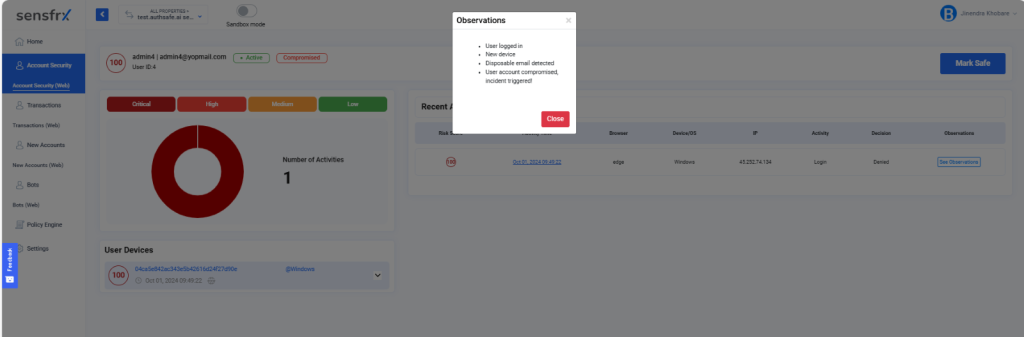
Here is the Sensfrx dashboard listing the reasons a transaction was flagged:
Integration method. Tools connect in three ways:
- JavaScript, dropped into a website.
- SDK, for mobile apps.
- Backend API, when you want more control or to feed another system.
Each trades ease of setup against data depth and performance.
Deployment options and integration methods
Check whether it runs in the cloud, on-premises or both, and how it connects to what you already run.
Can it plug into your CRM, payment gateway or internal risk engine?
Support for hybrid models (human + AI)
The useful tools automate the fast decisions and leave analysts able to review or override.
A flagged transaction gets auto-blocked and still lands in an analyst's queue for the final call.
Case management and analyst tooling
Analysts need to group related cases, add notes and track outcomes in one place. Look for investigation views and case tracking in the dashboard; that is where the team's time goes.
Where behavioral detection is heading
One survey found three in four ecommerce businesses plan to spend more on fraud prevention. Four developments to watch:
1. Combining behavioral detection with AI that reads intent
Newer systems pair behavioral biometrics (typing, swiping, clicking) with models that try to infer what the user is trying to do, which separates a customer from a fraudster on the same device.
Someone checking a balance and someone racing to move money out behave differently, and the model picks up the difference.
2. Linking sessions to spot fraud rings
Instead of judging one visit, systems connect sessions across accounts and devices to find fraud networks.
Five accounts sharing one typing style, device profile and behavior are one operator.
3. Smarter logins based on behavior
Authentication is becoming adaptive: the amount of friction depends on how risky the behavior looks.
Usual device, usual typing, straight in. Anything off, and the user gets an OTP.
4. Privacy-friendly ways to use behavior data
Privacy-enhancing technologies let companies use behavior for detection without holding identifiable personal data.
Think of a blurred photo: you see the shape of a person without knowing who they are.
How Sensfrx uses behavioral signals
Sensfrx scores every signup, login and payment in real time from device, network and behavior signals, and your rules turn the score into allow, review or block. The parts that matter here:
- Device fingerprinting: browser, operating system, IP and more, captured per session and watched for behavior that does not fit the device's history.
- Behavior tracking: login patterns, navigation and transaction activity, compared against the account's normal so deviations surface at once.
- Dynamic risk scoring: behavior history, device data and transaction pattern combined into one score per event, returned in time to act on it.
- Fraud validators and machine-learning models that catch account takeover and fraudulent transactions and keep learning from what your team labels.
- Encryption of the user data it collects.
Where to start
Legacy tools produce too many false positives and catch fraud after the money has moved. The fix is a model that reads behavior across the whole customer lifecycle and is retrained as attackers change. Add behavioral scoring at login and checkout, read the scores next to your current rules for two weeks, then let them block. Questions about integration go through the contact page.