Bot protection: What it is, how it works and how to choose a tool
What bot protection is, the five detection methods behind it, the attacks it stops, from credential stuffing to ticket scalping, and what to check in a tool.
 By 8 mins readPublished Updated
On this page
- What a bot attack is
- What bot protection is
- How bot protection works
- Types of bot attack
- Bots are harder to spot than they were
- Why businesses need bot protection
- Bot attack use cases: Attack type and impact
- Bot protection methods in detail
- How to choose a bot protection tool
- Where Sensfrx fits
- Where to start
Scalper bots run by a third party bought a large share of the tickets to a popular event on Ticketmaster and resold them at a markup, and Ticketmaster took the financial loss and the headlines. That is one bot attack on one company. Across the web, bot attacks rose 147% in a single year and nine in ten websites see them daily.
Bots do not need a human at the keyboard, and the current generation browses, clicks and types well enough to pass as one. Hoping your site is the exception is not a plan.
Below: what a bot attack is, how bot protection tells bots from people, the attacks it stops, and what to check before you buy a tool.
What a bot attack is
A bot attack is automated software pointed at a website, app or API to do something its owner does not want: steal data, take over accounts, test stolen cards, scrape prices, buy out inventory or knock the service offline with a DDoS flood. Credential stuffing, where a bot replays leaked username and password pairs against your login, is the most common.
Because nothing human is involved, the attack runs at machine speed and scale, and because modern bots imitate human sessions, telling them apart from customers is the hard part.
The Ticketmaster case above is the pattern: a third party found a weakness in the online ticketing flow, bought tickets in bulk faster than any person could, and sold them on at inflated prices.
What bot protection is
Bots go after whatever has value: customer records, business data, inventory, ad budgets. They exfiltrate data, run DDoS attacks and automate fraud at a volume no manual process matches, and they look human enough that signature-based defences no longer hold.
Bot protection stacks several detection methods, from IP allowlists and blocklists and static signatures through to behavioural analysis, to separate bots from people. Once a bot is identified, the response is rate limiting, a challenge, or a custom action such as blocking the session or routing it to review.
A good bot manager also knows which bots to let through. Search engine crawlers and monitoring tools are bots too, and blocking them costs you rankings and visibility.
How bot protection works
Five methods do most of the work, usually layered:
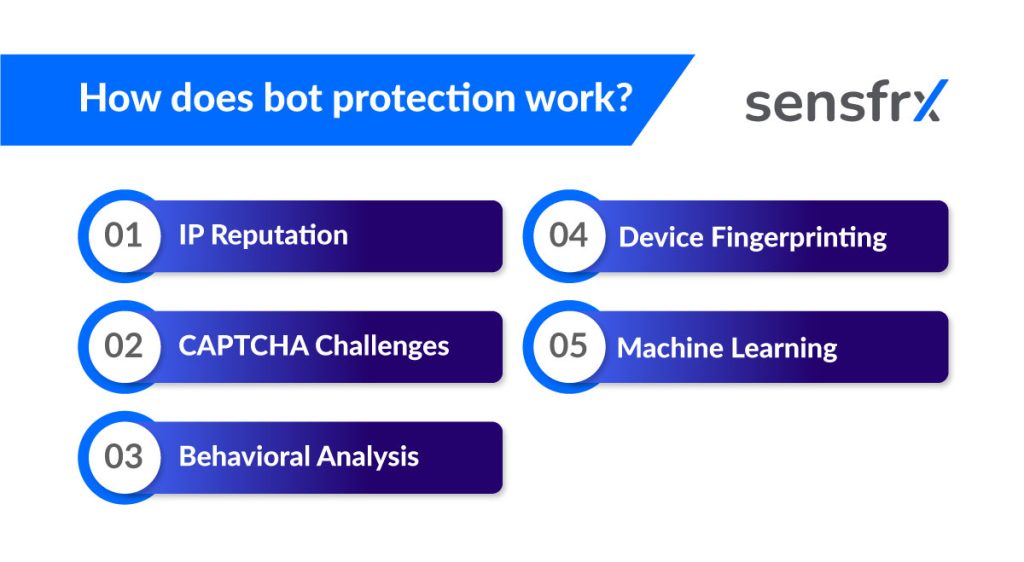
- IP reputation: check each address against databases of known bad sources and block the ones with history.
- CAPTCHA challenges: put a test in front of the session that a person passes and a script does not.
- Behavioural analysis: watch how the session behaves. Browsing faster than a person can read, or repeating one action in a fixed rhythm, gives a bot away.
- Device fingerprinting: collect device and browser attributes so the same machine is recognised across sessions and IP addresses.
- Machine learning: score traffic patterns in real time and adapt as new bot techniques appear.
Types of bot attack
The common ones, with what each does:
| Type of Bot Attacks | Explanation | Impact |
| Credential Stuffing | Automated bots use stolen username and password combinations to gain unauthorized access to accounts. | Results in account takeovers, data breaches |
| Web Scraping | Bots extract large amounts of data without permission | Results in intellectual property theft. |
| DDoS Attacks | Distributed Denial-of-Service attacks overwhelm a server with traffic, causing downtime and service disruption. | Causes significant operational disruptions |
| Scalping | Bots rapidly purchase tickets or products to resell at inflated prices | Loss of sales for legitimate buyers, and reputational harm. |
| Click Fraud | Bots simulate clicks on ads to generate illegitimate revenue | Wastes advertising budgets and undermines marketing efforts. |
Bots are harder to spot than they were
Attackers now route through residential IP addresses and run bots that move through a site like a real visitor. Defences that look for obvious automation, fixed timing, data centre IPs, missing JavaScript, do not see them.
Bad bot traffic blends into normal traffic, so detection has to work from behaviour and device signals rather than from the request alone. That is what machine learning and behavioural analysis add.
Without that layer, the cost shows up as data breaches, downtime and lost revenue.
Why businesses need bot protection
Bots hit the business in five places at once.
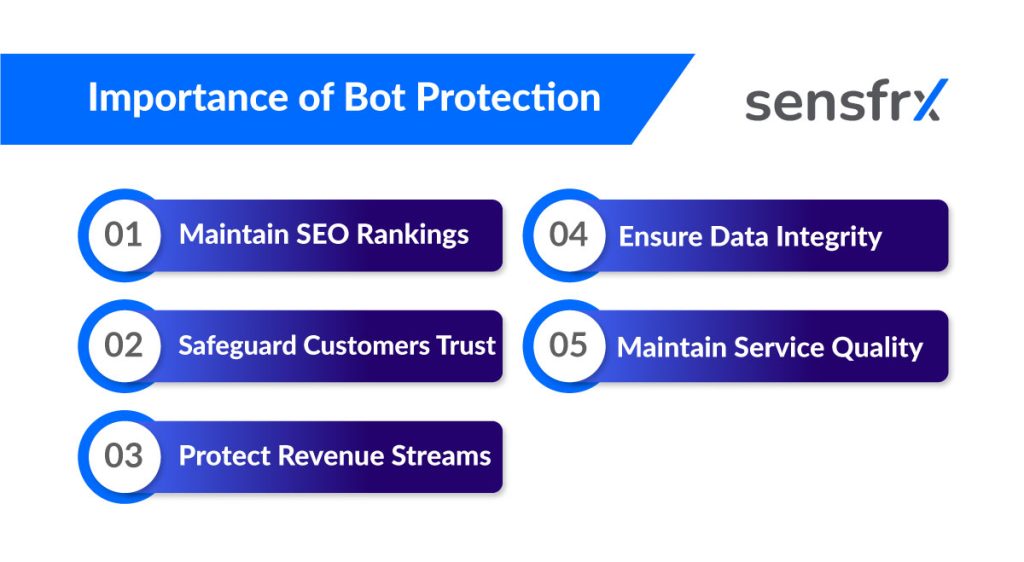
- Search rankings. Scrapers copy your content and republish it, and the duplicate can cost you a Google penalty. Blocking them keeps your organic rankings yours.
- Customer trust. Bots spread misinformation, host phishing and post fake reviews. Stopping them keeps the site a place customers believe.
- Revenue. Click fraud, account takeover, skewed analytics and service interruptions all hit the ledger. Most of those losses are avoidable.
- Data integrity. Bot traffic pollutes analytics and databases with fake signups and fake sessions, so every decision made on that data is wrong.
- Service quality. Stopping DDoS and other bot-driven disruption keeps the service up for the people paying for it.
Bot attack use cases: Attack type and impact
| Bot Attack | Type of Attack | Impact |
|---|---|---|
| PayPal Credential Stuffing | Credential Stuffing | Attackers gained unauthorized access to user accounts, leading to potential identity theft and financial fraud. |
| Facebook Data Scraping | Web Scraping | Personal information from 553 million accounts was leaked, risking user privacy and enabling further attacks. |
| Ticketmaster Scalping Incident | Scalping | Bots purchased large quantities of tickets for resale at inflated prices, frustrating legitimate customers and damaging brand reputation. |
| Major E-commerce DDoS Attack | DDoS (Distributed Denial of Service) | The attack overwhelmed servers, causing significant downtime and loss of sales during peak shopping periods. |
| DraftKings Account Takeover | Account Takeover | Automated bots exploited credential stuffing to hijack user accounts, leading to unauthorized betting and financial losses. |
| Latest Bot Attack | Type of Attack | Impact |
| PayPal Credential Stuffing | Credential Stuffing | Attackers gained unauthorized access to user accounts, leading to potential identity theft and financial fraud. |
Bot protection methods in detail
Five techniques, and a serious tool combines all of them:
- Behavioural analytics. Mouse movement, click patterns, typing cadence and dozens of smaller signals. A bot moves through a page faster than a person reads it and its movements are not natural; good systems also catch bots that simulate human movement.
- Machine learning. Models trained on traffic patterns and known bot signatures keep retraining as new techniques appear, so new bot behaviour gets flagged before anyone has written a rule for it.
- Device fingerprinting. A footprint per device from browser configuration, installed plugins, screen resolution and hardware. A bot that rotates IP addresses still carries the same fingerprint, which is what defeats distributed botnets.
- Challenge-response tests. CAPTCHAs have grown into interactive puzzles and contextual challenges that verify a human without wrecking the experience, and adaptive versions get harder as suspicion rises.
- Rate limiting. A cap on requests per IP per time window, with automatic blocking when it is exceeded. Current systems adjust the cap to normal usage, time of day and recent traffic rather than using one fixed number.
How to choose a bot protection tool
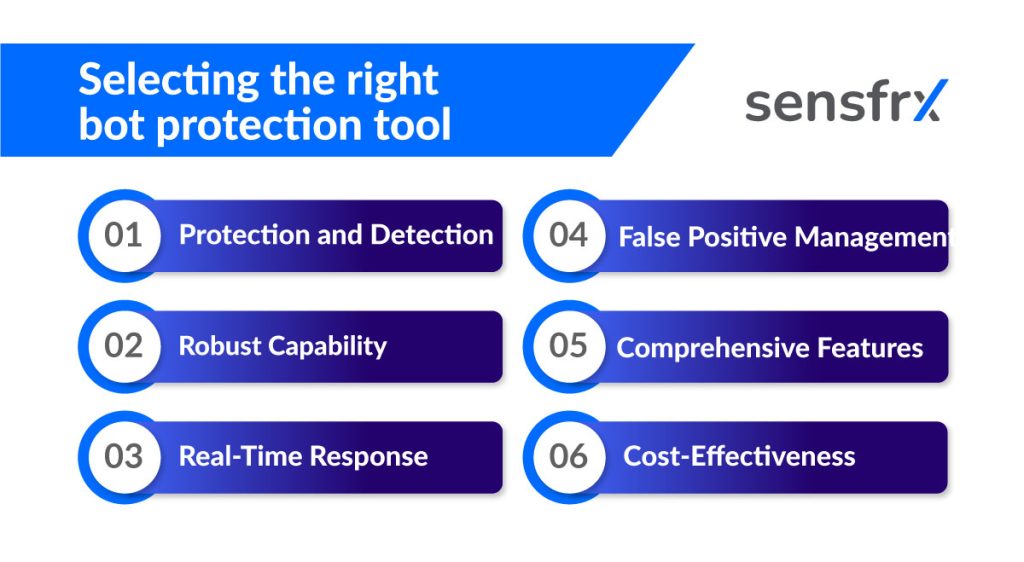
- Coverage. It has to detect and stop the attacks you get, credential stuffing and DDoS included, without taking the service down to do it.
- Detection depth. Machine learning, behavioural analytics and device fingerprinting should all be present; any one alone is beatable.
- Real-time response. Bots change behaviour mid-attack. The tool must adapt in real time and still tell customers from bots.
- False positive handling. Blocking real users costs more than most bot attacks. Ask how the tool learns from its mistakes and how you see them.
- Your own policies. You should be able to write rules and thresholds for your business, not inherit the vendor's.
- Cost against return. Price it against what bot traffic costs you in infrastructure, ad spend, support time and lost sales.
Where Sensfrx fits
Sensfrx scores every signup, login and payment in real time from device, network and behaviour signals, and your rules turn the score into allow, review or block. For bots that means credential stuffing, content scraping and other automated fraud get stopped at the session, not after the damage.
- Behavioural analysis: user interaction patterns are checked in real time for the signs of automation, such as an unnatural typing pace or an unusual session length.
- Device fingerprinting: device attributes separate genuine users from scripts, including scripts rotating IP addresses.
- Challenge-response: your rules decide what a suspicious score triggers, a CAPTCHA or similar challenge, a review, or a block.
- Real-time traffic monitoring: incoming traffic is watched continuously for unusual patterns so the response happens during the attack.
Plugins for WooCommerce, Shopify, WHMCS, Blesta and WISECP and a REST API mean the setup fits the stack you already run.
Where to start
Pull a week of server logs and count the sessions that never load JavaScript, never move the mouse, or hit the login endpoint hundreds of times. That number is the problem you are solving. Then put a tool in front of the signup, login and checkout flows, start with it in review mode, and tighten the rules once you have seen what it catches. Start on the free plan and run it against live traffic before you commit to anything.