Layer the controls: rate limiting and IP reputation at the network edge, behavioural analysis behind it, challenges (CAPTCHAs or proof of work) for doubtful sessions, credential protection on login, and content-level controls such as CSRF tokens and honeypot fields. Sensfrx does the behavioural part without static rules.
How to block bot traffic: Detect and stop automated threats
How to detect and block bot traffic with rate limiting, behavioural analysis, honeypots, fingerprinting and tiered risk scoring, without blocking customers.
 By 9 mins readPublished Updated
On this page
A bot is a program with a task, a set of instructions and a way to interact with a site. That is the whole of it. The speed and persistence that make bots useful for indexing the web make them dangerous when the task is testing stolen cards, stuffing credentials or scraping your prices.
They range from scripts that repeat one action to programs that imitate a human closely. Many are benign: search crawlers, uptime monitors, social schedulers. The rest are the problem.
Imperva's 2023 Bad Bot Report put malicious bots at nearly 30% of all internet traffic, and the evasion techniques keep improving. Below: what the traffic looks like, why detection is hard, what works, and where it is going.
How much of your traffic is bots
An earlier figure, a 2022 number attributed to Distil Networks, put all automated traffic at 42% of global web activity. The malicious share concentrates on ecommerce (price scraping, card testing), social media (fake accounts) and gaming (credential stuffing).
Bad bots scrape content, flood forums with spam and run distributed denial-of-service (DDoS) attacks.
Good bots, such as Google's crawlers or customer-service chatbots, make the web faster to search and easier to use.
Why bots exist
- Money: ad fraud, card theft, phishing.
- Data: harvesting email addresses and personal details for spam.
- Disruption: overwhelming servers to cause outages and lost revenue.
- Competitive intelligence: scraping prices and customer reviews.
- Manipulation: inflating views and likes, or spreading false information.
The more human the bots get, the more the defence has to read behaviour rather than signatures.
Sector-specific impacts
- Ecommerce: scalper bots hoard limited-edition stock; card-testing bots run stolen numbers through checkout and leave chargebacks; price scrapers feed rivals who undercut you. The loss is money first, then reputation and loyalty.
- Social media: fake accounts inflate followers, likes and engagement, spread misinformation and run coordinated spam, until the platform cannot tell real interaction from automation.
- Online gaming: bots cheat, farm resources and take over accounts, and fair play goes with them.
Each sector needs a defence built for its own abuse. The table below summarises the main threats and what they cost.
| Industry | Key Bot-Related Threats | Potential Impact |
|---|---|---|
| E-commerce | Price scraping, inventory hoarding, scalping, card testing | Lost revenue, reputational damage, customer frustration, chargebacks |
| Social Media | Misinformation, fake engagement, spam, harassment | Eroded user trust, damaged brand reputation, distorted public discourse |
| Gaming | Cheating, resource farming, account takeover | Unfair gameplay, disrupted in-game economy, loss of player base |
| Financial Services | Credential stuffing, account takeover, payment fraud | Direct financial theft, data breaches, regulatory fines |
| Travel & Hospitality | Price scraping, booking manipulation | Revenue loss, unfair competition, customer dissatisfaction |
Challenges in bot detection
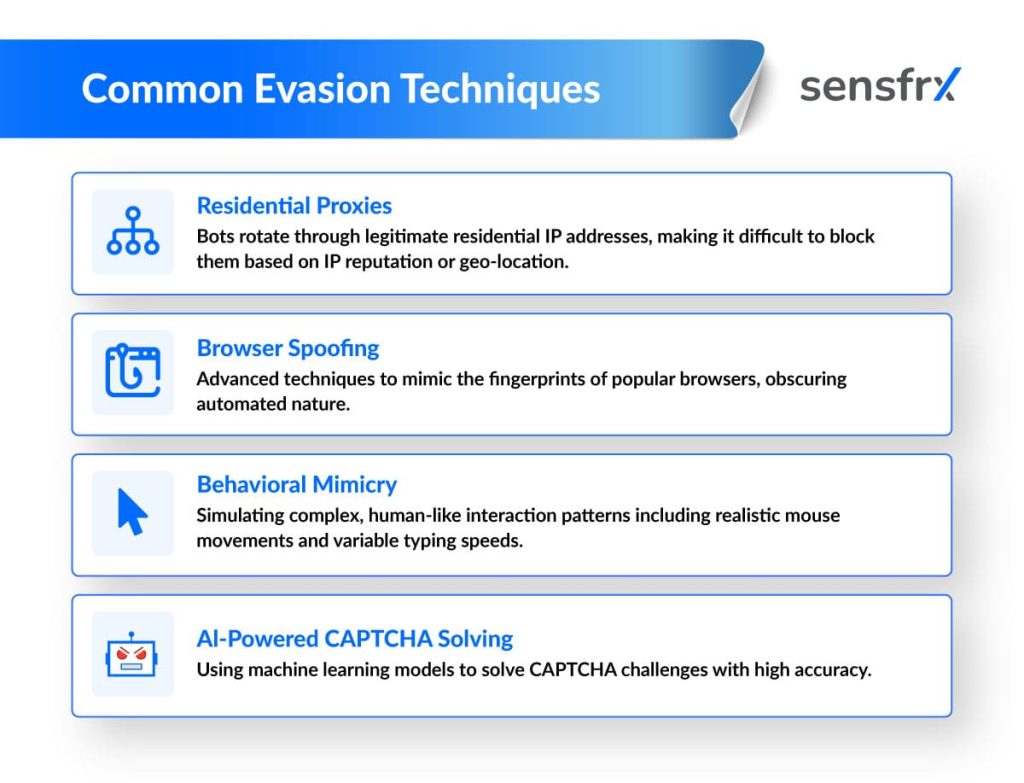
Bots are good at fast, precise, repetitive work and bad at anything unpredictable: subtle human behaviour, open-ended problems. Detection targets the weak spots.
Core detection ideas
- Behavioural analysis: how a visitor moves, clicks and scrolls. Bots jump between pages in a split second or trace mouse paths no hand would make.
- Honeypots: invisible links or form fields no person sees. A bot that fills one has identified itself.
- Challenge-response tests (CAPTCHAs): a task easy for a person and hard for a script. Basic bots fail; AI-driven solvers have cut their value against advanced ones.
- IP-address monitoring: where requests come from. A burst from one IP, or from addresses known for abuse, gets flagged or blocked.
The balance is the hard part. Checks that are too aggressive drive real users away; checks that are too lenient let bots through. Aim at what bots do badly (erratic timing, unnatural mouse movement, hidden traps, human-oriented challenges) and layer the checks so no single one carries the load.
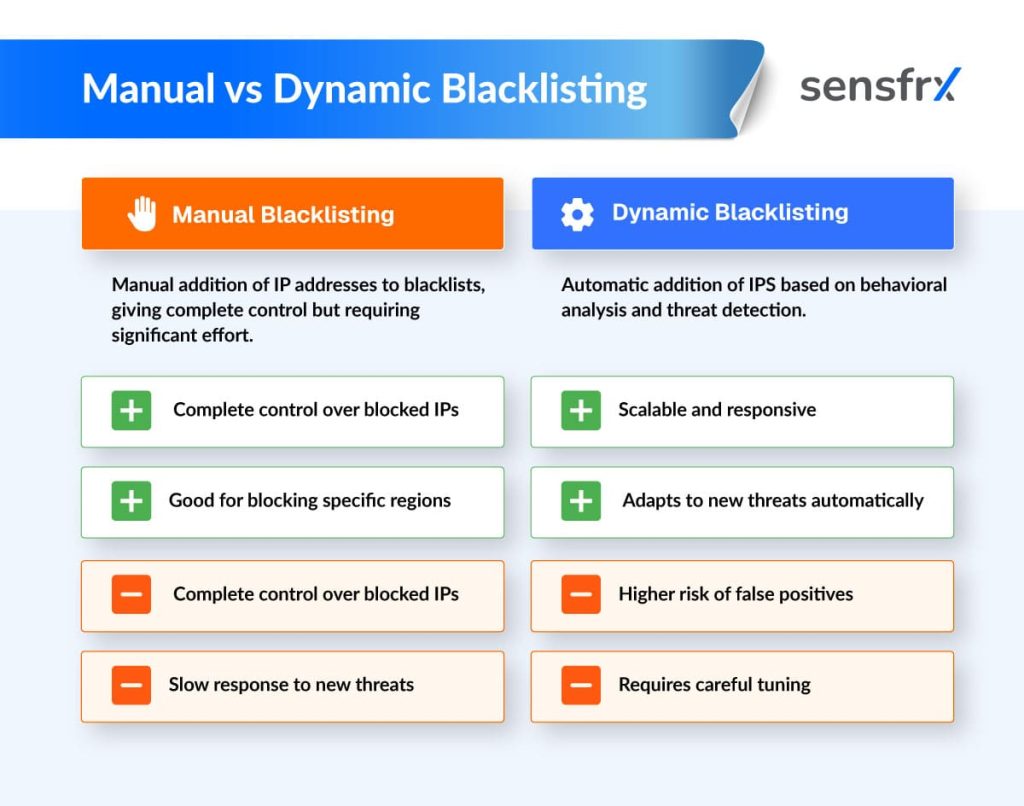
User-agent scrutiny compares browser and software metadata for inconsistencies; many bots never get the strings right.
Work published by Cloudflare and others between 2023 and 2025 describes ML models, trained on large datasets, that classify bot-like patterns with over 95% accuracy and adapt to evasion in real time. Device fingerprinting, which reads hardware, OS and session traits, holds up against VPNs and proxies. Graph neural networks (GNNs) are starting to be used to map bot networks through their linked behaviour.
Zero-trust architectures and server-side rendering challenges are the recommended counter to headless-browser bots. A 2024 SANS Institute report notes that hybrid AI bots now mimic human unpredictability, which is why the advice is a multi-layered system rather than any one technique, monitored and updated as the traffic changes.
A layered bot defence
The architecture that works is layered: network-level rate limiting and reputation filtering at the edge, behavioural analytics behind it, adaptive challenges for the doubtful cases, and containment for whatever gets through. Each layer cuts the volume the next one has to handle.
| Layer | What It Does | Typical Tools / Techniques |
|---|---|---|
| Network‑level filtering | Blocks traffic from known malicious IP ranges, bots using data‑center proxies, or abnormal request patterns. | IP reputation services, geo‑blocking, rate‑limit rules, CDN edge firewalls. |
| Behavioural analysis | Monitors how users interact with the site (mouse movement, typing cadence, navigation flow) to spot non‑human patterns. | JavaScript‑based fingerprinting, anomaly detection models, heat‑map analytics. |
| Challenge‑based verification | Presents tasks that are easy for humans but hard for automated scripts. | CAPTCHAs (image, audio, invisible), puzzle challenges, “prove you’re not a bot” JavaScript challenges. |
| Credential protection | Stops bots from brute‑forcing login or account‑creation endpoints. | Adaptive throttling, account lockout after failed attempts, password‑less login (magic links, WebAuthn). |
| Content‑level safeguards | Protects specific assets (forms, APIs) from automated abuse. | CSRF tokens, honeypot fields, signed request timestamps, API keys with usage quotas. |
1. Perimeter hardening
At the edge, rate limiting (say 100 requests per minute per IP) and IP reputation services drop known-bad sources. The filter is coarse, but it cuts the traffic that reaches the expensive layers.
2. Behavioural analysis
Modern bots imitate human interaction, so this layer uses behavioural biometrics:
- Inter-event intervals
- Cursor trajectory curvature
- Touch-screen pressure variance
Supervised classifiers such as random forests and gradient-boosted trees, trained on labelled traffic, reach precision above 0.95 with false-positive rates under 1%. Unsupervised anomaly detection (isolation forests, for example) catches the patterns no label exists for yet.
3. Challenge-response
A suspicious request gets a challenge. CAPTCHAs are still common; proof-of-work schemes (Hashcash-style puzzles) make the client spend verifiable compute instead. Scale the difficulty with the behavioural layer's confidence score so real users rarely see one.
4. Post-detection mitigation
When a bot gets past the earlier layers, runtime controls limit the damage:
- Rate-based throttling on compromised accounts
- Multi-factor authentication prompts after anomalous activity
- Automated credential rotation for high-risk services
They contain the incident and produce the forensic data the models retrain on.
What layering buys you
- Redundancy: one layer failing does not collapse the defence.
- Less friction: challenges fire only on low-confidence sessions, so real traffic barely notices.
- Continuous learning: post-detection data retrains the behavioural models against new tactics.
How Sensfrx blocks bots
Behavioural analysis instead of signatures
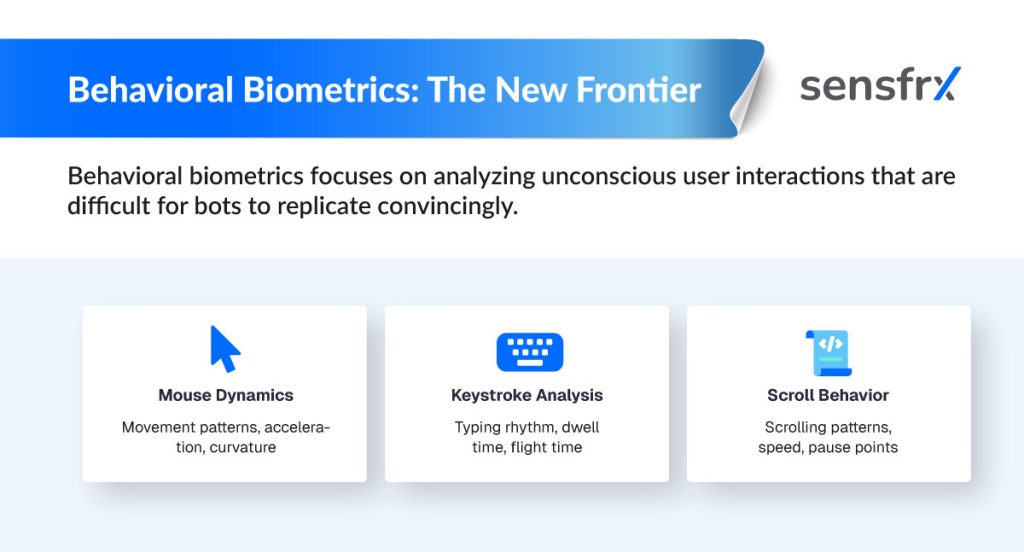
[Sensfrx](/) detects bots from behaviour rather than static rules or signatures. It builds a profile for every visitor from mouse movement, keystrokes, navigation patterns and other interaction cues bots struggle to copy.
Because it looks at how a visitor interacts rather than what they request, it catches bots built to imitate humans. Its Cognitive Engine learns from both human and bot traffic and picks out the faint patterns that separate the two.
New bot behaviour is detected and blocked as it appears, with no rule update on your side.
Fewer CAPTCHAs
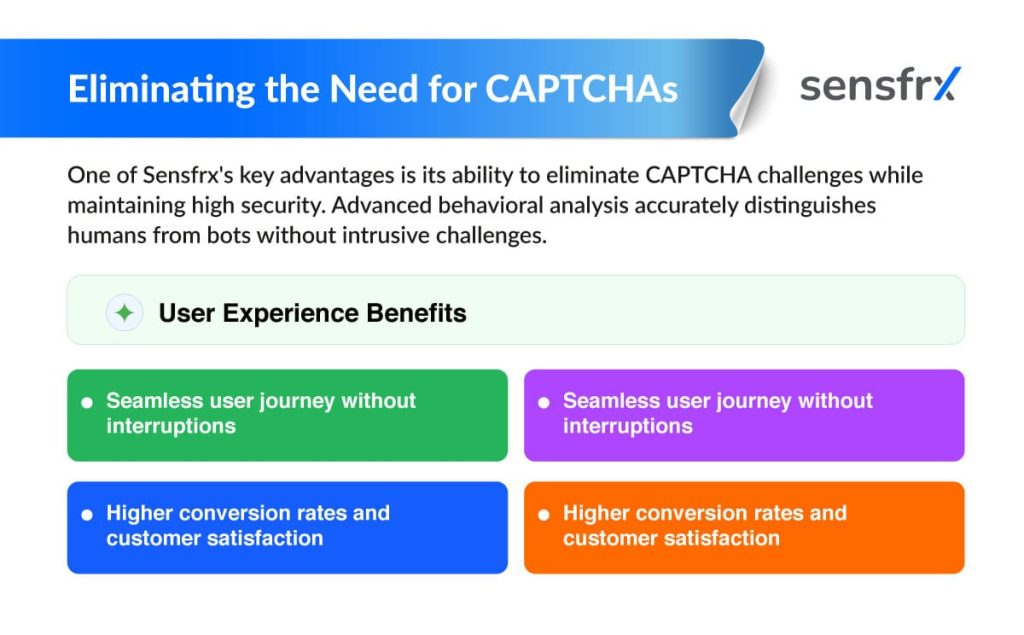
CAPTCHAs cost conversions and stop fewer bots each year. Sensfrx makes the human-or-bot call from behaviour, so most visitors never see a challenge, and the ones who do are the sessions the score could not settle.
The signals it reads are hard for a bot to fake even with AI behind it, and the usual CAPTCHA bypass services do not apply to them.
Reducing false positives with risk scoring
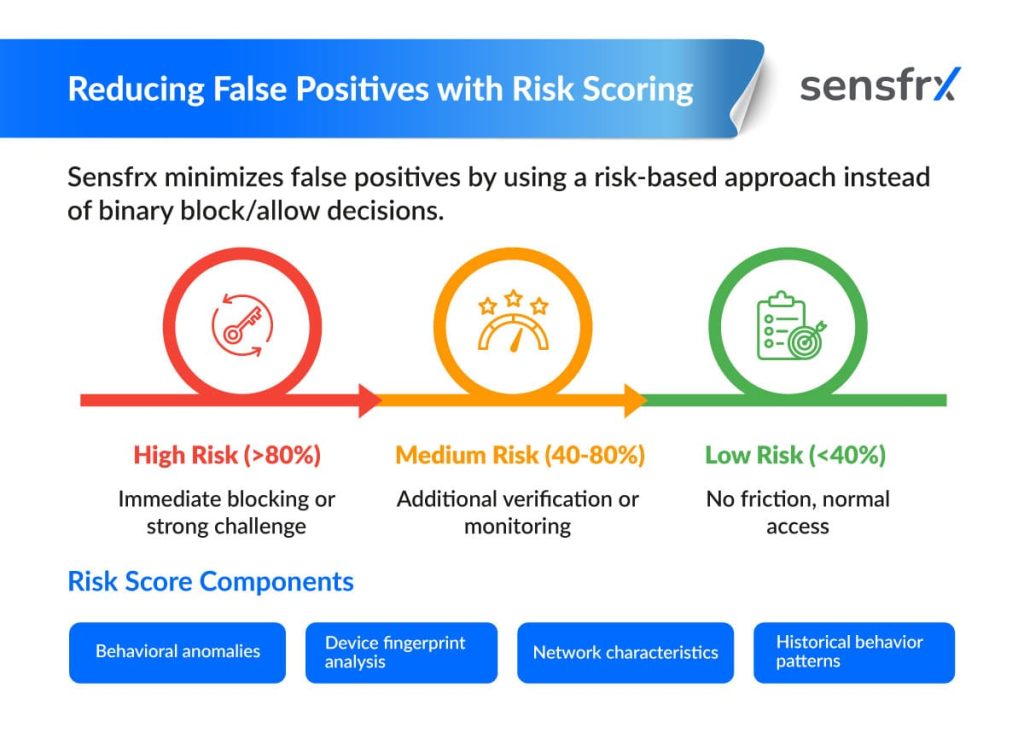
Every visitor gets a risk score from behaviour, device and network signals, and the response is tiered rather than block-or-allow:
- High risk: blocked outright.
- Medium risk: challenged, for example with a CAPTCHA.
- Low risk: through with no friction.
Fewer real customers get stopped, and that shows up in conversion.
The scoring models are retrained as traffic changes. They combine behavioural anomalies, device fingerprints and network characteristics into one score, which gives you more precise decisions than a rule set.
Common pitfalls and best practices
Three mistakes come up again and again:
- Over-blocking: aggressive filtering stops real users. Use adaptive thresholds and challenge only the doubtful sessions.
- Incomplete coverage: mobile traffic and AI-driven bots need to be in scope, not just desktop web.
- Stale defences: blacklists, models and threat intelligence need regular updates or they stop matching the traffic.
The habits that avoid them: layer the defences, watch the traffic continuously, and put progressive rate limiting and credential-stuffing protection on the login path.
Where bot detection is heading
AI-generated bots now produce realistic media, hide behind proxies and imitate human behaviour in detail. On the defence side, self-supervised learning and multimodal detection (text, behaviour and device data together) improve accuracy, shared datasets spread threat intelligence across platforms, and real-time device-level tracking tightens anomaly detection. Expect to replace parts of your stack as both sides move.
Where to start
Put rate limiting and IP reputation at the edge this week; they are cheap and cut the noise. Then add behavioural scoring on the paths bots care about (login, signup, checkout) and tier the response so only doubtful sessions get a challenge. Review what each layer caught every month and retune on it.
FAQs