Fake reviews and deepfake scams in ecommerce: How they work and how to defend
How fake reviews and deepfakes attack ecommerce: review farms, KYC bypass, contact-centre voice clones and synthetic identities, and the defence for each.
 By 11 mins readPublished Updated
On this page
Three questions now sit under every ecommerce transaction. Is the customer on the video call a person or a generated face? Was the review written by a buyer or by a model? Is the shopfront a business or a site built end to end by AI? Below: the technology behind the deception, the points where it gets in, and the layered defence that holds.
Around 95% of consumers read reviews before buying, which is why reviews are where manipulation pays. Merchants commission positive reviews, run negative campaigns against competitors and buy endorsements outright. Honest sellers lose the ranking and buyers lose the signal.
How big the problem is
Deepfakes, synthetic video, audio and images good enough to pass for a real person, are the sharp end. Ecommerce runs on the assumption that the person, the review and the shop are what they claim to be, and deepfakes break all three.
The cost and skill needed to make a believable fake have collapsed, so social engineering now runs at volume rather than one victim at a time.
Industry figures: global fraud attempts grow 21% year over year, and deepfakes now appear in 1 of every 20 failed identity verification attempts. Financial services, which has the same verification problem as ecommerce, takes 40% of those attacks. One projection has ecommerce fraud losses reaching $107 billion a year by 2029, driven by AI-enabled scams.
Global estimates
- The World Economic Forum estimates that fake reviews drive $200 billion a year in inflated ecommerce sales, up 31% from 2021.
- Fakespot's analysis of 1.2 billion Amazon reviews flagged 39% as unreliable, with electronics and fashion the worst categories.
- A Statista report puts 15 to 30% of reviews on Amazon, eBay and Walmart under suspicion of being fake.
The Taobao and Tmall ecosystem
- Taobao, founded in 2003 by Alibaba Group, hosts around 10 million active sellers and more than 900 million annual buyers. Tmall, its B2C counterpart, holds 40% of China's cross-border ecommerce.
- Against a reported 98% positive feedback rate, China's National Consumer Association logged 1.8 million complaints about Taobao and Tmall in 2024, most of them about product authenticity and review credibility.
- The "brushing" industry in China is large and priced like a service: $0.50 to $2.00 per fake review, or $30 to $80 for a package of "five stars + photo + 150 words".
How reviews are manipulated
- Review farms. Organised groups write templated reviews and recycle the text across platforms. A 2024 study found 60% of fake reviews on Taobao used near-identical phrasing.
- Stylised language and visuals. Superlatives ("life-changing product") and staged photos raise perceived authenticity by 25%.
- Influencer seeding. Brands pay Key Opinion Leaders on Douyin, Xiaohongshu and Instagram to post gifted content, often without the disclosure advertising rules require.
What it does to buyers
A natural experiment on 60,000 Taobao transactions measured it. Fake five-star reviews lift short-term sales by 15%. Post-purchase dissatisfaction rises 22%, and one-star "revenge" reviews rise 9% once buyers realise they were misled. Across markets, buyers misled by fake reviews spend $10.50 more per order on average and score their satisfaction 0.9 points lower on a 5-point scale.
How regulators and platforms have responded
- China's 2019 E-Commerce Law fines brushing up to $300,000. In 2024 the State Administration for Market Regulation issued $5.2 million in penalties against Taobao, Jingdong and Pinduoduo.
- Alibaba's "zero tolerance" programme removed 480 million suspicious reviews in 2024 using AI classifiers with 94% precision.
- The UK's Digital Markets, Competition and Consumers Act (2024) allows fines of up to 10% of global turnover for review fraud; the EU's Digital Services Act (2024) carries similar penalties.
- Amazon's transparency programme flags incentivised reviews and cuts their visibility by 30%.
What counts as a fake review
A fake review is a misleading endorsement or a defamatory comment posted to shift consumer perception for commercial gain. It may be invented outright, unverifiable, or about a different product. Either way it corrupts the feedback honest buyers rely on.
The common mechanism is a payment: a cash rebate of $0.50 to $2.00 per review, or a gift voucher for a five-star rating, whatever the buyer's experience. In China this is called brushing. It inflates the merchant's reputation, buries negative feedback and poisons the platform's own opinion-mining systems.
Where fake reviews shape the purchase
A purchase runs through four stages: recognising a need, comparing options, deciding, and living with the result. Fake reviews work on each one.
Recognising a need
Buyers use reviews to judge whether a product is worth wanting. Exaggerated praise and staged photos manufacture that judgment, so manipulated products get wanted first.
The Taobao findings above, 60% near-identical phrasing and a 25% lift in perceived authenticity, show how cheap that manufacturing is. Influencer "fan effects" on Instagram and Xiaohongshu do the same job when sponsored posts go undisclosed.
Comparing options
When choosing between sellers, buyers favour high credit scores and large review counts as proxies for trust. Fake reviews inflate both.
Recommendation algorithms compound it by ranking high-review-count items first, which pushes manipulated products in front of time-poor buyers who then confirm the ranking by purchasing.
Deciding
Fake reviews shorten the decision by supplying detailed, plausible information: product descriptions, staged photos. Less time deciding, more wrong decisions.
The same Taobao experiment put numbers on it: 15% more sales, 22% more dissatisfaction, 9% more revenge reviews, and $10.50 more spent per order for a lower satisfaction score.
Living with the result
Fake reviews buy the first sale, not the second. Once the product fails to match the praise, the fan effect fades, trust goes, and the dissatisfied buyers leave the feedback that cancels the boost. Sellers who depend on fake reviews lose share to the ones who did not need them.
Where deepfakes get in: Three weak points on the customer path
Deepfakes hit three points between a customer's first signup and their last support call: onboarding, the contact centre, and the mobile login.
Onboarding: KYC and video verification
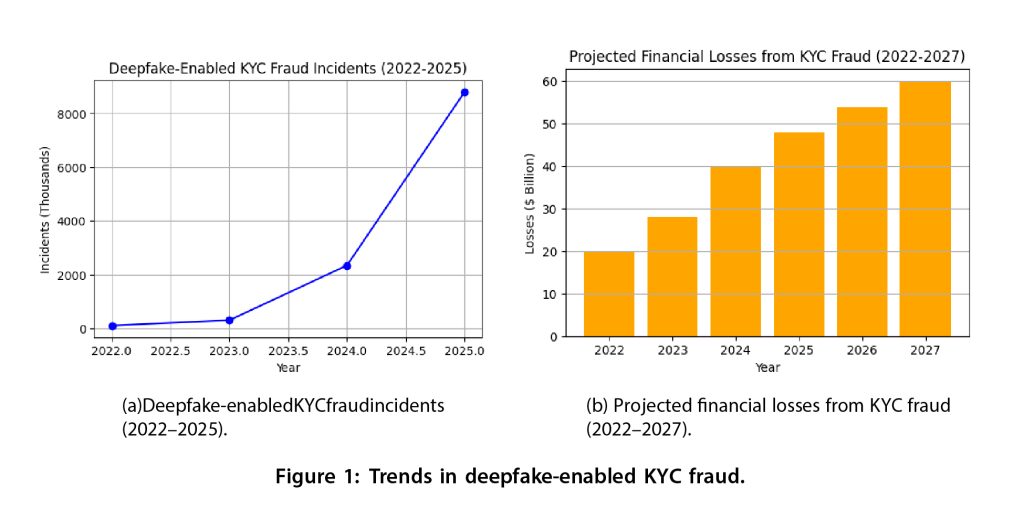
Digital onboarding, above all for financial services and regulated ecommerce, is the main target. KYC processes built on video verification can be passed by synthetic identities with generated faces. Tools such as Deepfakes Web and Faceswapper.ai get past facial recognition and basic liveness checks, and the resulting accounts are used for money laundering or fraudulent loans.
One estimate puts deepfake-enabled KYC fraud at $40 billion for global institutions, with $60 billion projected by 2027. Real-time deepfakes, or "live fakes", make it worse: software alters face and voice during a live call, so the fraudster can answer verification prompts on the fly and defeat photo-to-selfie comparison. One study reported that 0.1% of people can detect a deepfake in real time, and that a deepfake attempt occurs every five minutes worldwide.
The contact centre
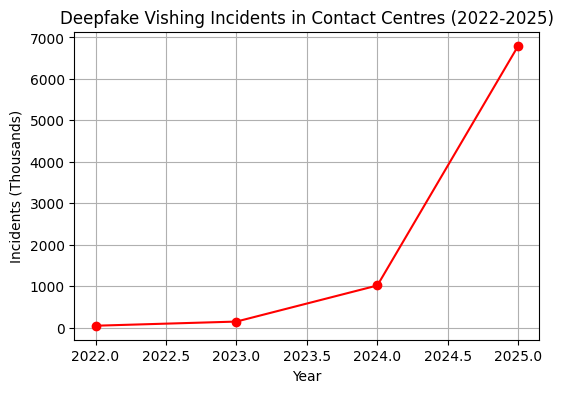
Agents now face deepfake vishing: fraudsters clone a customer's voice from a few seconds of social media audio and call in to push through a fraudulent return, change account details or drain loyalty points. In 2024, deepfake activity in contact centres rose 680% year over year and synthetic voice fraud in insurance rose 475%. Around 1 in 127 calls to a retail contact centre is fraudulent.
The same technique targets staff from the top. In 2024 a Hong Kong firm lost $25.6 million after a fake video call impersonating its CFO instructed the transfers.
Mobile: Getting past biometrics
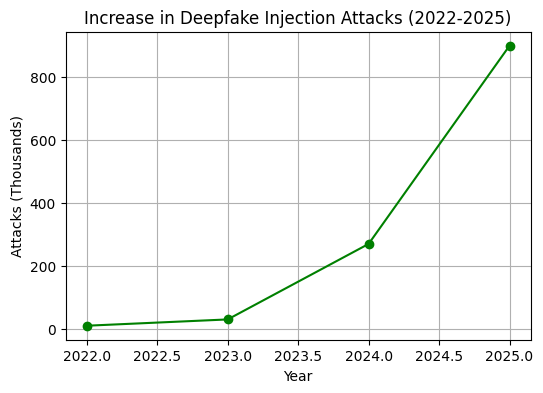
Face ID and voice authentication can be fooled with generated video and cloned audio. Injection attacks, which grew 9 times in 2024, skip the camera and microphone and feed synthetic media straight into the authentication flow, so liveness detection never sees a real sensor. With 187.5 million mobile shoppers in the US in 2024, half of ecommerce sales, that is a large surface.
The trust tax: What deepfake fraud costs
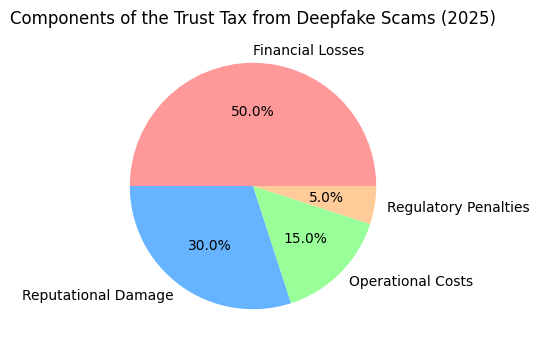
Deepfake attacks levy a "trust tax" on ecommerce in four currencies.
- Direct loss. Single vishing incidents have cost more than $1 million; the 2024 Hong Kong case cost $25.6 million. Some firms report mobile commerce losses of $10,000 an hour. Total deepfake fraud losses are projected to reach $40 billion by 2027.
- Reputation. Breaches cause churn and lost revenue. In one survey, 85% of finance professionals called deepfake scams an "existential" threat to brand integrity.
- Operating cost. AI detection, staff training and manual review all add overhead. KYC onboarding costs are up 20% because of the extra security.
- Regulatory risk. KYC and AML failures bring penalties. In 2024, European financial firms were fined $5.2 million for breaches linked to the dark web.
Recommendations
- Harden KYC. Combine biometrics with behavioural analysis and real-time deepfake detection; no single factor survives a live fake.
- Train staff. Teach contact-centre agents what a cloned voice sounds like, and give them hard verification steps such as executive passcodes that a voice cannot supply.
- Buy detection. Tools such as Reality Defender and Cyble detect deepfakes in real time.
- Work with regulators. Current AML frameworks predate generative AI; push for guidance that names deepfakes.
Anatomy of deepfake scams: Three categories and their defences
Deepfake scams fall into three categories, impersonation, synthetic content and identity fraud, and each needs a different countermeasure.
1. Impersonation and social engineering
Impersonation scams mimic someone the victim trusts and let human psychology do the rest.
- Customer impersonation. Voice clones or deepfake video, often backed by breached data, let fraudsters pose as real customers to the contact centre and push through fraudulent returns, redirected refunds, address changes or loyalty point theft. In 2024 these scams were 32% of contact-centre fraud and cost retailers $1.5 billion worldwide.
- Executive impersonation (CEO fraud). A cloned voice or a deepfake video call from "the CFO" pressures an employee into an urgent wire transfer. A UK company lost $30 million to one such call. CEO fraud incidents rose 420% from 2023 to 2024.
- Vishing and family-emergency scams. Voice samples from social media become a cloned relative in distress asking for money. These scams rose 520% in 2024, with older consumers the main target.
2. Synthetic content and digital forgery
Synthetic content scams fake the shop and the social proof before the buyer has spent anything.
- AI-generated storefronts and catalogues. Generative AI produces complete fake stores with photorealistic product images, convincing copy and even virtual try-on tools. Such sites cost consumers $2.8 billion in 2024.
- Deepfake testimonials and AI-written reviews. Large language models write the reviews and deepfake video supplies the testimonials. In 2024, 42% of online reviews were judged unreliable. "Review-for-refund" networks scale it further.
3. Identity and application fraud
Identity fraud uses deepfakes to build synthetic people who pass the checks.
- Synthetic identities for new-account fraud. Stolen data plus invented details plus a deepfake video for the biometric step produces an account that passes KYC and is then used for money laundering or fraudulent loans. Losses are projected at $18 billion by 2027; in 2024, 28% of new-account fraud involved synthetic identities.
Typology of deepfake scams and defences
The table maps each tactic to its mechanics, target, impact and defence.
| Category | Tactic | Mechanics | Target | Impact | Defences |
|---|---|---|---|---|---|
| Impersonation | Customer impersonation | Voice cloning, deepfake video | Contact centre | Return fraud, takeover | MFA, detection tools |
| Impersonation | Executive fraud | Voice cloning, video calls | Finance | Large-scale loss | Executive passcodes, training |
| Impersonation | Vishing/family | Voice cloning (TTS) | Staff | Extortion | Voice anomaly detection |
| Synthetic | AI storefronts | AI image + LLMs | Customers | Payment fraud | URL reputation, site checks |
| Synthetic | AI reviews | LLMs, deepfake media | Customers | Trust erosion | Authenticity algorithms |
| Identity fraud | New-account fraud | Deepfake video, synthetic IDs | KYC systems | Money laundering | Multi-modal biometrics |
Regulatory measures
Review fraud is now a regulated offence in the main markets. China's Anti-Unfair Competition Law (2017) fines misleading commercial practices $30,000 to $300,000, and in 2024 the State Administration for Market Regulation levied $5.2 million against Taobao, Jingdong and others. The UK's Digital Markets, Competition and Consumers Act (2024) allows fines up to 10% of global turnover; the EU's Digital Services Act (2024) is similar. The platforms moderate with AI as well, Alibaba's 480 million removals in 2024 at 94% precision being the largest programme.
Where to start
Review farms, synthetic identities and fake storefronts have one thing in common: each one needs accounts, and accounts are created at a signup you control. Score every signup from device, network and behaviour signals and block the farm's tenth account from the same device before it can post a review or pass a loan application. Fake registration prevention is the place to begin; deepfake detection on the video step comes after.
Sources
- World Economic Forum, "The trillion-dollar cost of fake reviews," WEF White Paper Series, 2023.
- Fakespot, "2024 global review analysis report," Fakespot Research Publications, 2024.
- Statista, "E-commerce worldwide: statistics and facts," Statista Reports, 2024.
- Alibaba Group, "Annual report FY2024," Alibaba Group Corporate Publications, 2024.
- Marketing China, "Taobao and Tmall statistics and key trends: a look into China's e-commerce powerhouse," Marketing China Reports, 2023.