Fraud prevention in remote work environments
The fraud risks that come with remote teams, from ghost employees and time theft to phishing and card misuse, and the controls that keep them in check.
 By 6 mins readPublished Updated
On this page
A remote team runs on personal laptops, home routers, public Wi-Fi and messages from colleagues nobody has met in person. That is also the setup fraud needs: a ghost employee on payroll, a padded timesheet, a message from the "CEO" asking for an urgent transfer.
The outside pressure has risen too. Accenture reports that 97 percent of organizations have seen more cyber threats since the 2022 start of the Russia-Ukraine war, and phishing, ransomware and credential theft land harder on a workforce outside the office network.
The controls are not exotic. Most of what follows is access hygiene, reconciliation and a reporting channel people trust.
Why remote work raises fraud risk
Five things change when the office empties out.
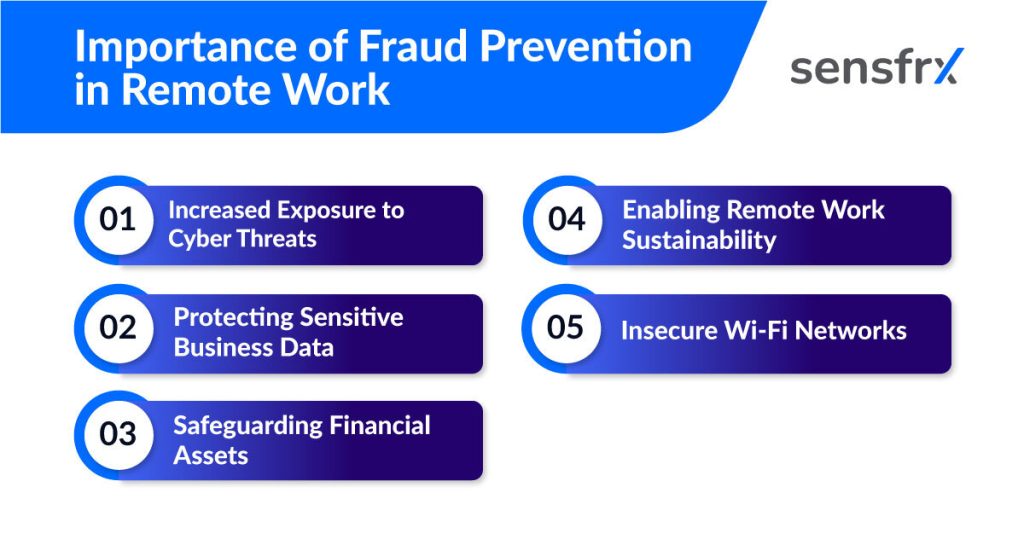
- More exposure to attack. Personal devices and unsecured networks make remote staff easier targets, and phishing, ransomware and credential theft are more common in remote setups.
- Business data in more places. Staff pull company data from homes, cafes and co-working spaces, and every location is another place to lose it.
- Money on the line. Scams built for remote workflows, fake invoices and account takeovers among them, turn into direct losses.
- Remote work is permanent. It is not going away, so the security has to be sustainable rather than an emergency measure.
- Insecure Wi-Fi. Public networks are less secure, and staff who move between locations end up on them.
Five types of fraud in remote teams
Fraud in a remote setup falls into five groups.
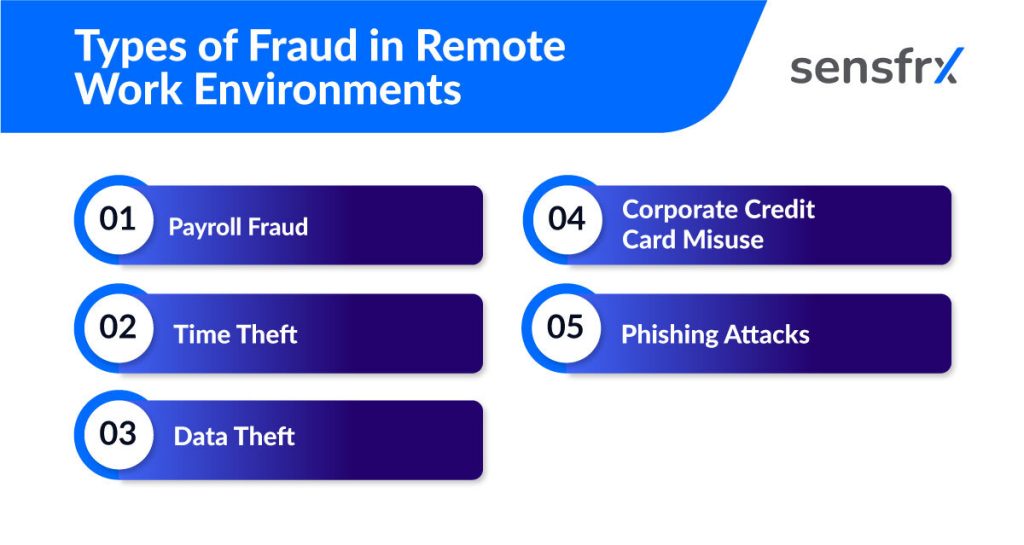
- Payroll fraud: ghost employees added to the payroll so someone can collect their salary, or real salaries changed without approval to divert the extra.
- Time theft: timesheets and tracking systems altered to show hours that were not worked.
- Data theft: systems broken into, or sensitive information taken by someone who had access and no permission.
- Corporate card misuse: personal spending on the company card, claimed as work.
- Phishing: fake emails or messages from someone posing as a senior manager or a known contact, built to get a remote employee to hand over data or credentials.
The fraud triangle
Criminologist Donald R. Cressey's "fraud triangle" says workplace fraud needs three things at once: pressure (a reason), opportunity (a way) and rationalization (an excuse). Take away any one of them and most fraud does not happen.
Source: https://www.embroker.com/blog/fraud-triangle/
What pushes people toward fraud
Pressure usually looks like one of these:
- Financial stress: debt, medical bills, personal expenses.
- Job dissatisfaction: feeling undervalued or treated unfairly.
- Greed or pressure to succeed: wanting money, status or results faster than the job delivers.
Under that pressure, a weakness in the system starts to look like a solution.
The shape of the fraud follows the industry. Construction, for example, sees:
- Billing schemes: overcharging for materials or services, or invoicing for materials that were never delivered.
- Bid rigging: competitors agreeing in private who wins a project and shaping their bids to match.
- Material theft: tools, equipment and supplies leaving the site, or company fuel ending up in personal vehicles.
Each one raises costs and eats the trust the business runs on.
Controls that work for remote teams
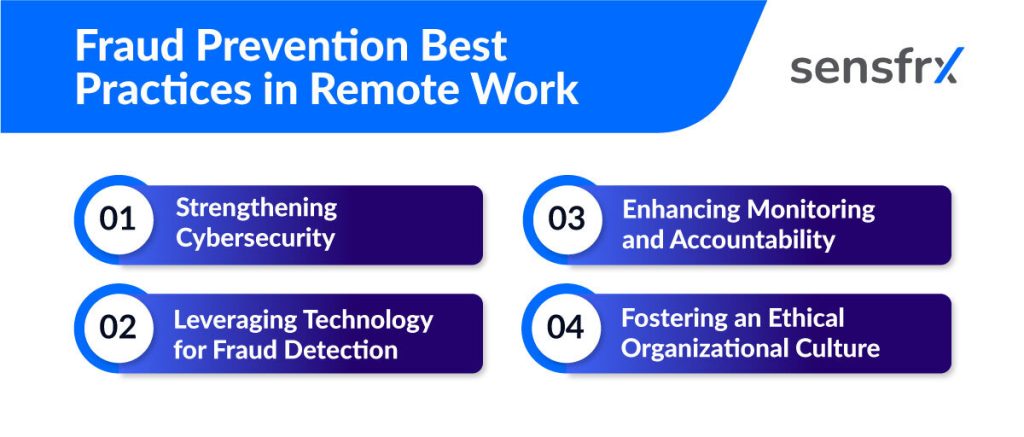
Tighten access
- Write down what staff can and cannot do with company devices and data from home, and tell them.
- Put multi-factor authentication and role-based access on every sensitive system, so a stolen password alone opens nothing.
- Require strong, unique passwords; a password manager makes that realistic.
- Give people a clear, quick way to report suspicious activity or an incident.
- Audit the fraud prevention policy on a schedule and review access with it. When someone changes role or leaves, the old permissions go the same day.
Use tooling that watches in real time
Several classes of tool catch fraud as it happens:
- SIEM tools: security information and event management systems collect logs across the estate, spot unusual activity and alert the IT team at once.
- Endpoint detection and response (EDR): also called endpoint detection and threat response (EDTR), it watches user devices for ransomware, malware and other threats and responds on the device.
- Analytics tools: SAS Analytics, Power BI or Tableau run over expense and card data and flag the personal purchases, such as a sudden rise in entertainment spend on one card.
Reconcile hours, records and payroll
- Time tracking: tools such as Toggl Track or Hubstaff show when logged hours do not match the work done.
- Data audits: review financial and operational records on a schedule to surface errors and fraud early.
- Payroll reviews: match the payroll run against the list of active employees; ghost employees show up as names nobody manages.
Build a culture that reports
Train people on fraud awareness and on how to report it. Regular sessions teach them to recognize phishing, ransomware and the other scams aimed at them, and phishing simulations show you who still clicks and where the gaps are.
Set clear expectations for conduct: how sensitive data is handled, how company resources are used, what counts as a conflict of interest. People who know the rules and the consequences are harder to talk into bending them, and have less room to claim they did not know.
Leaders model it. When decisions are transparent and concerns get answered in the open, staff follow the example without anyone looking over their shoulder.
What leadership has to do
- Own the risk. Leaders are accountable for fraud risk: stay alert to the signs and act on them fast.
- Audit on a schedule. Frequent checks of records and processes catch mistakes and fraud early, and it is leadership's job to make sure they happen.
- Keep talking about it. Open, regular communication about fraud keeps the topic in people's minds.
- Give people a safe way to speak. Anonymous hotlines or online forms let staff report concerns without fear.
Where to start
Start with the connections: a VPN for anything internal, and firewalls and endpoint protection on every device that touches company data.
Then the people: train them to spot phishing and malware, and make reporting easy.
Sensfrx covers the point where remote fraud meets your own customers. It scores every signup, login and payment from device, network and behaviour signals, and your rules allow, review or block each one. Start on the free plan or a 14-day free trial.