Preventing account takeovers with AI: How it works
How AI and machine learning score each login on behaviour, device and network signals to stop account takeover, and what the next ATO attacks will look like.
 By 6 mins readPublished Updated
On this page
Account takeover (ATO) is the use of stolen or guessed credentials to get into someone else's online account. It is one of the most common and most expensive forms of online fraud, and the attack surface keeps growing: more accounts, more saved cards, more password reuse. The fix is to judge every login on more than the password, and that is the job AI and machine learning do well.
What is account takeover?
Account takeover is identity fraud against an existing account. The attacker gets the username and password from a website breach or from malware, then runs automated login tools that try the pair against other popular sites and apps. That is credential stuffing, and because people reuse passwords, a share of the pairs work. Each working pair is an account the attacker can now spend from.
The credentials come from four places:
- Phishing sites that trick users into typing their login
- Keylogging malware that records what is typed on the device
- Brute-force tools that guess password combinations
- Social engineering that talks the user into handing them over
The targets are accounts that hold something worth taking: financial data, purchase history, loyalty rewards or personal information that opens the next account.
The accounts that get hit most:
- Email accounts, because they receive the password resets for everything else
- Retail accounts with saved payment cards
- Bank accounts and digital wallets
- Social media profiles
The impact of account takeover
A successful takeover costs money and privacy at once. With the account open, the attacker can:
- Buy goods on the stored payment cards, again and again until the card is stopped
- Transfer money out of the victim's account
- Read sensitive email and use it for the next attack
- Steal personal information for identity fraud
- Read or delete private data such as photos, videos and records
For the victim, the aftermath is weeks of work: regaining the account, resetting the email that was used to hijack it, checking for identity fraud and reversing the fraudulent payments.
Addressing the account takeover threat with AI/ML
AI-based identity and access management collects risk signals for every user and every authentication event: behaviour patterns, location, time of day, device, browser and operating system. From those it builds a baseline of how the real user signs in, and it judges each new login against that baseline.
The analytics engine reads all the signals at once and produces one risk score per access event.
Scores fall into low, medium and high bands, and you decide what each band triggers: allow, step-up verification or block, according to your own security policy.
How AI helps defend against account takeover
ATO attacks are automated and adaptive, and the defence has to be too. Four capabilities carry most of the weight.
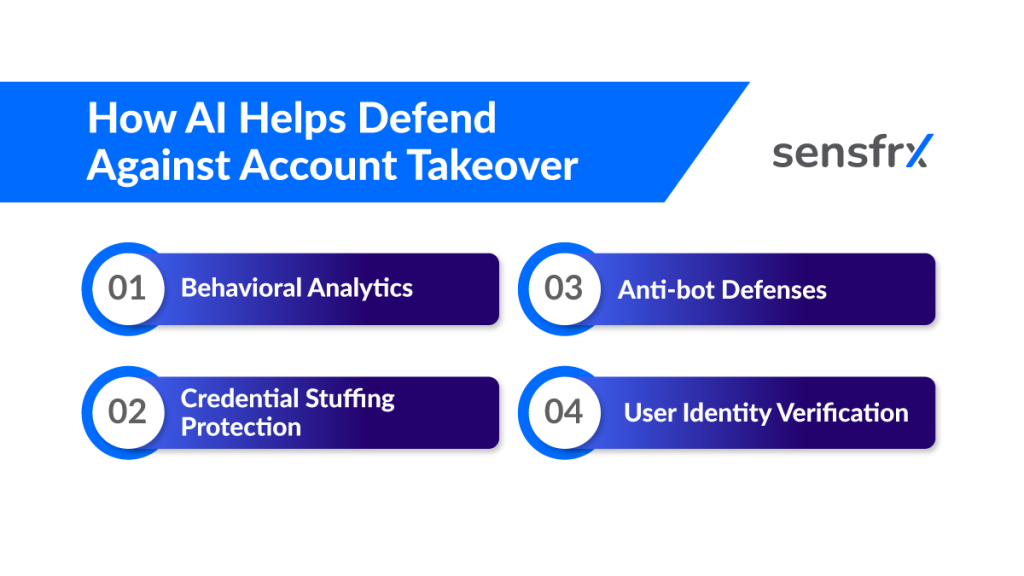
- Behavioral analytics. The model learns each user's normal access pattern and flags what departs from it: a login from an unfamiliar country, an unknown device, a time of day the user has never been seen.
- Credential stuffing protection. Models trained on large histories of stuffing traffic recognise the rhythm of bots trying credentials and flag it on the first attempts rather than the thousandth.
- Anti-bot defences. Mouse movement, micro-interactions with the page and other signals separate a person from a script. Real logins pass; automated ones are blocked.
- User identity verification. When a login scores as suspicious, the system asks for more proof, such as a visual puzzle or another factor, so the real owner gets in and the attacker does not.
Adoption of zero trust security frameworks
Zero Trust changes the default. Its rule is "never trust, always verify": every access request is checked the same way whether it comes from inside the network or outside it. That removes the implicit trust tied to network location or device ownership, which is the trust stolen credentials rely on.
Under Zero Trust every user and device is authenticated and verified before it reaches a resource, so a misused credential or a hijacked device gets no further than the first check.
Case studies: AI/ML in account takeover prevention
Two deployments show what the approach looks like in practice.
A Fortune 500 company. A multinational facing a wave of ATO attempts across a large customer base trained an AI system on millions of data points to spot patterns and anomalies. It picked up threats in real time and stopped them before any material damage was done.
Behavioural analytics at a bank. A large bank under ATO attack ran a prevention system that acted as an early warning, which held down the number of attacks that got through and protected customers' money and personal data.
How Sensfrx prevents account takeover attempts
Sensfrx layers six checks on every login:
- Login monitoring. Login attempts, usernames, device details, IP addresses and related signals are tracked to flag suspicious attempts.
- Risk analysis engine. Past login history, usual devices and usual locations feed a model that scores each attempt. A high score triggers action at once: a login from an unknown location at 3 AM gets a verification step before it proceeds.
- Precision fingerprinting. Browser type, operating system, fonts, plugins, screen resolution and more combine into an accurate fingerprint for each device that touches an account, which identifies a device more reliably than older methods.
- IP profiling. AI builds profiles of IP addresses and geolocations and flags logins from new or unknown IPs.
- Bot activity detection. Mouse movements, keystrokes and network activity are compared with human patterns, and login attempts from bots are blocked.
- Real-time protection. Behavioural, device and connection data are analysed as the login happens, so anomalies are caught before the session is granted.
The future of account takeover attacks
As AI defences spread, attackers adapt their takeover techniques to get around them. Expect:
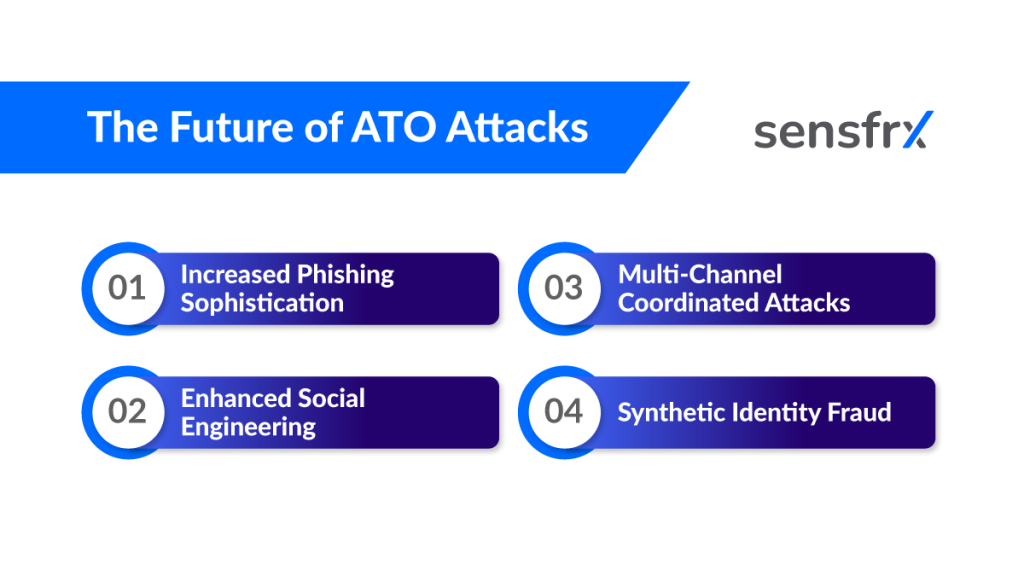
- Sharper phishing. Personalised, well-researched lures that get users to hand over credentials without tripping the usual phishing warnings.
- Better social engineering. Breach data and social media give criminals enough detail to pass as real contacts.
- Coordinated multi-channel attacks. Phishing, smishing and vishing run together against one victim, wearing down their guard across channels.
- Synthetic identity fraud. Enough stolen data to fabricate digital identities, which means more accounts opened for later takeover.
Where to start
Criminals adapt, and so does the defence: more data, new detection patterns and models that learn from each case. Put a risk score in front of every login, step up verification when the score is high, and stop letting the password be the only thing between an attacker and the account.
Sensfrx does this for signups, logins and payments, with your rules deciding what to allow, review or block. Create a free account and put it in front of your login.