Account takeover detection: Best practices for 2026
How account takeover attacks unfold, six signs that show up in your login data, and detection practices (device baselines, IP checks, ML) that catch them.
 By 13 mins readPublished Updated
On this page
Account takeover (ATO) starts with a stolen password and ends with a drained balance, a hijacked inbox or a wave of phishing sent from a trusted address. The credentials come from data breaches, phishing and credential stuffing; the damage lands on the business that let the login through.
An attacker gets in through phishing, credential stuffing or a vulnerability in the application. Once inside they can buy with saved cards, move money, pull data or use the account to attack others.
What an account takeover attack is
In an ATO attack someone who is not the account owner logs in as them and can do everything the owner can: make purchases, read and export data, change the recovery email, or use the account as a springboard into other systems.
Why ATO matters
ATO hurts three parties at once: the user whose account it was, the business that approved the login, and everyone the account is then used against.
Why ATO keeps growing
Three things drive it:
- More accounts per person. Every new online service is another login to steal.
- Cheap stolen credentials. Years of breaches have left a vast supply of username and password pairs on the dark web, and credential stuffing runs on them.
- Better tooling. Phishing kits and social engineering now use AI to write and target lures, so the attempts are harder to tell from real traffic.
How an ATO attack unfolds
The four stages
Most ATO attacks follow the same path: reconnaissance, finding an entry point, taking the account, and cashing out.
- Reconnaissance. The attacker collects email addresses, password hints and personal details from public sources, or plants a keylogger or malware to capture credentials directly.
- Entry point. With enough information they look for the weak spot: a password reused across sites, a guessable security question, or a phishing email that looks enough like the real service to harvest a login.
- Takeover and fraud. Once in, they often change the password and recovery details to lock the owner out, then spend from saved payment methods or move funds.
Defences that work
The basics, for users and for the teams that support them:
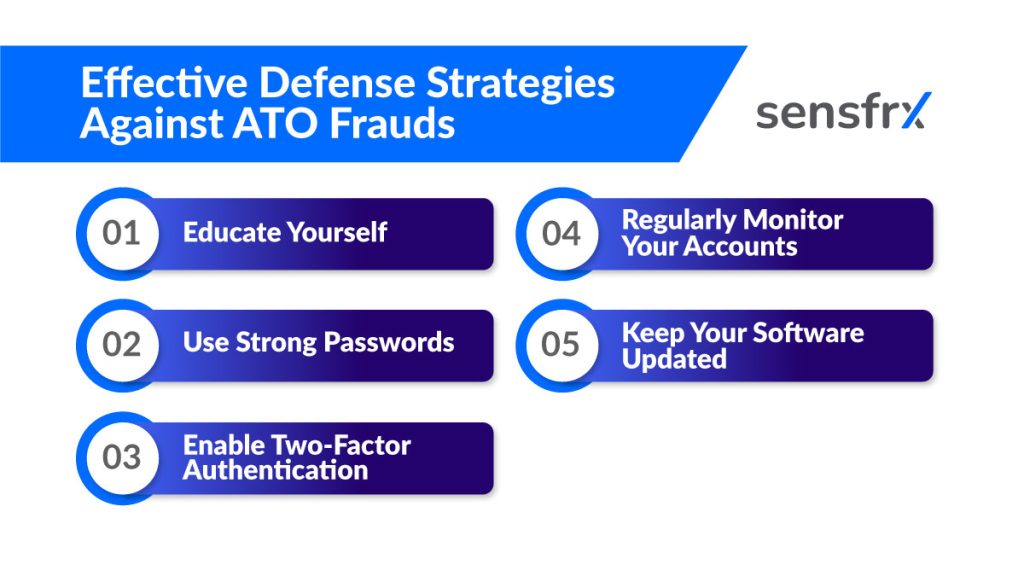
- Know the current scams. People who recognise a phishing lure do not click it.
- Unique, strong passwords. No patterns, no personal information, nothing reused from another site.
- Two-factor authentication. A second factor turns a stolen password into a failed login.
- Watch the account. Unknown transactions or changed login details mean: change the password now and report it to the platform or bank.
- Patch. Updated devices and software close the holes attackers use to plant malware.
How account takeover fraud happens
From stolen credential to cash-out
ATO is a pipeline, and each stage leaves its own signals:
- Compromising credentials. Phishing emails, malware and social engineering get the login out of the user. This is the most common starting point.
- Testing validity. Bots run the stolen pairs against many sites. A pair that works is used or sold.
- Using or selling them. With a working login the attacker might:
- Buy with saved payment methods
- Move money out of bank accounts or crypto wallets
- Send phishing from the trusted account, which gets far better click rates
- Climbing to higher-value accounts. An email account is the prize, because password resets for everything else flow through it. One compromised inbox cascades into many accounts, including:
- Corporate accounts with access to business data
- Financial accounts holding real money
- Social media accounts of public figures, for reputational damage or further fraud
What attackers do with a compromised account
- Phishing from inside. Messages sent from a real customer's account carry its trust, and the links lead to a lookalike login page that harvests the next set of credentials.
- Credential stuffing. Password reuse means one breach opens many doors. The attacker replays the same email and password across sites with similar logins and keeps whatever works.
How the attacks work in practice
Four techniques account for most account takeovers: phishing, malware, credential stuffing and application vulnerabilities. Businesses and individuals lose millions of dollars a year to them.
The four techniques
- Phishing. A fake email or site that mimics a real one and asks the user to log in or enter card details. Care with links and attachments from unknown senders, and a glance at the address bar before typing a password, stop most of it.
- Malware. Software delivered through an infected download or attachment that captures credentials on the device and sends them to the attacker. Current antivirus and care with downloads are the counter.
- Credential stuffing.** Stolen username and password pairs from one breach, replayed against other sites. Millions of pairs sell cheaply on the dark web. Multi-factor authentication, biometric or one-time password (OTP), breaks the replay.
- Application vulnerabilities. Outdated software, weak authentication or poor coding that lets an attacker in without any credentials. Regular updates and security audits close these.
Why ATO is hard to detect
Attackers change tactics faster than rules change, and they hide inside normal-looking behaviour.
- Tactics move. Rule-based detection written for last quarter's pattern misses this quarter's. Credential stuffing in particular looks like a normal login because it is one, with the right password.
- Automation that imitates humans. Purpose-built tools randomise timing, device and location so the traffic passes manual review and basic filters.
- Hidden in plain sight. A fraudster logging in from several devices and locations looks like a busy real user. Basic systems cannot separate the two.
- Detection versus friction. Larger orders, new devices and unfamiliar locations are all signals, but hard rules on them alone block real customers too. Too many false positives cost revenue and goodwill.
Signs of account takeover fraud
Indicators of ATO fraud
Three things change when an account is taken over: the login pattern, the activity inside the account, and the customer details. Your systems need to catch all three signals in real time.
- Logins from new devices or places. Attackers rotate devices and IP addresses to hide; the result is a login that does not match the owner's history.
- Several password change requests in a short window. Either an attacker is cycling through guesses or has just got in and is locking the owner out. The same pattern across many accounts points to a campaign.
- Bursts of failed logins. A brute-force or stuffing run leaves a trail of failures before the one success.
- Many IP addresses or geolocations in a short time. Proxies make one attacker look like logins from around the world.
- Changed customer details. A new email address or phone number on the account, with no prior notice, is the attacker rerouting notifications. Alert on it the moment it happens.
- Many accounts from one device. Dozens of accounts touched by a single device or IP address is a botnet, not a customer.
Continuous monitoring
Continuous monitoring means logging every login attempt, transaction and account change as it happens and analysing the stream for patterns that do not fit.
- It catches the repeat offender: several login attempts from different IP addresses, or buying patterns the account has never shown, stand out within minutes rather than at month end.
Real-time fraud detection
Real-time detection adds machine learning to the stream, scoring each login and transaction as it arrives so the risky ones can be stopped before they complete.
- A compromised account is flagged at the first odd event, and the business can suspend it or route it to review before any money moves.
What account takeover costs
ATO is identity theft at account level, and the bill comes in three parts: money, trust and overhead.
Financial losses
The attacker spends from saved payment methods or moves money out directly. The longer the takeover goes unnoticed, the larger the amount.
The business then refunds the customer and eats the chargebacks, and some customers stop using the account or the site altogether.
Loss of user trust
A hacked account tells the customer the company could not protect their data, and that reputation spreads.
Victims hesitate to share information with the company again, and as the story travels through social media, prospective customers decide not to sign up or buy.
The hidden costs
On top of the direct losses: identity verification tools, fraud detection systems and security staff to manage the threat, plus the time spent investigating cases, issuing refunds and restoring accounts.
How to detect account takeover fraud
Seven detection practices that work together:
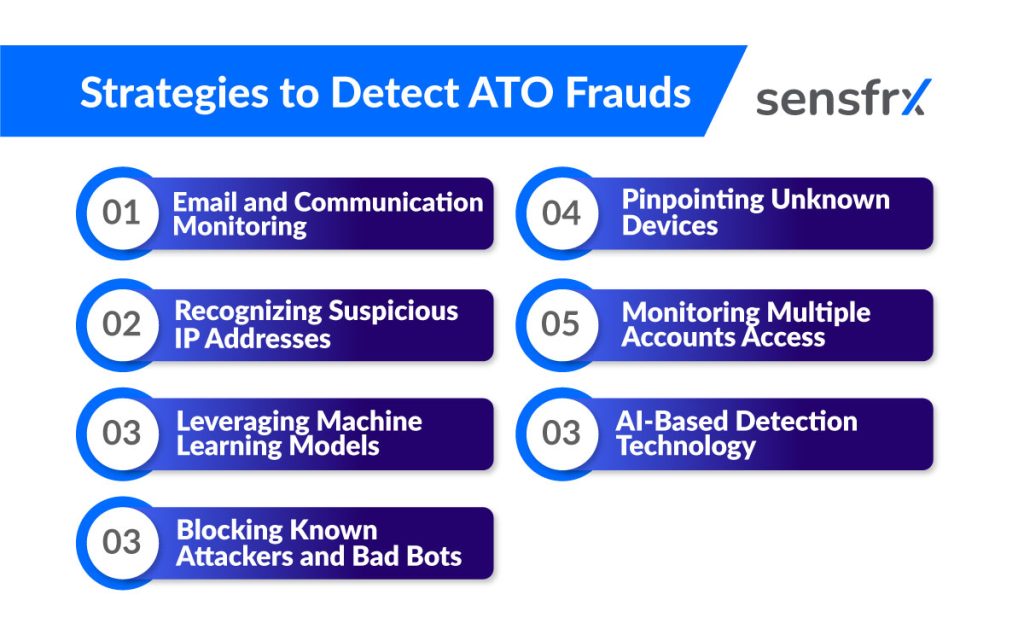
Email and communication monitoring
Many takeovers start in the inbox. Attackers read a victim's email or messages for details that open an account, or use the channel for phishing, social engineering and malware. Watch it.
Phishing messages copy a real company's logos and tone and ask for a login or card details.
Social engineering skips the technology: the attacker poses as customer support or as someone the victim knows, and talks them into handing the information over.
Recognising suspicious IP addresses
An IP address says where, and roughly who, a login is coming from. Monitoring the addresses behind login attempts shows the patterns of an attempted takeover.
Start with a baseline per account: the usual devices, locations, times of day and other login details. Anything outside it should raise the risk score and trigger a closer look.
Machine learning models
Machine learning finds the anomalies in large volumes of login and transaction data and adapts as the attacks change, which fixed rules cannot.
Anomaly detection flags what departs from the norm: logins from unfamiliar places or devices, or many logins in a short window.
Behavioural biometrics builds a profile from typing speed, mouse movement, scroll patterns and device habits, and flags sessions that do not match the person who usually holds the account.
Blocking known attackers and bad bots
Known attackers are people or groups that target accounts deliberately; bad bots are programs built to look human. Both use stolen credentials, brute force, credential stuffing and social engineering.
Track login attempts across every channel, web, mobile app and API, so repeated failures and logins from odd places are visible in one view. Then match against a list of known bot IP addresses from a security vendor or data intelligence source.
Pinpointing unknown devices
A device the account has never used before is one of the clearest ATO signals.
Build a device baseline per user from past logins and transactions: device type, location, IP address and browsing behaviour. A device fingerprint makes the device itself recognisable across sessions.
Then score deviations. An unknown device presenting a user's credentials from an unfamiliar location or IP address should be challenged, not waved through.
Monitoring access across accounts
Look across accounts, not just within one. Fraudsters use bots and VPNs to hit many accounts at once, so the pattern shows up as the same IP address, device or time window touching accounts that have nothing in common.
Record failed logins too. A sweep of failures across many accounts is a stuffing run in progress.
AI-based detection
AI-based detection rests on anomaly detection: a login from a new location or device raises an alert, and a burst of failed logins points to an automated attack.
The models retrain on new data, so when attackers change tactics the detection follows.
How Sensfrx detects account takeover
[Sensfrx](/) scores every login in real time from device, network and behaviour signals, and your rules decide whether to allow it, challenge it or block it.
What it does
- Real-time monitoring. Every login and transaction is scored as it happens, so an attempt is caught before it does harm.
- Step-up on risky logins. A login that scores badly can be challenged with an extra factor, so a stolen password on its own is not enough to get in.
- Behaviour baselines. Machine learning models learn each user's normal pattern and flag the deviations, which keeps false positives down as attacks change.
- Reporting and analytics. Dashboards show attempted attacks and where the pressure is, so you can fix weak points before they are used again.
Why teams pick it
- Fast to deploy. Plugins for WooCommerce, Shopify, WHMCS, Blesta and WISECP; REST APIs for everything else.
- Rules you control. Thresholds and actions match your own workflow.
- Lower cost. Fewer manual reviews and less fraud loss.
- Compliance. Designed to comply with PCI DSS and GDPR.
Where to start
Start with the login. Fingerprint devices, baseline each account's usual locations and times, and challenge anything outside the baseline with a second factor. That one change turns most stolen passwords into failed logins.
Then add real-time scoring on transactions and account changes, so an attacker who does get in cannot change the email address or spend without a second look.
Teach users to stop reusing passwords and to report odd activity. Everything else above is a signal your fraud platform should already be scoring.
Frequently asked questions
What is account takeover (ATO) and why is it growing?
ATO is a hacker logging into someone else's account with credentials taken through phishing, a data breach or malware. It grows because more of life runs through online accounts, so each one is worth more to steal.
How do attackers get into accounts?
Four ways cover most cases:
- Phishing: fake sites or emails that collect the login
- Data breaches: bulk theft of credentials from a company database
- Spyware and keyloggers: capture on an infected device
- Credential stuffing: credentials from one service replayed on others
What are the consequences of an ATO attack?
For the victim and for the business:
- Financial loss: unauthorised transactions and purchases
- Identity theft: personal data used for further fraud
- Reputation damage: customers stop trusting a business that could not protect their accounts
- Operational disruption: compromised accounts used to launch further attacks
Why are ATO attacks hard to detect?
Because the attacker looks like the user. They log in from a new device or place the way a real user sometimes does, and tools such as credential stuffing and malware leave little trace.
What are the best practices for detecting ATO?
Five, used together:
- Multi-factor authentication (MFA) so a password alone is not enough
- Continuous monitoring of user activity for anomalies
- Machine learning models that find unusual patterns
- Behavioural biometrics such as typing speed and mouse movement
- Real-time alerts when something suspicious happens
How can businesses prevent ATO attacks?
Four habits:
- Educate users on phishing and on strong, unique passwords
- Harden the stack with encryption and secure password storage
- Audit regularly to find and fix vulnerabilities
- Use AI and machine learning for continuous detection
What does user behaviour analysis add?
A baseline of normal behaviour per user. Deviations such as an unusual login location or time trigger an alert, and the method picks up subtle changes a rule would miss.
What are the indicators of an ATO attack?
The main ones:
- Unusual login activity: new or multiple locations and devices
- Repeated password change requests
- Many failed logins
- Changed customer details: email, phone or other personal information
- Suspicious IP addresses: known bad IPs or unexpected geolocations
Why does continuous monitoring matter?
Because ATO is fast. Real-time analysis of logins, transactions and behaviour lets you respond before the money moves.
How can individuals protect themselves?
Five habits:
- Strong, unique passwords and no reuse across accounts
- MFA on every account that offers it
- Caution with links in unexpected emails and messages
- Regular account checks for activity you did not do, reported at once
- Software updates on every device