AI in transactional fraud detection: How it works and where it fails
How AI models score transactions, where rules fall short, the data and bias problems that limit the models, and what comes next for fraud detection.
 By 10 mins readPublished Updated
On this page
- The evolution of fraud detection
- The benefits of using AI in fraud detection
- Transaction fraud and its impact on businesses
- Challenges faced by traditional fraud detection methods
- The significance of using AI for transactional fraud detection
- Role of AI in transactional fraud detection
- AI fraud detection mechanism
- Challenges and limitations of AI in transactional fraud detection
- Data quality, availability and regulatory compliance in AI fraud detection
- Future of AI in fraud detection
- Where to start
Online transaction volume keeps rising, and fraud rises with it. Juniper Research forecast ecommerce fraud losses of $25 billion a year by 2024. Rule-based systems cannot keep up with that volume, which is why transactional fraud detection was one of the first jobs handed to machine learning.
A model can read every transaction against millions of past ones in the time the payment takes to authorise, and find patterns no review team could.
The evolution of fraud detection
The first systems were rules and thresholds: flag any transaction over a set amount, any card used more than a set number of times an hour. They worked while fraud was simple. As volume and complexity grew they missed new patterns and took too long to update.
AI turns the approach around. Machine learning models, with tools such as natural language processing (NLP) for text, learn from historical records what fraud looks like, find the patterns and apply them to new transactions as they arrive. The model keeps learning from new data, so it picks up fraud types nobody has written a rule for, and the team stops spending its week updating thresholds.
The benefits of using AI in fraud detection
Two benefits matter most. Real-time monitoring becomes possible, because the model handles the volume at the speed transactions arrive. And false positives fall: fewer genuine orders declined, fewer customers lost at checkout, and fewer analyst hours spent clearing orders that were never fraud.
Transaction fraud and its impact on businesses
Transaction fraud, also called payment fraud or card fraud, is an unauthorised transaction made with stolen or counterfeit payment details. It has grown with digital payments and online shopping.
It hits small and large businesses alike. Juniper Research projected online payment fraud losses above $200 billion by 2024. The losses show up in cash, in reputation and in customer confidence.
Challenges faced by traditional fraud detection methods
Manual review and rule-based systems were the standard. Device checks, two-factor authentication and security questions still have a place, but on their own they do not hold against current attack tooling, and the attackers move faster than the rulebook.
The core limit is static rules written from past data. They cannot see a new pattern, and every exception needs a human, which is slow and error-prone.
The significance of using AI for transactional fraud detection
AI and machine learning (ML) read large volumes of transaction data fast and pick out the suspicious events with far better precision than static rules.
The models adjust as attacker tactics shift. Real-time scoring flags a suspect transaction while it is still pending, before the goods ship or the money moves.
Automation also takes the load off manual review, which matters most at the transaction volumes that would swamp a review team.
Alongside AI, biometric authentication such as face or fingerprint checks is spreading in payment flows, adding an identity check before the transaction completes.
Role of AI in transactional fraud detection
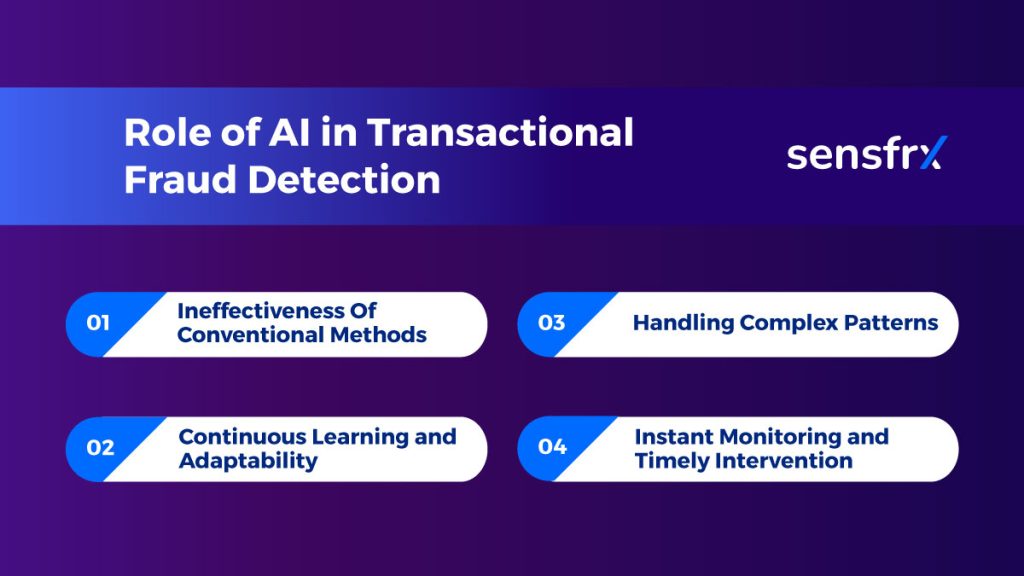
Digital transactions keep rising and so does financial crime. The Association of Certified Fraud Examiners (ACFE) estimates that businesses lose about 5% of annual revenue to fraud. AI's role in bringing that number down has four parts.
1. Ineffectiveness of conventional methods
Manual audits and rule-based systems cannot handle current data volumes or the pace at which fraud tactics change. Machine learning reads real-time data from many sources at once and flags fraud as it happens.
2. Continuous learning and adaptability
Fixed rules match a fixed picture of fraud. Models update as new data arrives, so detection tracks the attackers' changes instead of lagging them.
3. Handling complex patterns
Social engineering and insider collusion produce patterns spread across many events that look unrelated one at a time. Models find the links between those events that a rule, or a person reading one transaction, would miss.
4. Instant monitoring and timely intervention
Scoring in the transaction path means intervention before the loss, not after. Alerts on transactions or behaviour that break from the pattern let the team act while there is still something to stop.
AI fraud detection mechanism
1. Data collection and cleaning for AI fraud detection
Building a detection model starts with data: large volumes of transaction records, much of it irrelevant to fraud and in need of cleaning.
Cleaning removes irrelevant and duplicate records that would distort the dataset. Less noise means the model finds the real patterns and deviations faster.
2. Feature engineering for effective fraud detection
Feature engineering decides what the model looks at: the attributes that separate genuine transactions from fraudulent ones.
Transaction amount, location, time and merchant category code (MCC) are typical features. Each is a clue the model weighs when deciding whether a transaction looks normal.
It also means choosing the right features from a large set, with methods such as dimensionality reduction, which cuts compute without losing the signal.
3. Model training and deployment
Training begins with preprocessing: cleaning and arranging the data for the algorithm. Model accuracy depends on data quality, so this step is not rushed. Feature selection happens here too, keeping only the features that carry signal.
Then the algorithm is chosen. Supervised learning trains on a labelled dataset where fraudulent and genuine transactions are already marked; logistic regression, decision trees and support vector machines are the common choices.
Unsupervised learning works without labels. Clustering methods such as k-means and anomaly detection methods such as isolation forests find the transactions that do not fit the rest.
4. Real-time monitoring and continuous learning
Fraud changes shape, so the system has to score transactions in real time and keep learning.
Real-time scoring is the first gain over manual review, which is slow and inconsistent. Every transaction is examined as it arrives and the response is immediate when it needs to be.
Continuous learning is the second. The model reads historical transactions for patterns tied to fraud, and as new cases arrive it updates, so new fraud types are learned rather than missed.
Accuracy improves with time and data: the more fraud examples the model has seen, the better it separates the next one from normal traffic.
Challenges and limitations of AI in transactional fraud detection
AI is effective here, and it has limits. The first is that fraud tactics change. A model trained on historical data recognises established patterns well; a new or unknown form of fraud may pass until enough examples exist to learn from.
1. Data availability and quality
Models need large volumes of good data. In payments that data is sensitive, protected by privacy law and hard to obtain. Training sets often lack diversity, which leads to narrow or wrong predictions.
2. Training dataset bias
A model is only as good as its training data. Skewed or incomplete records produce biased predictions. If fraud was rare in the training set, the model learns that almost everything is genuine and may classify a fraudulent purchase as normal because that is what the majority looked like.
3. Resource requirements and expertise
Building and running these systems takes money and people with skills in machine learning, optimisation and big data analytics. Those people are scarce, and the system needs constant monitoring and tuning to stay accurate.
Explainability is the other cost. A human investigator can state the evidence behind a conclusion. Many deep neural networks cannot; they behave as black boxes, and it is hard to say how a given prediction was reached.
Data quality, availability and regulatory compliance in AI fraud detection
Accurate data is the base of the whole system. Bad data means false positives, and false positives mean unhappy customers. The model also has to fit into the systems you already run.
False positives are the most visible failure: a genuine customer declined, inconvenienced and less likely to return. The fix is ongoing supervision of the model and regular updates to keep the false positive rate down.
Regulation is the other constraint. Data privacy law is tightening in many countries, and the use of AI on customer data has to stay within what the relevant authorities allow.
Future of AI in fraud detection
Data volumes keep growing and older methods fall further behind. The developments below are where detection is heading.
1. Real-time detection with AI algorithms
AI processes large volumes of data as it is generated. Older methods detect late, and late detection costs more. Models read transactions, customer behaviour and other sources together and surface anomalies for investigation at once.
Predictive analytics adds a forward view. From the record of past fraud the model estimates where and when risk is likely, so controls are in place before the attempt.
2. Natural language processing (NLP) integration
NLP lets detection systems read unstructured content, such as emails and social media posts, for signs of fraud. The same capability helps spot insider threats in internal communication channels.
Fraud detection with AI is also spreading past payments into sectors such as healthcare and insurance, where it finds false claims and billing abuse.
3. Advanced machine learning algorithms
Algorithms that learn without constant supervision handle large datasets and find the patterns and outliers that mark fraud. NLP on unstructured data is one area where they have shown strong results.
4. Unstructured data analysis with NLP
Unstructured data has no fixed format: emails, documents, social posts, audio recordings. It often holds useful evidence of fraud, and rule-based systems cannot process it.
NLP, the branch of AI that teaches machines how humans communicate, extracts meaning from text with techniques such as named entity recognition and sentiment analysis.
One application is reading customer feedback and complaints on social platforms, which are also where fake reviews and malicious comments get posted.
5. Email and audio call communication analysis with NLP
NLP reads social media posts in bulk, flagging unnatural language patterns or sentiment around specific products so a problem is spotted before it spreads.
On email, NLP models that understand context can follow subtle shifts in a conversation and flag suspicious discussions between parties involved in fraud.
On recorded calls, the same models extract meaning from words, tone and pauses, which helps identify identity theft and phishing over the phone.
6. Blockchain technology in contract management
Blockchain is known for cryptocurrencies such as Bitcoin, but distributed ledgers also apply to contract management.
Every change to a contract is recorded and cannot be altered without agreement from all parties, and the peer-to-peer design removes the single point of failure that a central authority creates.
7. Human supervision in AI fraud detection
Models recognise patterns; people make the judgement calls. Human oversight is needed when a complex case arrives or a new fraud type appears, and the analyst's decision becomes training data for the model.
NLP on transaction text
Payment descriptions, order notes and user comments carry signal that numeric features miss. Read alongside the numbers, that text exposes patterns a transaction-only model does not see.
Computer vision does the same for images: an ID document reused across many accounts, or one that shows signs of tampering, is a signal in its own right.
Biometric authentication
Face and fingerprint checks tie the transaction to a person rather than a credential, which cuts identity theft at the point of payment.
Monitoring across mobile apps, websites and point-of-sale systems at the same time shortens the gap between a new fraud scheme appearing and the response to it.
Advanced AI algorithms
Sensfrx applies this in practice. It scores every signup, login and payment in real time from device, network and behaviour signals.
The models learn from historical data and adapt to new patterns, so anomalies are flagged as they appear rather than after the chargeback.
The scoring happens inside the transaction, where manual review takes minutes and covers a fraction of the volume. Your rules turn the score into allow, review or block.
Where to start
AI is the most effective answer to transaction fraud so far because of timing and throughput. A model scoring every transaction around the clock finds the risk while the payment is still pending, when the money can still be held; audits and investigations find it after the fact, when recovery is unlikely.
The same model reads in seconds what a review team covers in a day, and fewer false positives means your analysts spend their time on cases that matter.
Start by scoring payments. Sensfrx does that in real time, with a free plan and a 14-day trial on the pricing page.