Airline ticket fraud: Types, warning signs and prevention
The four main airline ticket scams, the warning signs for travellers, who absorbs the loss, and how airlines score bookings to stop fraud before ticketing.
 By 6 mins readPublished Updated
On this page
- Common types of airline ticket fraud
- Warning signs of airline ticketing fraud
- How airline ticket fraud impacts airlines
- Preventative measures for consumers
- Reporting and addressing airline ticket fraud
- What to do if you face airline ticket fraud
- How fraud detection systems can prevent airline ticketing fraud
- How Sensfrx helps
- Where to start
Airlines are the vertical hit hardest by online fraud. IATA's 2020 fraud whitepaper put the industry's loss from fraudulent online ticket purchases at over $1 billion a year, with airlines accounting for almost 46% of fraudulent transactions.
The cost goes past the chargebacks. Fraud disrupts operations, ties up service teams and damages the airline's name with the travellers who got burned.
Common types of airline ticket fraud
Four schemes account for most of it.
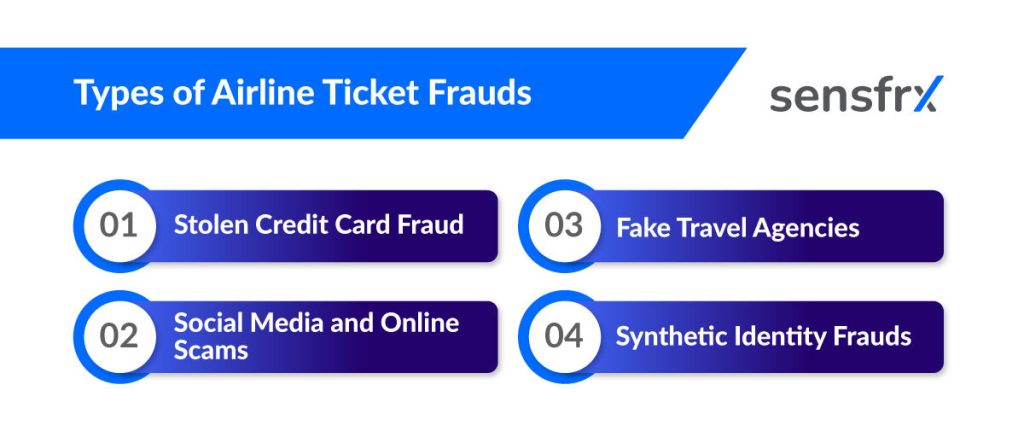
1. Stolen credit card fraud
The fraudster buys tickets with card details taken in a phishing attack or a data breach, then resells them at a discount on third-party sites or social media. The cardholder disputes the charge later, and the airline takes the chargeback.
2. Social media and online scams
Fake promotions and giveaways on social media promise free flights or fares far below market. The link leads to a clone of a booking site that takes the payment and the traveller's personal details, and issues nothing.
3. Fake travel agencies
A professional-looking website, a customer service number and prices well under every real competitor.
The traveller finds out at the airport that the ticket is invalid or was never issued.
4. Synthetic identity fraud
Synthetic identity fraud is among the fastest-growing financial crimes, fed by large customer data leaks.
The fraudster mixes real data bought on the dark web with invented details to build a new identity, then books and pays under it.
The same identities are used to run automated logins against real accounts at scale and take them over.
Warning signs of airline ticketing fraud
Three signs catch most scams before the payment.
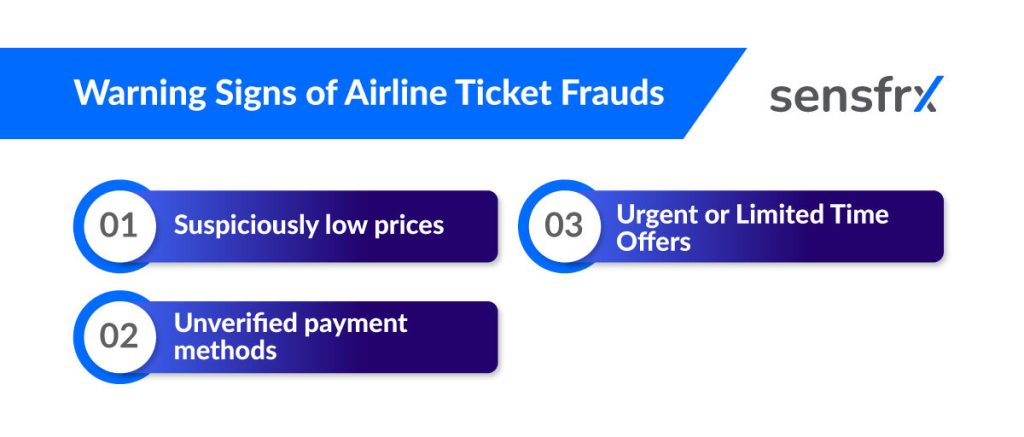
1. Suspiciously low prices
A fare far below the market is the lure. Check the offer on the airline's own site before paying anywhere else.
2. Unverified payment methods
Real airlines and agencies take payment through verified card systems. An agent who asks for a wire transfer, a gift card or cryptocurrency is asking for money that cannot be recovered.
3. Urgent or limited-time offers
Pressure to decide now is a tactic, and it works because it stops people checking.
Airlines rarely sell this way. Check any such promotion on the official channel first.
How airline ticket fraud impacts airlines
On direct-channel sales the airline absorbs the loss. When a stolen card pays for a ticket and the real cardholder disputes it, the chargeback lands on the airline, not on a travel agency.
That comes straight out of margin.
On the indirect channel, IATA member airlines can pass the loss to the travel agency through an Agency Debit Memo (ADM).
Preventative measures for consumers
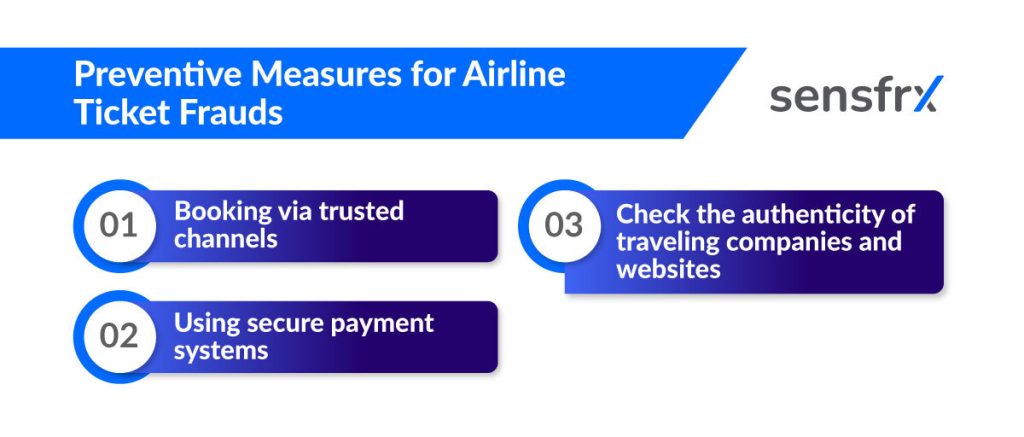
1. Booking via trusted channels
Book on the airline's own site or with an agency you know. Check the URL and the padlock (https://) before entering card or personal details.
2. Using secure payment systems
Pay by credit card, which carries chargeback protection. Debit cards, crypto and bank transfers give you little or none.
3. Check the authenticity of travel companies and websites
Never book with an agency you have not checked. Look for reviews, a physical address and a track record before paying.
The role of law enforcement and airlines
Airlines cannot prosecute, and law enforcement cannot see the booking data. The two work together when airlines:
- Share data on fraud patterns and incidents
- Run fraud detection on bookings
- Cooperate in investigations and prosecutions
- Take part in industry-wide anti-fraud initiatives
- Train staff and inform customers
Close cooperation is what turns a chargeback into a prosecution.
Reporting and addressing airline ticket fraud
If you think you have been defrauded, act the same day. Tell the airline or agency, and file a report with local police and with the Federal Trade Commission (FTC).
If you paid by credit card, dispute the charge with the issuer. Keep every email, receipt and screenshot.
What to do if you face airline ticket fraud
In order:
- Call your bank or card issuer, report the fraud and start the chargeback.
- File a police report and keep a copy.
- Report the fraud to the relevant consumer protection agencies.
- Contact the airline, explain what happened and ask what help they can offer.
- If you are stranded, contact your country's embassy or consulate.
- Consider a credit monitoring service in case your details are reused.
- Do not post details of the incident online; scammers use them to target you again.
How fraud detection systems can prevent airline ticketing fraud
Fraudsters keep finding new ways to steal cards, miles and tickets, and they now use AI tools to scale the attempts.
A fraud detection system answers in kind. It reads each booking in real time against a baseline of normal behaviour and flags the deviations: a purchase from a new location, an unusual payment method, a device seen on earlier fraud.
Combined with multi-factor authentication and threat intelligence shared between airlines, it catches fraudulent bookings before tickets are issued.
How Sensfrx helps
[Sensfrx](/) scores every booking before the ticket is issued. Six parts of that:
1. Real-time transaction monitoring
Every transaction is checked as it happens. Purchases that break from the customer's pattern, such as an unusual location or payment method, are flagged in the flow.
2. Models that learn from past fraud
Machine learning models retrain on past fraud cases, so accuracy improves over time: fewer false positives, more real fraud caught.
3. Transaction fraud prevention
Data from booking systems, payment gateways and customer profiles is read together, which exposes inconsistencies such as a billing address that does not match the card or account activity that does not match the booking.
4. Behavioral analysis
A baseline of normal behaviour per user makes the anomalies visible. A customer who always books from one city and suddenly buys from another country gets flagged for review.
5. Known fraud infrastructure
Devices, IPs and networks already tied to confirmed fraud are recognised when they return, so a booking that arrives through scam infrastructure is flagged even if the card is new.
6. Alerts and notifications
When a booking scores high, the operator is alerted in real time and the transaction can be held or sent for extra verification before the ticket is issued.
Where to start
Airline ticket fraud is organised and growing. The traveller's side of the defence is habit: check the URL, pay by credit card, distrust the fare that beats everyone.
The airline's side is a risk score on every booking. Start with the direct channel, where you absorb the loss, and with the highest-value routes.
Sensfrx scores bookings, logins and signups in real time, with your rules deciding what to allow, review or block. Create a free account and test it on your own traffic.