Travel fraud: The four types, how to detect them and how to stop them
Why travel gets hit, the four common fraud types, eight detection signals from geolocation to device fingerprinting, and the rules that stop them.
 By 11 mins readPublished Updated
On this page
Travel is a good place to commit fraud. The goods are high-value, digital and delivered instantly; a flight or a hotel night booked on a stolen card is flown or resold before the cardholder sees the statement. Airlines, hotels, car rental firms and online travel agencies all pay for that, in chargebacks and in lost customers.
Four types of fraud account for most of the loss: stolen cards at booking, cancellation and flight-credit abuse, fake travel sites, and account takeover of loyalty accounts. Below: why travel is targeted, how each type works, eight signals that detect it, and the rules that stop it.
Why is the travel industry targeted for fraud?
Two reasons: what travel sells, and how it gets paid.
High-value digital goods
Flights, rooms and tours are expensive, digital and delivered on the spot. Three consequences:
- Quick to use or resell. A fraudulent flight booking can be flown or sold on before the chargeback arrives. Tickets and reservations transfer easily.
- Luxury with little scrutiny. First-class seats and luxury hotel stays bought on stolen cards get consumed before anyone questions the transaction.
- No delivery address. There is no parcel, no shipping address and no signature, each of which would otherwise be a chance to catch the fraud.
Thin margins and payment exposure
Airlines, hotels and agencies run on thin margins, so each fraud loss hurts more than its face value.
- High volume, low margin. A ticket sold for a few hundred dollars that comes back as a chargeback costs the fare, the fees and the seat that could have gone to a paying customer.
- Many payment paths. Online gateways, third-party booking platforms and mobile payments each carry their own weaknesses, and fraudsters work all of them: stolen cards, account takeover, loyalty program theft.
- Online by default. Most travel is booked on the web or in an app, which is where payments get intercepted or manipulated.
- Chargebacks and refund abuse. Book on a stolen card, then either take the trip or cancel for a refund. The business loses the service and the payment.
- New payment methods. Mobile wallets and cryptocurrency are accepted before every business has the controls to screen them.
Common types of fraud in the travel industry
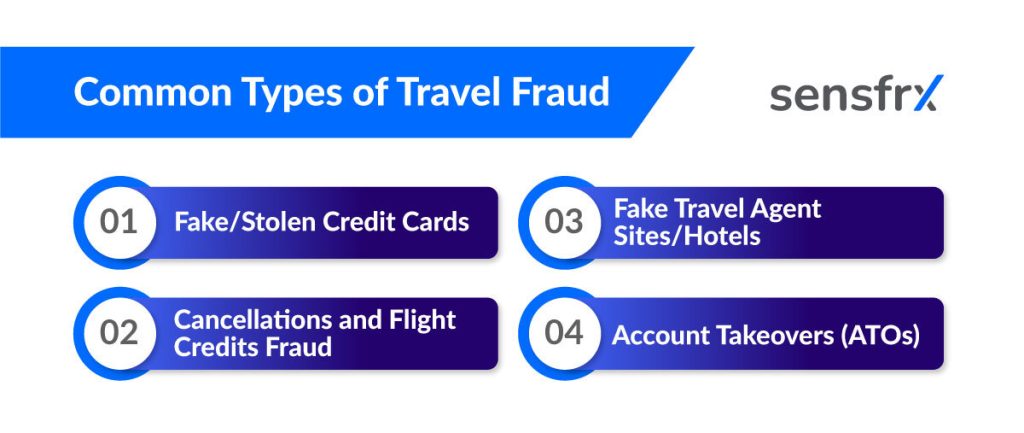
Four types, each with its own mechanics and its own fix.
1) fake or stolen credit cards
The most common. Stolen card details are used to book flights, hotels, car hire and tours. Instant delivery and no physical product make it low-risk for the fraudster.
- How it works. The fraudster buys through a legitimate travel site or agency with stolen card data. By the time the cardholder disputes it, the trip is booked or taken, and the merchant is left with the chargeback.
- Impact. The merchant loses the payment and pays the chargeback fee. A high chargeback rate also damages standing with payment processors, which means higher fees or being dropped altogether.
- Prevention. Payment verification such as 3D Secure, and transaction monitoring that flags unusual activity at booking. See card testing fraud for the pattern that usually precedes it.
2) cancellations and flight-credit fraud
Refund and credit systems built for disrupted travel are a second route to cash. The booking is made on stolen payment details and then cancelled, or stolen flight credits are spent on new bookings.
- How it works. Book on a stolen card, use part of the service or none, cancel, and claim a refund or a flight credit. A stolen transaction becomes a clean credit in the fraudster's name.
- Impact. Direct loss, plus the staff time spent investigating each cancellation and credit redemption.
- Prevention. Stronger checks on cancellations and credit redemptions: a second factor before any itinerary change or refund request is processed.
3) fake travel agent sites and hotels
Scammers build convincing sites and ads that imitate travel agencies or hotel chains and undercut the real price.
- How it works. The traveler books a holiday, hotel or flight on the fake site. The site takes the money and delivers nothing, or harvests the card details for later use.
- Impact on consumers. The victim finds out on arrival: no booking, or no hotel.
- Impact on businesses. The brand that was imitated takes the blame and loses the sale, and customers trust the real site less.
- Prevention. Travelers should book direct or through agents they can verify. Businesses should monitor for misuse of their brand and report fake sites as they appear.
4) account takeovers (ATOs)
The fraudster gets into a customer's account and spends what is stored there. In travel that often means loyalty points and frequent flyer miles, which are worth real money and rarely watched.
- How it works. Phished or reused passwords get the attacker in. Once inside they change the contact details, redeem points, book flights or rooms and take personal data.
- Impact on consumers. Financial loss, and the loss of points built up over years, often unnoticed for months.
- Impact on businesses. Reputation damage, lost trust, possible legal liability, and the cost of compensating customers for stolen rewards or bookings.
- Prevention. Strong unique passwords and multi-factor authentication (MFA) on every account, real-time monitoring of logins, and alerts on unusual activity. Our loyalty fraud guide covers the points side in detail.
How to detect travel fraud
Detection combines signals from the transaction, the device and the account.
No single signal is decisive. The eight below are the ones that carry the most weight for airlines, hotels and booking platforms.
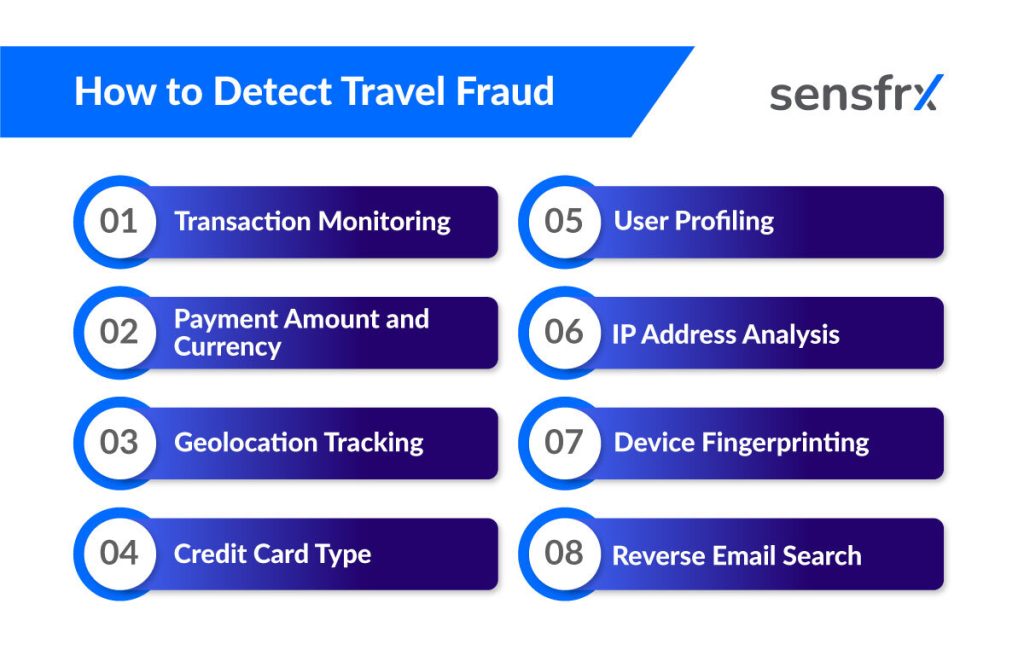
1) transaction monitoring
Examine each transaction as it happens: abnormal spending, several bookings in a short window, anything that departs from the customer's usual pattern. A hit raises an alert for action before the booking is confirmed.
2) payment amount and currency
An unusually large payment, or one in a currency that does not fit the customer, is a flag. Thresholds and rules route these to review.
3) geolocation
A booking from somewhere far from the customer's usual location deserves a second look. Compare the claimed location with the IP address.
4) card type
Prepaid cards and cards issued in countries with high fraud rates are routinely stepped up for extra verification. The check is whether the card fits the customer's profile and history.
5) user profiling
Build a profile of each customer's normal: booking patterns, preferred payment methods, usual destinations. Deviations from the profile are where fraud shows up, and the profile has to be kept current to stay useful.
6) IP address analysis
Compare the IP's location with the account and the transaction. An IP already linked to fraud, or one behind a proxy or VPN, is a reason to stop or review the booking. See how to identify and block malicious IPs.
7) device fingerprinting
Record the characteristics of the device, type, operating system, browser settings, and compare them against devices seen in past fraud. A known bad device is blocked before it books. Device fingerprinting explains the method.
8) reverse email search
Check the email address against records of past fraud and risky behavior. Accounts created with temporary or disposable addresses are a staple of fraudulent bookings.
Tools for travel fraud protection
Three kinds of tooling do the detection above at scale.
Machine learning
Machine learning (ML) models find patterns across volumes of bookings no analyst could read, and retrain as new data arrives so new tactics are caught. Applied in real time, they flag deviations from a customer's behavior and anomalies in payment data as they happen.
Full fraud prevention platforms
A single platform that combines transaction monitoring, geolocation, user profiling and payment analysis lets a travel company watch every risk factor in one place and gives reviewers one record per case.
Manual review plus automation
Automation flags; people judge. Human reviewers handle the ambiguous cases machines get wrong, which keeps false positives down and keeps good customers from being declined.
Best practices to prevent travel fraud
Three practices, all of them rules a fraud team can write and tune itself.
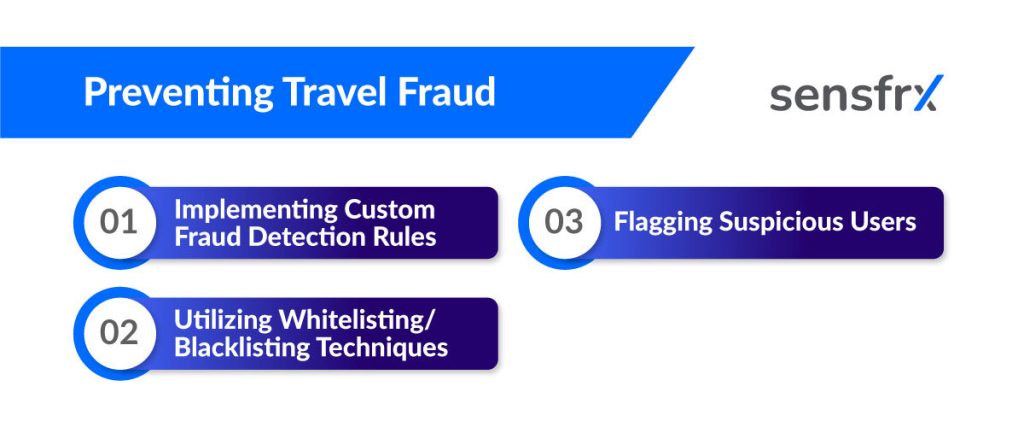
1) custom fraud detection rules
Generic rules miss travel-specific risk. Write rules for your own customers and your own fraud.
- Risk parameters that fit travel. Flag last-minute bookings, large transactions, frequent cancellations, sudden changes of destination, several cards on one account.
- Adjust as the fraud moves. Review thresholds regularly; raise sensitivity around peak season, when phishing and card fraud both spike.
- Alert automatically. When a transaction or account falls outside the defined safe range, the rule fires and someone sees it at once.
2) allowlists and blocklists
Classify users, accounts and payment methods by risk so the known-good flow through and the known-bad do not.
- Allowlist trusted customers. Customers and partners with a clean history skip some checks and get a faster booking.
- Blocklist known fraud. Users with a chargeback history, suspicious payment methods, specific IP addresses and email domains tied to past fraud are refused.
- Keep both lists current. An IP or payment type that was safe last year may not be now. See IP allowlisting and IP blocklisting.
3) flag suspicious users
Identify the accounts behaving abnormally and watch them before they cost you anything.
- Behavioral analytics. Booking history and spending patterns set the baseline; an expensive trip booked at an odd hour from an unfamiliar place breaks it.
- Multiple failed transactions. Several failed bookings or payment errors in a short time usually mean someone is testing stolen card numbers.
- Risk-based authentication. For flagged users, require MFA or manual review before a high-value transaction goes through. Good customers see no extra friction; fraudsters hit a wall.
- Escalate to manual review. Automated flags go to a fraud analyst who investigates, so false positives are caught and real threats are handled quickly.
Where Sensfrx fits
Sensfrx scores every signup, login and payment in real time from device, network and behavior signals. Your rules turn the score into allow, review or block. That covers three of the four fraud types above at the point they enter.
A booking on a stolen card is a payment scored before it is accepted. Account takeover of a loyalty account is a login scored against the device and behavior the account usually shows. Cancellation and flight-credit fraud starts with a stolen-card booking, so stopping the payment stops the credit. Fake travel sites are outside any merchant's control; brand monitoring is the answer there.
The custom rules described above are yours to write: the score is the input, and allow, review or block is the output.
Start with fraud prevention for travel and ticketing, or contact us with questions the docs do not answer.
Where to start
Travel is targeted because the goods are digital, valuable and instant, and because margins leave no room to absorb chargebacks. Four fraud types do most of the damage: stolen cards, cancellation and credit abuse, fake sites and account takeover.
Start with the payment: score every booking on device, network and behavior signals before it is accepted, and add MFA to loyalty accounts. Then write the travel-specific rules (last-minute, high-value, repeat cancellation) and route hits to a reviewer.
Frequently asked questions (FAQs)
1) What are the common types of fraud in the travel industry?
Stolen credit cards at booking, cancellation and flight-credit fraud, fake travel agent sites and hotels, and account takeovers (ATOs). Each exploits the digital, instant nature of travel services.
2) Why is the travel industry frequently targeted for fraud?
High-value digital goods such as flights and hotel nights can be used or resold at once, transaction volume is high, margins are thin, and payments flow through several systems with different weaknesses.
3) How do fraudsters use fake or stolen credit cards in the travel industry?
They book flights, hotels and other services with stolen card details. The booking completes in seconds, usually before the fraud is detected, and the merchant takes the chargeback.
4) What is cancellation and flight credits fraud?
A booking made with stolen payment details is cancelled for a refund or a flight credit, turning a stolen transaction into usable credit. Airline policies on changes and credits are worked the same way.
5) How do fake travel agent sites and hotels operate?
They imitate real agencies or hotels with convincing sites and low prices. Customers pay and get no booking, or have their card details stolen, and the imitated brand takes the blame.
6) What are account takeovers (ATOs) and how do they impact the travel industry?
The fraudster gets into a customer's travel account and spends what is there: loyalty points, stored cards, personal data. Customers lose points and money; businesses lose trust and often pay compensation.
7) What strategies can travel companies use to detect fraud?
Transaction monitoring, payment amount and currency checks, geolocation, card type analysis, user profiling, IP address analysis, device fingerprinting and reverse email search.
8) What role does machine learning play in detecting travel fraud?
ML models learn what fraudulent bookings look like from past data, adapt as tactics change, and flag anomalies in real time so transactions can be stopped before they complete.