Cryptocurrency fraud prevention: Strategies & solutions
Common crypto scams (phishing, Ponzi, fake ICOs, pump-and-dump, exit scams), why crypto attracts fraudsters, how to spot them and the controls a platform needs.
 By 10 mins readPublished Updated
On this page
Crypto fraud scales with adoption. Chainalysis put cryptocurrency-related crime at $4.52 billion in 2019, almost triple the $1.74 billion of 2018. Pseudonymous wallets, irreversible transfers and thin regulation give a scammer everything a card fraudster wishes they had.
What is cryptocurrency fraud?
Any scam that takes digital currency or the credentials that control it: phishing for private keys, Ponzi schemes dressed as yield, fake token sales, fake exchanges, and straight hacking of wallets and platforms.
How big crypto fraud has become
The numbers behind the growth:
- Adoption: more people paying and investing with crypto means more targets, and the scammers arrived with the investors.
- Reported cases: the US Federal Trade Commission's 2020 tally was over 10,000 cryptocurrency scam reports and more than $80 million lost, almost triple the 2019 count.
- Phishing and social engineering: by one count nearly half of crypto crime runs through tricking victims out of login credentials or private keys.
- Ponzi schemes: high returns promised, paid from new deposits until the inflow stops and the operator disappears.
- Fake initial coin offerings (ICOs): token sales modelled on IPOs, where many projects were fraudulent or failed and left buyers with worthless tokens.
- DeFi scams and hacks: lending and borrowing protocols with no intermediary are a standing target for both scammers and exploiters.
Types of crypto fraud
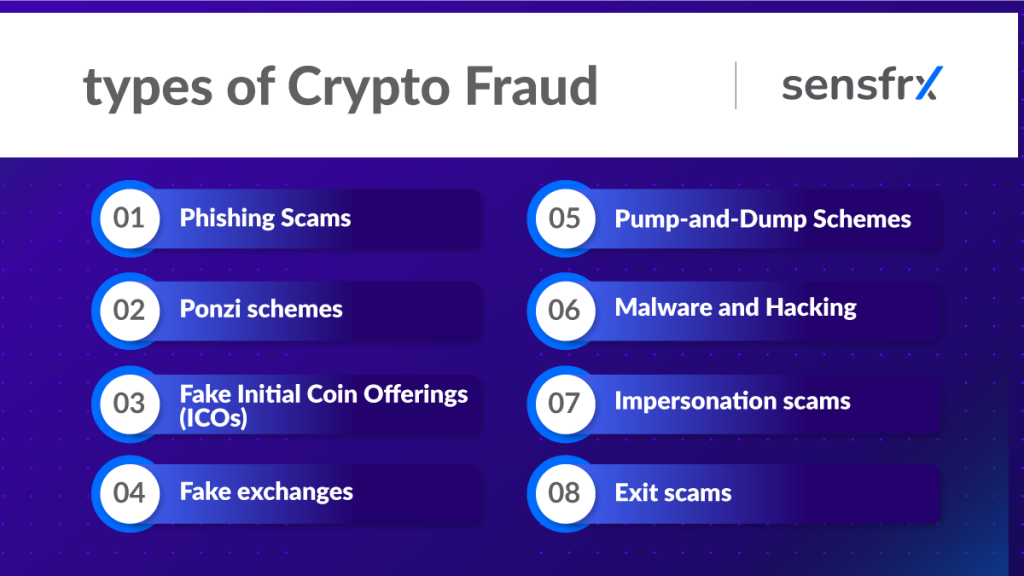
The forms below cover most of what a platform or its users will meet.
Phishing scams
A fake email, message or site posing as an exchange or wallet provider asks for login credentials or private keys. With either, the attacker empties the account.
Ponzi schemes
The scheme promises high returns and pays early investors with later investors' money. The apparent success draws more deposits until the inflow stops, the scheme collapses, and most participants lose everything.
Fake initial coin offerings (ICOs)
An ICO sells tokens that represent ownership or usage rights in a platform. A fake one sells the tokens with no intention of building anything, promises high returns, and vanishes with the proceeds.
Fake exchanges
A website built to look like a real exchange, designed to take deposits that never come back.
The signup form doubles as a data harvest: the personal details collected are used to get into the victim's real wallets and accounts.
Pump-and-dump schemes
The operators inflate a coin's price with false news of partnerships or launches, spread through social media and messaging apps, then sell into the spike. The price collapses and late buyers hold the loss.
Malware and hacking
Malware on a victim's device, or a phished login, gives the attacker direct access to wallets and exchange accounts. The funds move in one transaction.
Impersonation scams
A fake social profile wearing the name and photo of a known investor or industry figure asks followers to send crypto, often with a promise to send more back.
Exit scams
An exchange or investment scheme shuts down without warning and leaves with the users' funds. Some operators plant a story about a hack to cover a planned exit.
The common defence as a user is research before you deposit, and a refusal to chase returns no legitimate product offers.
What makes cryptocurrency so appealing to fraudsters?
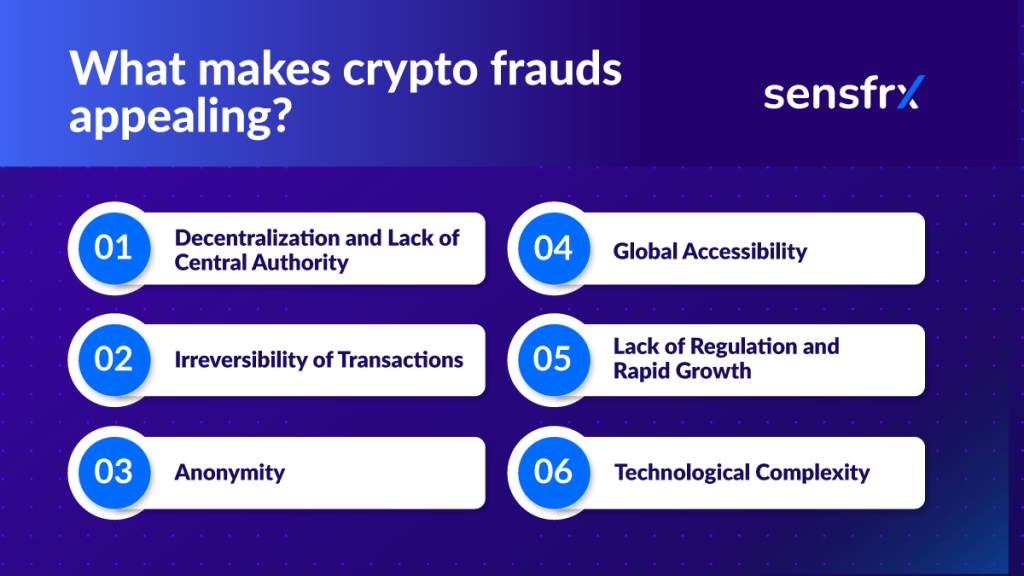
Five properties, each useful to legitimate users, each useful to a thief.
The first is pseudonymity. A bank transaction is tied to a name and address; a crypto transaction is tied to a wallet address. The fraudster's identity is one step removed from the start.
Decentralization and lack of central authority
No bank or government sits in the middle of a transaction, so there is no single point where fraud can be monitored or stopped.
Fraudsters use that gap to run fake sites and apps that copy real platforms and collect credentials or deposits.
Irreversibility of transactions
A confirmed blockchain transaction cannot be reversed. Once the funds move, the victim has no practical way to get them back.
There is also no one to appeal to. In the banking system a victim can ask the bank to freeze or reverse; with a decentralised, lightly regulated asset the legal routes are few.
Peer-to-peer transfers have no intermediary, so no arbiter exists for a dispute between the two parties.
Anonymity
A crypto payment needs no name or address, so a person can pay and move funds without identifying themselves.
Transactions are recorded across a network of computers rather than by one institution, and wallets are random strings rather than names, which makes origin and destination hard to trace.
Global accessibility
Funds cross borders in minutes without a paper trail, so a scam run from one country against victims in another is hard for either country's authorities to pursue.
Many countries still lack clear rules on cryptocurrencies, which leaves room to operate without legal consequence and makes fake ICOs easy to launch.
Lack of regulation and rapid growth
Compared with regulated finance, crypto runs with little oversight: no body monitors transactions or protects consumers the way a banking regulator does.
The market also moves fast. New coins appear almost daily and prices swing, so investors struggle to keep up and scammers have fresh cover every week.
Technological complexity
Blockchain is secure and complicated, and the complexity hides schemes: tracing where funds went, or who ran a scam, takes skill most victims do not have.
Add irreversibility, and a scammer who gets the funds keeps them.
How to spot cryptocurrency scams
The tells, from a user's side.
Unrealistic promises and volatility
High returns in a short time with no risk is the oldest tell. Crypto is volatile; anyone promising a fixed or guaranteed return is selling something other than what they describe. Research before you commit.
Lack of transparency
A real project has a clear whitepaper, a roadmap, stated goals and open communication with investors. Vague explanations or a thin whitepaper point to a project that is not what it claims.
Poor security practices
Check the security history of any exchange or wallet before you use it. Read user reviews, and confirm it supports two-factor authentication and encrypts data.
Treat requests for personal information or funds with suspicion. Phishing copies real sites and emails; use only platforms you trust and never share private keys or login credentials with anyone.
Pump-and-dump schemes
Watch for a sudden price spike with a hype campaign behind it, and for pressure built on fear of missing out. A surge with no fundamental cause is the setup for the dump.
Ponzi schemes
These often pose as investment products or multi-level marketing (MLM) programs. The tell is a recruitment requirement, where earnings come from bringing in new people rather than from any real investment, together with returns that are too good and no product or service behind them.
White paper assessment
A whitepaper sets out a project's goals, technical design and use cases. Its clarity and depth are a direct measure of the project's legitimacy.
A legitimate one names the team and their backgrounds, explains how the system works, states the risks, gives realistic timelines, identifies the target audience, shows how funds will be allocated, and describes what the token is for.
A shallow or promotional whitepaper is a warning. Check its claims against outside sources.
How to prevent cryptocurrency fraud on your platform
Verify user identities
- Know Your Customer (KYC): collect ID documents and proof of address, verify them, and meet the regulations that apply to you.
- Multi-factor authentication (MFA): a second factor on login and on withdrawals.
Enhance privacy with zero-knowledge proofs (ZKP)
Zero-knowledge proofs let a user prove something (that they hold a credential, that they meet a condition) without revealing the data behind it.
In cryptocurrency they support private peer-to-peer payments and identity checks that do not expose personal data, so a platform can verify without holding information it would otherwise have to protect.
Using blockchain technology
CipherTrace's 2020 figure for cryptocurrency stolen or scammed was more than $1.9 billion. The ledger itself gives a platform some tools against that.
- Tamper-resistant records: a distributed ledger copies every transaction across many machines, so altering history after the fact is hard.
- Digital identities: an identity tied to a wallet's transaction history makes it harder for a bad actor to stay anonymous across repeated abuse.
- Smart contracts: self-executing agreements that run when their conditions are met, with every step recorded, which removes the discretion fraud needs.
Real-time transaction monitoring with AI
Monitoring with machine learning reads large volumes of transaction data from many sources as it arrives and flags the patterns and outliers that point to fraud, in time to hold the transaction.
At that volume and speed it beats manual review on both accuracy and time.
The models keep learning from new data, which cuts losses and lowers the false positives that cost you legitimate customers.
Educating users
Tell your users what the scams look like, through the blog, social channels, email and a help-centre page they can find when they need it.
Cover phishing and fraudulent ICOs in particular, and the three checks that catch most of it:
- Red flags in messages: spelling errors and odd phrasing in emails or posts that claim to be from you.
- Site security: the lock icon and https in the address bar before any login or deposit.
- Suspicious offers: returns too good to be true, and pressure to transfer funds at once.
Users who know the patterns stop many attempts before your systems ever see them.
Collaboration within the cryptocurrency industry
Share what you see. Known threats and suspicious actors passed between platforms, through industry information-sharing systems such as the Cryptocurrency Anti-Money Laundering (CAML) system, reach the next target before the fraudster does.
Shared data is also how fraudsters who work across several platforms get identified and tracked.
Where to start
Fraud prevention on a crypto platform is a set of controls, not one tool: identity checks at onboarding, a second factor on login and withdrawal, real-time scoring of every transaction, user education, and shared intelligence with the rest of the industry.
Sensfrx covers the scoring part: device fingerprinting, behavioral analysis and dynamic risk scoring on every signup, login and payment, with your rules deciding what gets allowed, reviewed or blocked. Start on the free plan and read its scores alongside your current monitoring before you let it block.
Compliance is part of the control set. MiCA in the EU and the SEC and CFTC in the US set the rules platforms and users operate under, and meeting them is what keeps your licence and your users' trust.
Frequently asked questions (FAQs)
Q. Why is cryptocurrency fraud prevention important?
A. Because transactions are irreversible and the assets move in minutes. Prevention is the only point at which a loss can be stopped, and it is what keeps investors and market trust intact.
Q. What regulatory bodies oversee cryptocurrency fraud prevention?
A. In the United States, the Securities and Exchange Commission (SEC) and the Commodity Futures Trading Commission (CFTC). In the European Union, the Markets in Crypto-Assets Regulation (MiCA) sets the framework.
Q. How can regulatory compliance help in cryptocurrency fraud prevention?
A. Compliance with MiCA and anti-money-laundering (AML) law forces the controls that stop fraud: verified identities, monitored transactions and reporting. It protects the customer and the platform's standing at the same time.
Q. What role does user education play in preventing cryptocurrency fraud?
A. A user who recognises a phishing message or an impossible return does not become a victim. Blogs, social posts, newsletters and help-centre pages are how a platform gets that knowledge to them.
Q. How does cryptocurrency operate on blockchain technology?
A. A blockchain is a distributed ledger that records every transaction across a network of computers. Transactions are grouped into blocks, each block links to the one before it, and the chain is copied everywhere, which is what makes past transactions hard to alter.