Website owners, social media platforms, advertising and data agencies, and attackers who collect it. Government agencies can obtain it as well.
Digital footprinting in fraud prevention: What it is and how to use it
What a digital footprint is, active versus passive footprints, how ecommerce sites use footprint data to score risk, and the privacy limits to respect.
 By 9 mins readPublished Updated
On this page
Every visit to your site leaves a trail: the device, the network it came from, the email and phone typed into the form, the pages opened on the way to checkout. That trail is a digital footprint. A fraudster leaves one too, and it rarely matches the footprint of the customer whose card or account they are using.
The same data cuts both ways. Attackers mine footprints to phish and impersonate people; fraud teams read them to tell a returning customer from a stolen identity.
What a digital footprint is
A digital footprint, also called a digital shadow or electronic footprint, is the trail of data a person leaves while using online services: sites visited, emails sent, posts made, the contact details entered while shopping. Pieced together, it tracks a person across the internet. Some of it is left on purpose and some of it is collected without the person noticing.
The quiet part is the larger part. Cookies record where you went and what you did. Accept them and the site operator can track you, share or sell the data to third parties, and lose it in a breach along with everything else.
Active and passive footprints
Footprints come in two kinds, and the split matters for privacy and fraud work alike. Active data is what the person chose to share. Passive data is what was collected about them anyway.
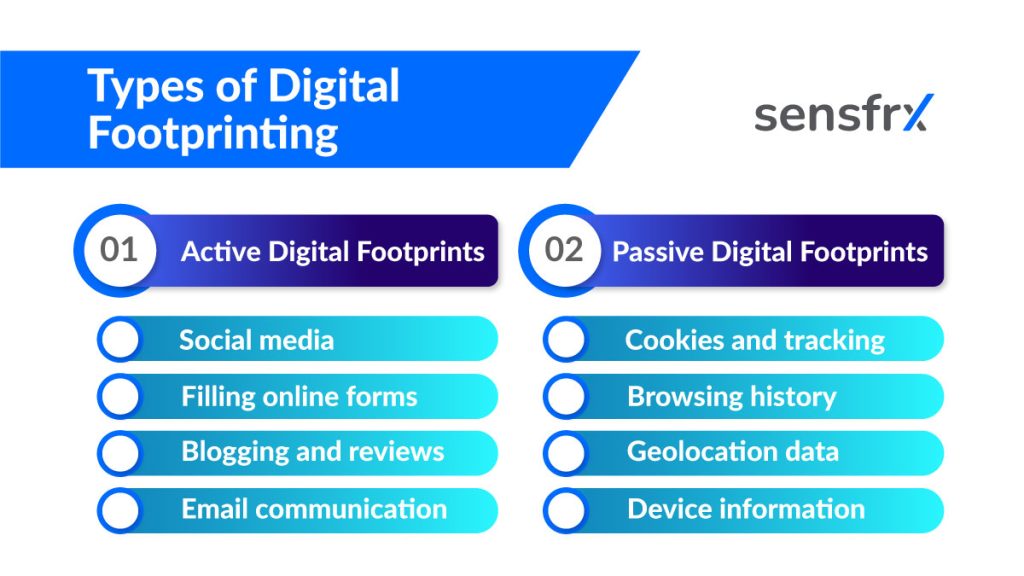
Active footprints are the data people share on purpose:
- Social media posts, shares and comments on Facebook, Instagram and Twitter.
- Forms filled in for registrations, subscriptions and surveys.
- Blog posts and product reviews.
- Email.
Passive footprints are collected without the person's knowledge or consent, which makes them harder to manage. They include:
- Cookies and tracking that feed targeted advertising.
- Browsing history: sites visited, search queries, on-site behaviour.
- Geolocation from GPS-enabled devices.
- Device data: hardware type, operating system and browser.
Why digital footprints matter
A footprint reveals behaviour, shapes reputation and is read by companies the person never dealt with. It lasts, and it is hard to take back.
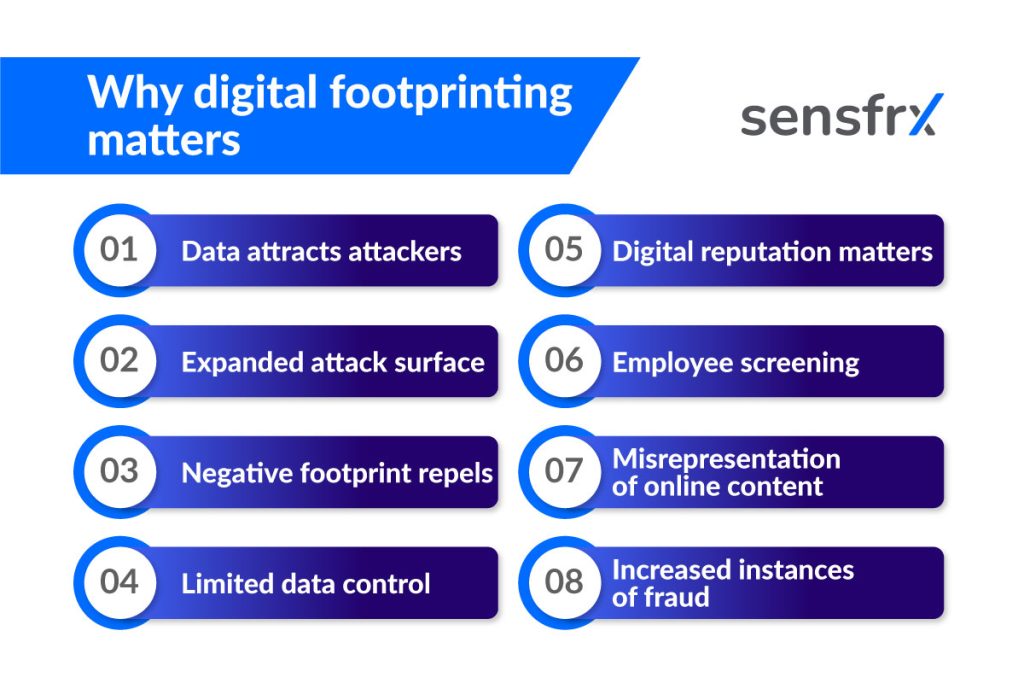
For a company, a large footprint is a target. Stockpiles of personal data draw attackers who make money from ransomware, holding the data hostage and threatening to sell it on the dark web.
The bigger the footprint, the more exposed the company is to cyberattacks. Every internet-connected device and app in the IT estate is a possible way in, and vendors' assets and activity open the door to supply chain attacks.
A negative footprint costs business. Critical press, unhappy customers venting on social networks and a shabby company website all leave marks that prospects find before they find you.
Once data is public, or even semi-public as with a Facebook post, its owner has little say over how others use it. A person's digital reputation is their reputation: employers check candidates' social media before hiring, and colleges and universities check applicants'. Words and pictures posted online get taken the wrong way, or altered, and the author carries the consequences.
For fraud teams, the footprint is the raw material of attacks. Criminals use it to phish for account access and to assemble fake identities from real people's data.
How to add digital footprinting to an ecommerce site
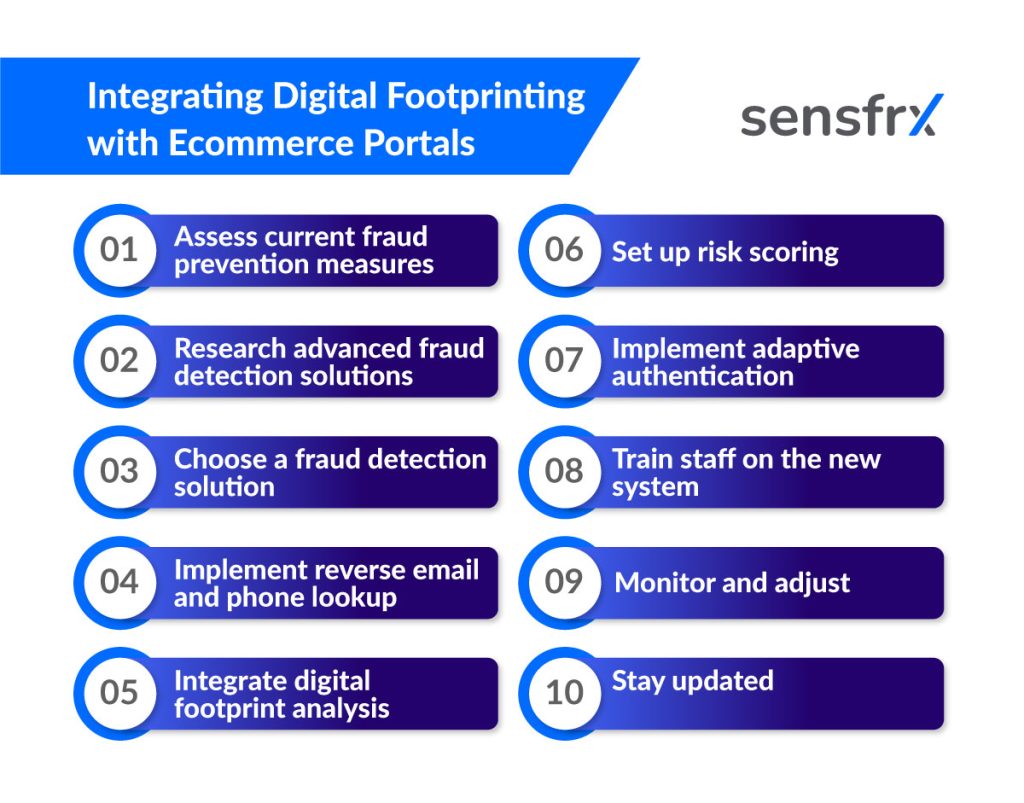
The rollout runs in roughly this order.
Start with what you already run. List the fraud controls on the platform and measure them: how many good orders they decline, and how often they catch the fraud that hurts you, such as account takeover and card testing.
Then look at third-party tools that add data enrichment and digital footprint analysis. Pick the one that balances accuracy with ease of use and fits the platform you run, whether through a plugin or an API.
Wire in reverse email and phone lookup so every signup and order is checked automatically. A throwaway email domain or a phone number with no history is a flag the moment it is submitted.
Add footprint analysis through the tool's API or platform integration. It compares the customer's online presence across platforms with what they typed into your form and surfaces the mismatches.
Set up risk scoring. Not every flag deserves the same response, so configure the system to give each customer a clear score and write down what counts as high risk for your business.
Make authentication adaptive: extra verification only for high-risk sessions, nothing extra for the rest. Low-risk customers keep a one-step checkout.
Train the team to read risk scores and footprint data, and give them written rules for flagged orders so decisions are consistent.
Review performance on a schedule, tracking false positives and false negatives, and adjust thresholds and rules as the numbers move.
Keep up with new fraud techniques and update the detection setup to match. A configuration tuned a year ago is already behind.
Use cases for digital footprinting
Footprint analysis shows up across industries wherever a new account or a payment needs checking. The table lists the main ones.
| Industry | Description | Applications of Digital Footprinting |
| Financial Services | Banks use digital footprinting to identify fraud by analyzing device info, location data, and user behavior | Risk assessment for loans and credit scoring |
| E-commerce | Online retailers track customer behavior to combat fraud, identifying unusual patterns. | Monitoring customer behavior for anomalies |
| Cybersecurity | Organizations enhance security by identifying vulnerabilities, detecting unauthorized access, | Vulnerability assessment and monitoring for insider threats and potential breaches |
| Identity Verification | Industries like healthcare and government use digital footprinting, | – Prevention of identity theft – Secure access to sensitive information |
| Marketing and Customer Experience | Companies leverage digital footprinting data to personalize user experiences and improve customer service | -Tailored product recommendations – Enhanced customer service through data insights |
| Insurance | Insurance companies analyze digital footprints to verify claims and detect fraud. . | – Fraud detection in insurance claims – Enhanced accuracy in claim processing |
| Gaming and Gambling | Online gaming platforms use digital footprinting to prevent cheating, ensure fair play. | – Prevention of cheating in games – Compliance with regulations |
| Travel and Hospitality | Airlines and hotels utilize digital footprinting to prevent fraud in loyalty programs and booking systems. | – Secure booking systems – Protection of customer accounts from unauthorized access |
Challenges and limitations
Footprinting is useful and imperfect. The limits fall into two groups: what you are allowed to collect, and what you can get right.
Privacy and regulation
Customers who feel watched leave. Visible tracking can push a shopper to abandon the cart or not come back at all.
GDPR and CCPA set the rules for what can be collected and kept, and a wrong move is a legal problem and a PR problem at once. Collect what the risk decision needs and nothing more.
Accuracy, volume and friction
Fraudsters keep changing technique, and footprint systems have to be retuned to keep up.
A badly tuned algorithm produces false positives and declines real customers. Sensitivity against accuracy is a trade-off you set deliberately and revisit.
The volume is large. Processing all of it in real time, without missing the one signal that matters, is a hard engineering problem in its own right.
Every extra check is friction. Put the verification in front of the high-risk minority and keep it out of the way of everyone else.
Where fraud prevention is heading
Fraud shifts with technology and with how people shop. Five trends shape what comes next.
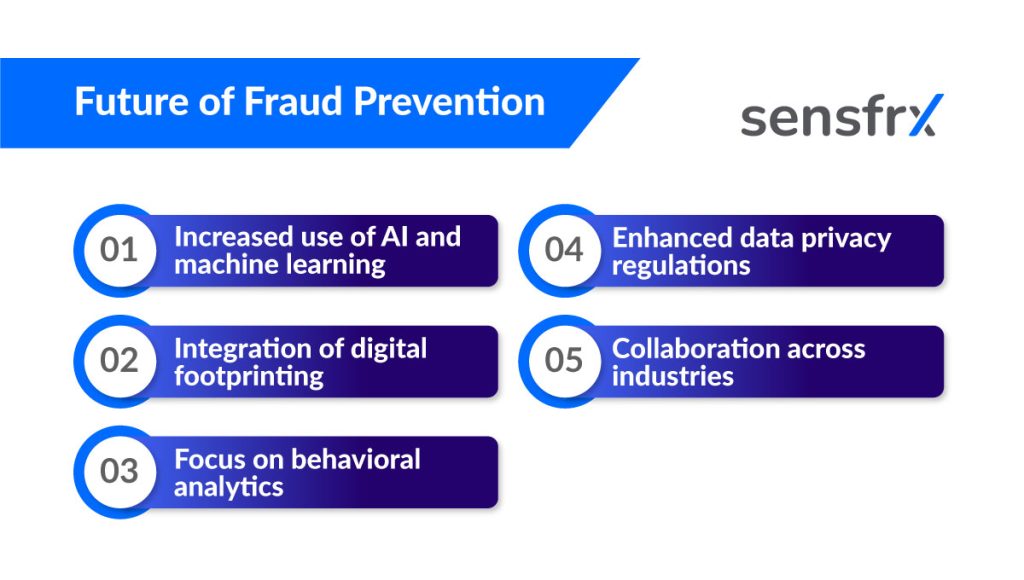
- More AI and machine learning. Models that read large volumes of data in real time and flag behaviour that looks fraudulent.
- Footprinting built into onboarding. Footprint checks move into the signup flow itself, so suspicious accounts are caught at creation rather than at the first chargeback.
- Behavioural analytics. Risk judged from how the user acts: unusual login times, a change in buying pattern, a session that moves differently from the account's history.
- Tighter privacy rules. Footprinting collects a lot of personal data, so regulation around it will tighten. Fraud prevention has to work within transparent data handling, not around it.
- Cross-industry sharing. Banks, ecommerce platforms and security firms sharing fraud patterns, so one company's lesson becomes everyone's defence.
Where Sensfrx fits
Sensfrx is a self-serve fraud prevention platform that scores every signup, login and payment in real time. The footprint each event leaves is the input.
1. Device, network and behaviour signals
Each event is scored on the signals it carries: the device, the network it arrived from, and how the session behaves compared with the account's history.
2. Real-time scoring
The score is produced while the signup, login or payment is in flight, so the decision lands before the account is created, the session opens or the order is approved.
3. Behaviour that does not fit the account
A session that behaves unlike the account's past sessions raises the score. That is how a stolen credential used by someone else gets caught even when the password is right.
4. A score and a decision
Every event gets a score, and your rules turn it into allow, review or block. You set the thresholds, so the balance between catching fraud and declining good customers is yours to tune.
5. Rules you change as fraud changes
When a new pattern shows up, adjust the rules. Plugins cover WooCommerce, Shopify, WHMCS, Blesta and WISECP; a REST API covers everything else.
Where to start
No one has no footprint, and no company can erase the one its customers leave. What a company can do is read it: the trail a fraudster leaves on your site differs from the trail your customers leave, and the difference is measurable in real time.
Sensfrx reads that trail on every signup, login and payment and gives you a score to act on. Start the free trial; there is a free plan as well.
FAQs