Fraud detection APIs: How they work and how to integrate one
How fraud detection APIs collect signals, score risk and trigger actions, the five behaviors they flag, why REST fits the job, and the steps to integrate one.
 By 6 mins readPublished Updated
On this page
A fraud detection API takes the facts about a signup, login or payment, returns a risk score in milliseconds, and lets your application decide whether to allow, challenge or block. Juniper Research's 2021 report projected online payment fraud would cost the world $206 billion by 2025.
Online fraud changes shape as controls improve. Fake accounts, stolen identities and fraudulent payments are each hard to spot by eye until the money has moved, which is why the check has to be automated and has to run inside the request.
What a fraud detection API is
A fraud detection API is an HTTP endpoint your application calls with the data around an event: login details, payment information, user activity. The service compares that data against rules and models, flags anything unusual and returns the result in real time.
The same APIs serve ecommerce, retail, social platforms and banking, because fraud at signup, login and checkout looks much the same everywhere.
The scale of the problem, as the research firms have measured it:
- Juniper Research's 2021 report projected online payment fraud would cost the world $206 billion by 2025.
- Juniper's 2022 report put cumulative business losses to online payment fraud between 2023 and 2027 at over $343 billion.
- Online payment fraud was forecast to rise from $130 billion (2020) to $206 billion (2025).
How a fraud detection API works
Four steps, every time.
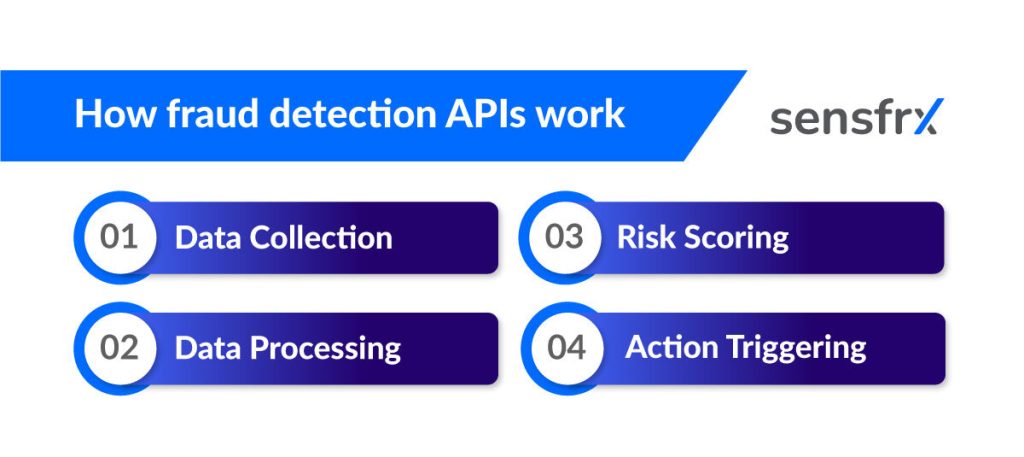
1. Data collection. The API collects signals at each key event:
- At signup, the email address and IP address.
- At login, the device, location and time of access.
- At checkout, the card used, the shipping address and the order details.
2. Processing. The data goes to the detection system, which runs preset rules or machine learning models over it to find anything out of pattern.
Example: a user who logs in from two countries within minutes is flagged.
3. Risk scoring. Each action gets a score.
Example: a login scored 90 out of 100 means a high chance of fraud, perhaps because it came from a device the account has never used.
4. Action. Your rules map the score to a response:
- A low-risk transaction is approved without friction.
- A high-risk login gets a two-factor challenge, such as an OTP sent to the user's phone or email.
- A suspicious event goes to a queue for a human to review.
Real customers pass through without noticing. Only the risky events pay a cost.
Five behaviors the API flags
1. Billing and shipping addresses that do not match
A mismatch is a common sign of stolen card details: the thief has the billing address from the card data but needs the goods sent somewhere else.
Example: a purchase billed to New York and shipped to an unknown address in California.
2. Disposable email addresses
Temporary inboxes let a fraudster pass email verification without leaving a traceable identity.
Example: a signup with "abc123@mailinator.com".
3. Logins from impossible locations
Two logins from far-apart places within a short window point to a compromised account.
Example: the same user logs in from London and Tokyo within an hour.
4. Many registrations from one device
Repeated signups from a single device is how fake accounts are farmed.
Example: one phone registers 10 accounts on an ecommerce site.
5. Brute force attempts
An attacker guesses credentials at machine speed.
Example: one account takes hundreds of failed login attempts within minutes.
Detection methods
Under the score, the API runs several checks:
- IP address tracking. The user's IP is checked for reputation and for behavior that differs from the account's history.
- Device fingerprinting. Operating system, browser and hardware traits identify the device; a new or markedly different device raises the score.
- Behavioral analysis. Machine learning learns each user's login times, locations and actions and flags departures from them.
- Geo-velocity. How fast the user's location changes. Faster than a plane can fly means two people.
- Scraper and crawler detection. Rapid requests and fake user agents mark bots, which stops data scraping and automated abuse.
- Email checks. Addresses that look generated, with gibberish local parts or disposable domains, score as higher risk.
What you get from an API instead of manual review
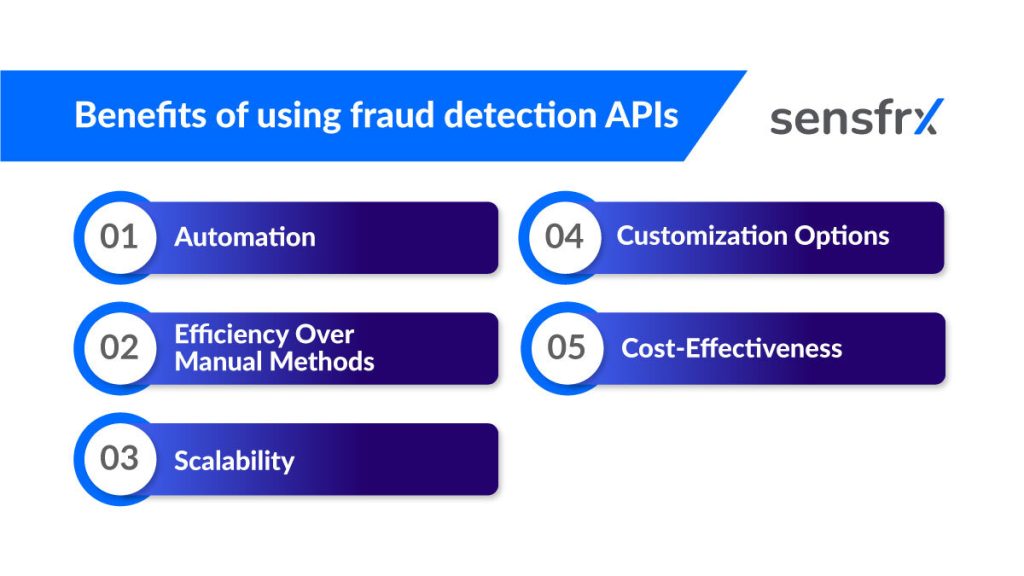
Automation. The API runs around the clock with no extra staff, and alerts you when something needs a person.
Speed and accuracy. Detection and response happen as the event occurs, faster and more consistently than a review queue.
Scale. Volume grows and the API keeps up; there is no team to expand.
Control. You set the alert triggers, thresholds and rules to match your own risk appetite.
Cost. Pay-per-use pricing means a small business pays for what it checks and a large one does not pay for idle capacity.
Where the API sits in a real product
Transaction screening. Every payment is checked before it is accepted. On an ecommerce site the API catches a burst of expensive orders that does not fit the account's history, and blocks payments from flagged IPs so stolen cards cannot be used.
Authentication and verification. The API confirms the user is who they claim to be through OTPs or biometric checks. An ecommerce app verifies a fingerprint at login; when an unknown device tries, the API blocks it and alerts, or challenges the user with an OTP by email or phone.
Behavioral analysis. A streaming platform sees a user streaming from two countries within minutes. The API flags it and either raises an alert or suspends the account until the owner confirms.
Why REST
REST APIs are lightweight and work with any stack, which is why most fraud detection services expose one. Five reasons it fits this job:
1. Integration
Standard HTTP, no proprietary libraries. The same endpoint serves web apps, mobile apps and backend services.
2. Scale
REST is stateless, so each request stands alone and horizontal scaling is straightforward. That matters at ecommerce and banking volumes.
3. Familiarity
Every developer has used one. There is no new protocol to learn before the first request goes out.
4. Latency
Fraud decisions must happen inside the request. REST responses are fast enough to approve, challenge or reject before the page renders.
5. Standard formats
JSON or XML in and out, which every language parses and every third-party service accepts.
REST is the right choice when you need:
- Platform-agnostic integration.
- Scale, flexibility or cross-platform reach.
- Advanced features, central control and strong security.
How to integrate one
Six steps from decision to first scored request:
- Define the goal. An ecommerce platform might want to stop fraudulent checkouts or catch high-risk users at registration.
- Compare providers: Sensfrx, Seon, Sift, FraudLabs Pro or MaxMind. Check risk scoring, transaction monitoring, device fingerprinting and machine learning against your goal.
- Read the API documentation: request and response examples, error handling, sample code.
- Confirm support for your languages and frameworks. Most cover Python, JavaScript and PHP.
- Sign up for API keys and use them to authenticate every request.
- Tune risk scores, thresholds and rules to your own traffic, so the API reflects how your customers behave.
Where to start
Sensfrx is built to be the fast option in that list: REST APIs plus ready-made SDKs for multiple languages, plugins for WooCommerce, Shopify, WHMCS, Blesta and WISECP, and a free plan for businesses of any size. Pricing and the 14-day trial are right here.