Free trial abuse is the deliberate exploitation of a time-limited or feature-limited offer, usually by creating fake accounts to keep using paid features without paying. The tools are disposable emails, virtual phone numbers, signup bots and proxies. It ranges from one person with several accounts to bot campaigns that consume GPU cycles or API quotas, and fraud rates run between 0.17% and 8% of signups. Midjourney's 2023 decision to end free trials after bot farms overwhelmed its servers is the best-known case.
Free trial abuse: How it works and how to stop it at signup
How free trial abuse works, what it costs SaaS and AI services, the Midjourney and GitLab cases, and a layered, low-friction way to stop it at signup.
 By 10 mins readPublished Updated
On this page
Free trial abuse is the repeated exploitation of a time-limited or feature-limited offer: one person or one script opening account after account to keep using a paid product for nothing. It cost Midjourney its free tier and forced GitLab to put a credit card check in front of free CI minutes. For a SaaS or AI service, the bill shows up as infrastructure spend, lost conversions and product analytics you cannot trust.
What follows: how the abuse works, what it does to a business, the cases that made companies change their trials, a layered prevention strategy that keeps friction low for real users, a seven-day rollout, and the metrics to watch. The short version: get telemetry and a manual review loop in place before you spend on machine learning.
Why free trial abuse is growing
Free trial abuse costs direct revenue, inflates infrastructure spend and distorts the product metrics you plan around. It ranges from one user with three email addresses to coordinated bot campaigns that burn through compute or API quotas in hours. AI services with heavy backends have made the problem worse, because a single abused account can run up real GPU, storage or third-party API costs before anyone notices.
The defences used to be built in-house. They are now standard parts of fraud-prevention platforms: disposable email block lists, device and IP intelligence, velocity rules, graph link analysis and step-up challenges, all low friction for real users.
What free trial abuse does to a business
The direct loss is the smallest part. The table shows where the rest lands.
| Area of Impact | Description of Consequences |
| Financial Costs | The most immediate impact is on the company’s bottom line. This includes excess expenditure on compute/GPU resources, higher Content Delivery Network (CDN) and database costs, and the need for an increased headcount dedicated to manual review and investigation. |
| User Experience Degradation | Legitimate paying customers suffer from the fallout of abuse. Service performance can degrade, leading to slower response times. To combat fraud, companies may be forced to implement stricter throttles and usage limits, negatively impacting the experience for genuine users and potentially increasing churn. |
| Data & Analytics Integrity | Product and marketing strategies are compromised by skewed data. Inflated engagement figures, misleading retention metrics, and flawed user funnels can lead to poor go-to-market decisions, misallocated growth budgets, and incorrect product feature prioritisation. |
How abusers work, and who it has hurt
The toolkit is cheap: temporary emails and phone numbers for disposable identities, bots to automate mass signups, and VPNs or proxies to hide where the traffic comes from. The more organised abusers run production workloads through permissive trial APIs, or sell working trial credentials on marketplaces.
The damage is visible in the decisions companies have made. Midjourney stopped its free trial after bot farms drove up latency and GPU costs. GitLab made credit card verification mandatory to stop crypto-miners from burning its free CI/CD resources. Netflix and Disney+ have dropped free trials in most regions to end serial signups from people dodging subscription fees.
- Multi-accounting with disposables.** Burner emails, virtual phone numbers and VPNs allow endless resets, often scripted.
- Bot-driven mass signups. Scripts flood the trial, max out the features (thousands of AI images, say) and vanish.
- Credential stuffing and sharing.** Breached logins hijack live trials, and underground rings sell access on Discord or Telegram.
- Geo-evasion and pattern mimicry. Proxies hide the origin while AI-generated "human-like" usage dodges the obvious flags.
Detection is a class-imbalance problem. Fraud rates sit between 0.17% and 8% of signups, so the abusers hide inside a much larger body of real users.
Cases by industry
The pattern is the same everywhere; the details change by sector.
- AI and image generation (Midjourney). In 2023 Midjourney paused free trials indefinitely, citing "extraordinary abuse", after bots overwhelmed its servers to generate and scrape images in bulk. Restricted prompt demos did not stop the demand spikes, and abusers resell outputs on black markets, which costs AI firms GPU cycles they never get paid for.
- Gaming. In free-to-play titles such as Fortnite, bots farm trials for loot that is resold through real-money trading. Better Business Bureau data logged more than 200 scam reports by mid-2025 and over $86K in losses since 2022 from trial-linked phishing.
- Social media. Premium badges and ad-free feeds attract sock puppets. X and LinkedIn trials are gamed with AI-generated profiles for engagement farming, which feeds misinformation and dilutes ad revenue. Trials are the low-barrier entry point for high-value extraction.
- DevOps and software development (GitLab). Developers cycle through trials with proxies to hoard CI/CD compute credits. GitLab's reported 2025 figures put abuse in enterprise trials at 15%, which distorted usage data and delayed feature rollouts. Underground forums sell "unlimited GitLab trials" for $5 a month.
- Streaming (Netflix and Disney+). Password-sharing rings turn one trial into a fleet of households, with VPNs to beat geo-locks. Before Netflix's 2023 crackdown, password sharing was costing it an estimated $500M a year. Disney+ saw more than 7M leaked logins in 2024, which then fed trial abuse. Stuffed credentials stream around the clock, straining bandwidth and skewing viewer data.
A layered way to prevent and detect it
The aim is to raise the abuser's cost at every step while leaving real users alone. Four layers do that, each cheaper and quieter than the one after it.
| Strategy Layer | Key Tactics |
|---|---|
| Foundational Measures (Low-Friction) | Implement email verification, block disposable domains, and use basic device/IP reputation checks. Apply rate limits on signups and set conservative initial feature quotas for all new users. |
| Adaptive Verification (Risk-Based) | For suspicious or high-value trials, trigger step-up challenges such as phone number or credit card verification. Employ progressive feature unlocks that expand a user’s access as they provide more verified signals. |
| Behavioural & Relational Analysis | Monitor usage velocity (e.g., API calls per minute) for anomalies. Use graph analysis to link and identify coordinated fraudulent accounts based on shared IPs, device IDs, or payment details. |
| Automated Response & API Hardening | Use machine learning models to score risk and automate actions like issuing a CAPTCHA, quarantining an account, or flagging for manual review. Secure APIs by requiring keys and metering resource-intensive calls. |
You do not need to build the layers yourself. [Sensfrx](/) puts the same building blocks behind one API and dashboard, so wiring it into the signup flow gives you:
- A real-time risk score for every trial signup, from device, network and behaviour signals.
- Detection of the abuse vectors above: burner emails, bot farms, VPN hopping and credential reuse.
- A policy engine where someone who is not an engineer turns "block disposable domains", "challenge VPN users" or "hold high-velocity clusters" into live rules in minutes.
- A review action, so a rule can flag and log before it ever blocks, and you can measure drop-off and false positives on real traffic first.
- The score history you need to track signup quality, trial cost per account and appeal outcomes, which is the evidence product and finance teams want before they fund the next step.
That is the fastest route from knowing what to do to doing it. The rollout below takes seven days and no downtime.
Rolling it out
The rollout runs in three phases: integrate, tune in review-only mode, then enforce. Done in that order, it protects signups against fake registrations, account takeover and bot traffic without blocking a single real user before you have seen the data.
Seven-day roadmap with Sensfrx
Phase 1: Set up and integrate (days 1 to 3)
- Day 1: Account setup. Create a Sensfrx account, add your property, generate API keys, and set every rule to review rather than block so the first days are observation only.
- Day 2: Client side. Add the JavaScript tag to your web pages and the mobile SDK to your apps for device fingerprinting and behaviour signals.
- Day 3: Server side. Install the server-side SDK and call the risk API when a user signs up for a trial, so each signup is scored in real time.
Phase 2: Watch and tune (days 4 to 6)
- Day 4: Baseline. Read the fake-registration analytics in the dashboard and find your own abuse markers: disposable emails, several accounts from one device, VPN traffic, high-velocity signups.
- Day 5: Policies. Write the rules that answer them: block disposable emails, challenge VPN users, flag multi-registrants, block high-risk bots.
- Day 6: Test. Leave the rules on review for a day, check what they would have caught and what they would have blocked wrongly, and move the thresholds.
Phase 3: Enforce (day 7)
- Day 7: Switch on. Move the tuned rules from review to block, do a final dashboard pass, and set a standing weekly review so new abuse patterns get a rule before they get expensive.
Running it day to day
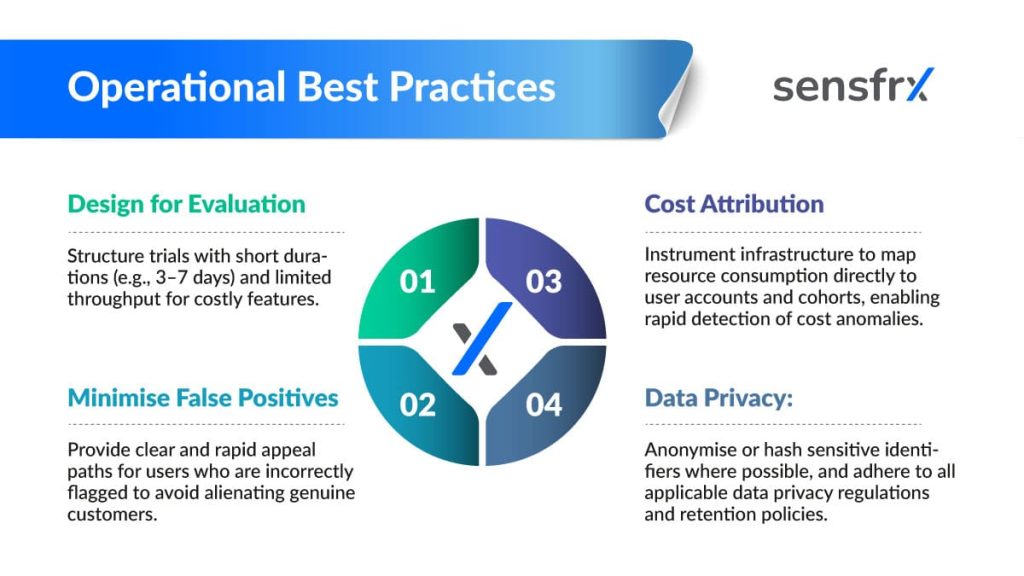
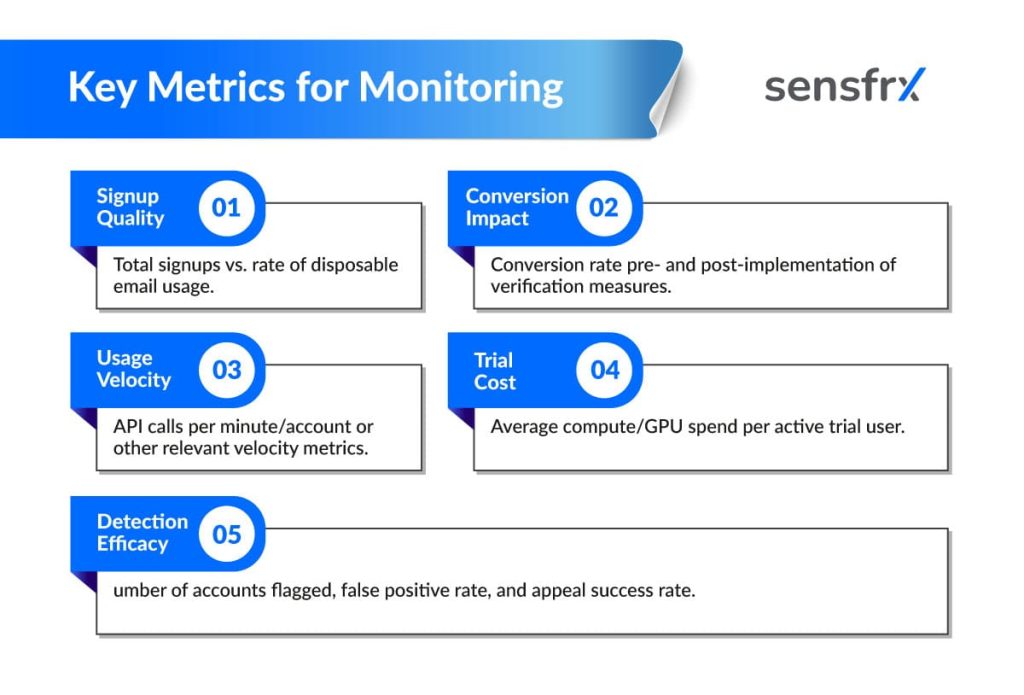
After go-live the work is measurement. Track the metrics below, review the flagged queue, and adjust rules when abusers change tactics, with the same care for real users' friction that you had on day one.
Metrics to watch
These numbers tell you whether the controls are working and where to tune next.
Where to start
Build the foundation before the machine learning: telemetry, rule-based checks and a manual review loop you can run every week. Start by wiring in Sensfrx, blocking disposable email domains, setting basic rate limits, and attributing infrastructure cost to each trial account. Then A/B test one verification step, phone or card, on a small cohort. You will be able to size the problem and show the return before you spend on anything heavier.
References
- Knight, W. (2023). "Midjourney's CEO Says the Company Is Stopping Free Trials Due to 'Extraordinary' Abuse". Wired. https://www.wired.com/story/midjourney-stops-free-trials-abuse-deepfakes/
- GitLab Team (2022). "How we're tackling crypto mining abuse on GitLab.com". GitLab Blog. https://about.gitlab.com/blog/2022/07/20/how-were-tackling-crypto-mining-abuse-on-gitlab-com/
- Wang, D., et al. (2022). Survey of graph-based fraud detection. IEEE Transactions on Neural Networks and Learning Systems. DOI: 10.1109/TNNLS.2022.3216838.
- Liu, Z., et al. (2021). "EnsemFDet: An Ensemble Approach to Fraud Detection based on Bipartite Graph". Proceedings of the 2021 International Conference on Management of Data (SIGMOD '21). Association for Computing Machinery, New York, NY, USA, 2409 to 2413. DOI: 10.1145/3448016.3457252.
Frequently asked questions