Machine learning in fraud detection: How it works and where it beats rules
How machine learning detects fraud: the three model types, where they beat static rules, the four build stages, and named examples from payments and insurance.
 By 9 mins readPublished Updated
On this page
- What machine learning is
- How machine learning applies to fraud detection
- Machine learning vs. Rule-based fraud detection
- How fraud detection with machine learning works
- Where machine learning is used in fraud prevention
- Real-world examples of machine learning in fraud detection
- What machine learning gives a fraud team
- Where to start
Rule-based fraud detection flags a transaction when it trips a fixed condition: amount over a threshold, a new country, three orders in ten minutes. Machine learning scores it against everything you have seen before. That difference is why ML now sits at the centre of fraud prevention for payments, signups and logins, and why rules alone leak both fraud and good customers.
The short version: rules are cheap to write and easy to evade. Models cost more to build, catch patterns no analyst wrote down, and get better as they see more fraud. Most teams end up running both, with the model doing the scoring and the rules setting the thresholds.
What machine learning is
Machine learning (ML) is the branch of AI where a program learns the decision from data instead of being handed the rule. You give it examples; it finds the patterns that separate one outcome from another and applies them to new cases.
Three types matter for fraud work.
Supervised learning
The model trains on labelled data: each past transaction tagged fraud or not fraud, usually from chargebacks and analyst decisions.
It learns which combinations of features (amount, device age, email domain, time since signup, shipping distance) separate the two classes, then scores new transactions on the same features.
Common algorithms include linear regression, decision trees and support vector machines.
Unsupervised learning
No labels. The model groups data by similarity and flags what does not fit any group.
Clustering algorithms such as K-means sort transactions into clusters, and the ones far from every cluster are the outliers worth a look.
This is how you find fraud you have no labels for yet: a new scheme shows up as a cluster that did not exist last month.
Reinforcement learning
The model acts, gets a reward or a penalty, and adjusts.
In fraud detection that loop looks like threshold tuning: the system raises or lowers its block threshold based on how the last batch of decisions turned out, measured in chargebacks and false declines.
How machine learning applies to fraud detection
A fraud model does one job: given a transaction, login or signup, output a probability that it is bad.
It learns that probability from history. Every past event, with its device, network, behaviour and outcome, becomes a training example. Normal looks like the bulk of the data; fraud looks like the exceptions that later turned into chargebacks or account recovery tickets.
With more data the boundary sharpens. The model picks up signals an analyst would not write a rule for, such as a long gap between billing and shipping address combined with a device first seen two minutes before checkout.
Retraining keeps it current. When fraudsters change method, the new pattern shows up in the outcome data and the next training run picks it up without anyone writing a rule.
The same approach covers more than payments.
Models trained on network traffic, user activity and system logs flag breaches and insider misuse the same way: by scoring how far an event sits from the baseline.
Machine learning vs. Rule-based fraud detection
Rules came first and still do useful work. The problem is what they miss and what they wrongly block.
Where rules fall short
A rules engine checks each transaction against conditions an analyst wrote: amount over a limit, a country on a list, more than a set number of orders from one IP in an hour.
Simple to write, simple to read in an audit. Five costs come with that simplicity:
- No adaptation. A rule catches the fraud it was written for. A new pattern passes until someone notices and writes another rule.
- False positives. Blunt thresholds block real customers. Each false decline is lost revenue and often a lost customer.
- Manual load. Someone has to write, tune and review the rules, then investigate what they flag. That does not scale with volume.
- Narrow coverage. Rules describe known patterns. Anything that does not match passes.
- Slow response. From a new pattern appearing to a rule going live can take days or weeks, and the fraud runs the whole time.
What a model changes
A model replaces the hand-written conditions with a learned boundary.
What that buys you:
- Adaptation. Retrain on recent outcomes and the model follows the fraud without a rule change.
- Fewer false positives. Scoring on hundreds of features at once separates good from bad more finely than three thresholds can.
- Scale. The same model scores a thousand or a million transactions a day with no extra analysts.
- Lower running cost. The build costs more up front; the day-to-day cost drops because fewer humans review fewer alerts.
- Real-time decisions. Scoring happens in the request path, so the block lands before the order ships or the session is issued.
How fraud detection with machine learning works
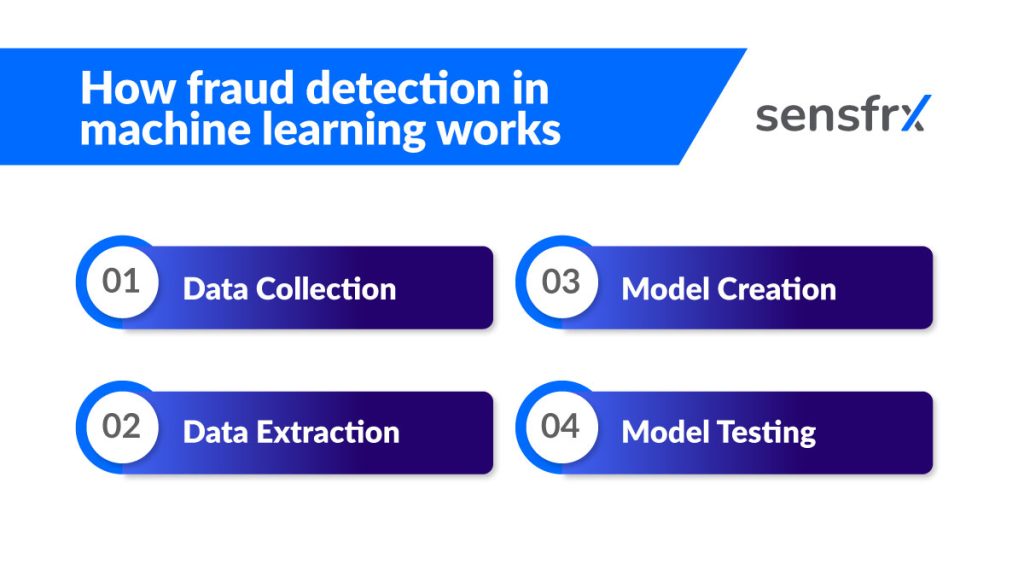
Building a fraud model has four stages. Rushing any of them shows up later as a model that scores well in testing and badly in production.
1. Data collection
Gather the raw material: historical transactions, user activity logs, device data, IP and network attributes, and the outcomes (chargeback, refund, confirmed fraud, confirmed good). Model quality is capped by what you collect here. Missing outcome labels is the usual gap.
2. Data extraction
Turn raw records into features the model can use. That means cleaning and normalising the data, dropping fields that add noise, and engineering features that carry signal: time since account creation, distance between billing and shipping address, number of cards seen on this device, velocity counts per IP and per email.
3. Model creation
Train candidate models on the prepared data. Decision trees, logistic regression and neural networks are the usual starting points. Each learns a different boundary between good and bad; the job here is to find the one that separates them best on your data.
4. Model testing
Test on data the model has not seen. Measure accuracy, precision and recall, and look at where it fails: which fraud it misses and which good customers it blocks. Tune features, thresholds and the algorithm until the error profile matches what the business can live with, then keep measuring after launch.
Where machine learning is used in fraud prevention
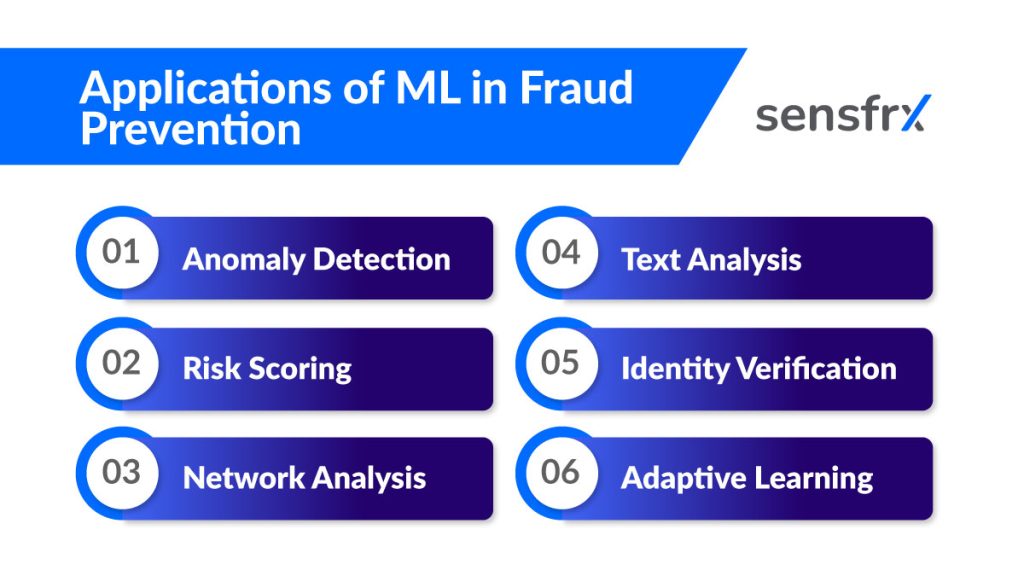
Six places a fraud model earns its keep.
1. Anomaly detection
Finding what does not fit: a spending pattern, a login time, a location or a device that sits far from the user's own history and from everyone else's. The model does this across thousands of attributes at once.
2. Risk scoring
Every transaction, login or account gets a score built from history, behaviour and context. The score drives the decision: allow below one threshold, review between, block above. It also sets the queue order for analysts, so they see the worst cases first.
3. Network analysis
Graph models connect accounts through shared devices, cards, addresses, phone numbers and IPs.
A fraud ring that looks like fifty unrelated customers one account at a time becomes a single cluster on the graph, and the whole ring can be actioned together.
4. Text analysis
Natural language processing (NLP) models read unstructured text: emails, chat logs, support tickets, reviews, claims.
They pick up phishing content, scripted scam conversations and inconsistent claim narratives that a keyword filter misses.
5. Identity verification
Models score whether the person behind a session is who the account says they are.
Inputs include face match, voice, typing rhythm and device fingerprint, checked in real time at signup, at login and before high-value actions.
6. Adaptive learning
The model updates as outcomes come in.
A new fraud pattern becomes training data as soon as the first cases are confirmed, so detection shifts with the fraud instead of waiting for a rule.
Real-world examples of machine learning in fraud detection
Named companies running ML in production fraud work:
Card and in-person payments
- Card fraud detection: PayPal uses ML to score transactions on location, device and user behaviour. JPMorgan Chase runs anomaly detection to flag activity that deviates from a customer's normal pattern.
- POS anomaly detection: Shopify applies ML to point-of-sale transaction data to catch unusual spending patterns and transaction times.
Marketplaces and banking
- Seller fraud: Alibaba uses ML to detect fraudulent sellers from product types, seller behaviour and ratings.
- Check fraud: Capital One uses deep learning to read checks and flag forged signatures or altered amounts against historical patterns.
E-commerce and card networks
- Fake reviews: Amazon uses ML to detect fraudulent reviews from language, reviewer behaviour and timing.
- Transaction monitoring: American Express uses ML to analyse millions of transactions per second for patterns such as rapid successive purchases or transactions at unusual times.
Insurance and healthcare
- Claims fraud: UnitedHealth Group applies ML across claims and provider data to detect fraudulent insurance claims.
- Medical identity theft: Anthem uses ML on medical history and prescription records to find inconsistencies that point to a stolen identity.
What machine learning gives a fraud team
Three outcomes, in the order finance teams tend to notice them.
1. Lower cost
Automated scoring cuts the labour spent on manual review and the technology spent on maintaining rule sets.
Analysts stop reading every flagged order and start working the short list the model puts at the top of the queue.
2. Higher accuracy
A model trained on your own history learns which patterns are fraud and which are quirks of your customer base.
Fewer false positives means fewer good customers declined. Fewer false negatives means less fraud reaching the chargeback stage. Both numbers are measurable before and after the model goes live.
3. Always on
The model scores every event, at any volume, at any hour. There is no backlog at peak and no gap over a weekend.
Because scoring happens in real time, the decision lands before the goods ship or the session is issued, which is the only point at which stopping fraud is cheap.
Where to start
If you run on rules today, the first step is not a model. It is outcome data. Start recording which flagged orders turned out to be fraud, which passed orders came back as chargebacks, and which declines were real customers. Without those labels there is nothing to train on.
Then let a model do the scoring and keep your rules as thresholds on its output. The model finds the pattern; the rules decide what to do about it.
Keep analysts in the loop. Their decisions on the review queue are the labels that retrain the model, so the two improve each other.
Sensfrx handles the scoring side: every signup, login and payment gets a score from device, network and behaviour signals, and your rules turn it into allow, review or block.
[Start on the free plan](/), connect the plugin or API, and compare its scores against your current rules for two weeks before you change a threshold.