Check your medical records and credit reports for activity that is not yours, ask the providers involved about the charges, then report the fraud to the FTC, the police and the credit bureaus.
Medical identity theft: How it happens and how to stop it
What medical identity theft is, how patient data gets stolen, the signs a record is compromised, and what providers, insurers and victims should do.
 By 6 mins readPublished Updated
On this page
Medical identity theft is the use of someone else's name, Social Security number or insurance details to get treatment, prescription drugs or insurance payouts. The victim finds out when the bills arrive, or when their chart shows a diagnosis they never had. For the provider or insurer that let the thief through, it means claims paid to the wrong person, corrupted records and a breach notice.
It is also harder to clean up than card fraud. A stolen card gets cancelled. A corrupted medical record has to be corrected at every provider and insurer that copied it, and the thief's allergies or blood type can sit in the victim's chart for years. Prevention costs far less than the cleanup.
What medical identity theft is
A thief gets a person's name, Social Security number, insurance documents or other identifying details and uses them to file fake insurance claims, obtain prescription drugs or get other medical services.
The victim gets bills for services, drugs or treatments they never had. Worse, the thief's test results and diagnoses end up in the victim's record, which can lead to a misdiagnosis, the wrong treatment or a denied insurance claim later.
Unlike financial theft, it is slow to detect, and that makes it slow to fix. By the time anyone notices, the bad data has spread to every provider and insurer that holds a copy of the record.
How the data gets stolen
Most cases start in one of these ways.
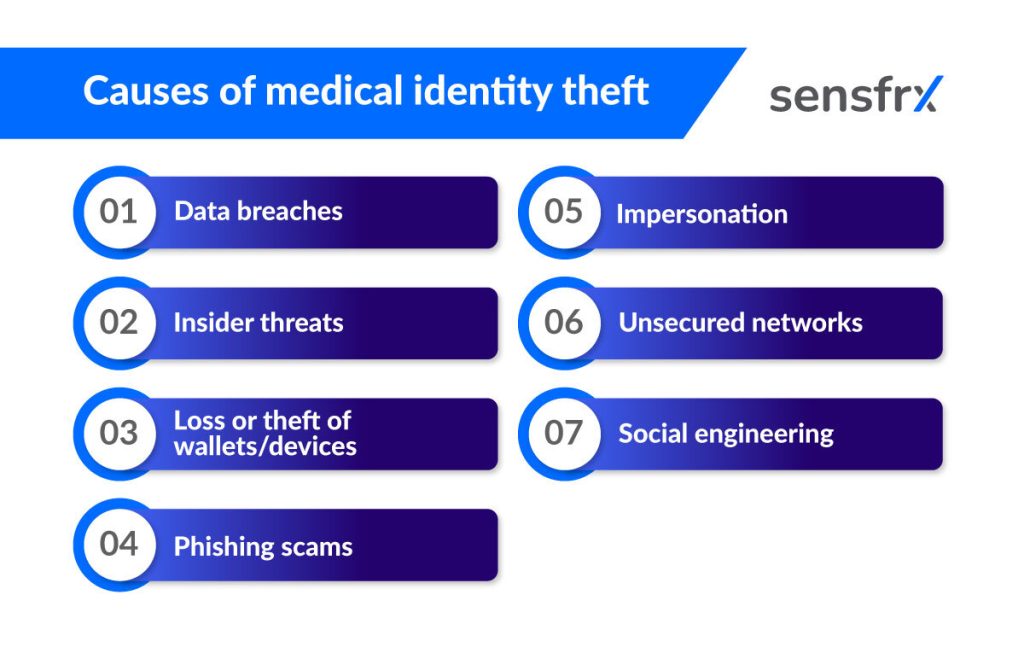
- Data breaches. Providers, insurers and the vendors that hold medical data are prime targets. One breach can hand over thousands of records at once.
- Insiders. Staff with access to patient records sell them.
- Lost or stolen wallets and devices. An insurance card, a laptop or a phone with records on it is enough.
- Phishing. Emails, calls or lookalike websites dressed up as the provider or insurer.
- Impersonation. Callers posing as healthcare workers ask patients for their details.
- Unsecured networks. Opening a patient portal or sending records over open Wi-Fi exposes the traffic.
- Social engineering. A casual conversation that draws out a date of birth, a policy number or a Social Security number.
Signs that a record has been compromised
The warning signs fall into five groups.
| Category | Signs of Medical Identity Theft |
|---|---|
| Financial Indicators | • Unexpected medical bills for services you didn’t receive.• Medical collection notices on your credit report that you don’t recognize. • Diminished credit score due to fraudulent medical debts. |
| Insurance Issues | • Insurance claims denied due to maxed-out benefits you didn’t use.• Notifications from your insurance provider about unfamiliar claims or services.• Discovery of unknown health insurance accounts under your name.• Discrepancies in your Explanation of Benefits (EOB) statements.• Denial of insurance coverage due to conditions you don’t have.• Being told you’ve reached your benefit limit unexpectedly. |
| Medical Record Discrepancies | • Errors in your medical records (unfamiliar treatments, diagnoses, or medical histories).• Discovery of unknown medical records under your name.• Difficulty obtaining life or health insurance due to incorrect medical conditions. |
| Unexpected Communications | • Calls from medical providers about appointments or follow-ups for treatments you never had.• Notices about unfamiliar prescriptions filled in your name. |
| Data Breach Notifications | • Notification that your medical provider’s records have been compromised. |
How to prevent medical identity theft
Prevention is a set of habits rather than one control. The table below lists them by area. For a provider or insurer, the ones with the most effect are the account controls: two-factor authentication on patient portals, a check at signup that a new account belongs to a real patient, and a check at login that the device and network match the person.
A correct medical record matters beyond money. In an emergency, a clinician treats from what is in the chart.
| Category | Key Actions |
|---|---|
| Protect Personal Information | • Safeguard Social Security numbers.• Securely dispose of documents.• Use strong passwords. |
| Monitor Medical Records | • Regularly check records for inaccuracies.• Obtain and review Explanation of Benefits (EOB). |
| Be Cautious with Personal Information | • Avoid sharing information unnecessarily.• Recognize phishing scams. |
| . Secure Online Accounts | • Enable two-factor authentication.• Use secure networks for online activities. |
| Shred Sensitive Documents | • Shred physical documents.• Securely delete digital data. |
| Report Suspicious Activity | • File police report.• Contact healthcare providers and insurers.• Place fraud alerts.• File FTC complaint.• Keep detailed records. |
What it costs when it goes unnoticed
The damage grows with the delay. Beyond the loss of insurer and taxpayer money, most people learn of the theft only when a bill arrives for treatment they did not have, or results come back for tests nobody performed on them.
Claims and settlements take months, so a victim may also find out when an insurer rejects a legitimate claim because someone else has already used up the benefit limit.
The medical risk is the worst of it. If someone was diagnosed under your identity, the next clinician who opens your chart may treat you on the basis of that person's results.
What to do if you are a victim
Act quickly and work through these steps in order.
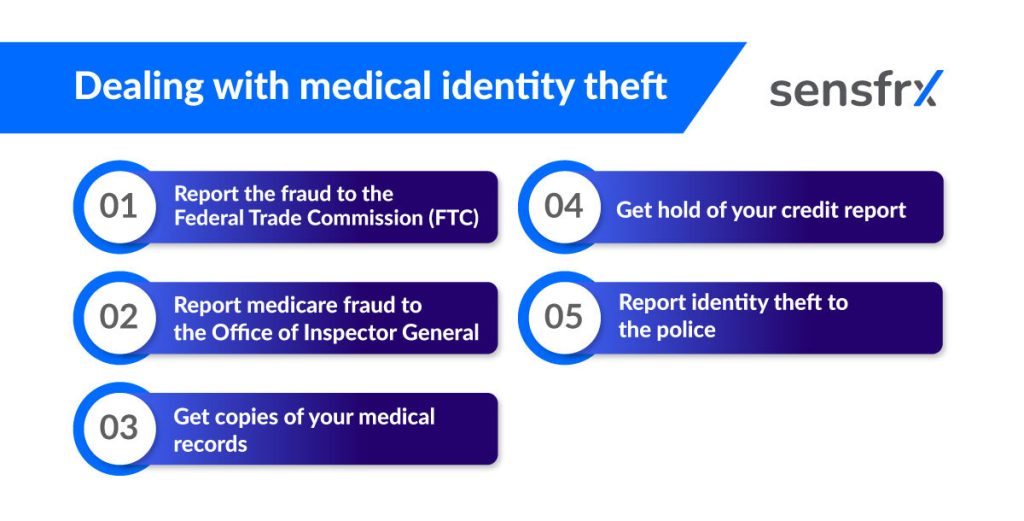
1. Report the fraud to the federal trade commission (FTC)
File a report at IdentityTheft.gov. The FTC turns it into a recovery plan for your situation.
2. Report Medicare fraud to the office of inspector general
The OIG investigates fraud in programs run by the Department of Health and Human Services, including Medicare.
3. Get copies of your medical records
Ask every provider named in your insurance or Medicare claims for your records, then read them for treatments, diagnoses and prescriptions that are not yours.
4. Pull your credit report
It shows new accounts opened in your name and any medical debt sent to collections. If you find either, contact the credit bureaus and place a fraud alert or a credit freeze so no further accounts can be opened.
5. Report the theft to the police
Some insurers and debt collectors will not act on a dispute without a police report.
Where to start
For a provider or insurer, the cheapest place to stop medical identity theft is where the stolen identity is first used: a new patient portal account, a login from a device the patient has never used, a claim filed from an unfamiliar network. Catch it there and the record never gets corrupted.
[Sensfrx](/) scores signups, logins and payments from device, network and behaviour signals, and your rules decide what to allow, review or block. Try it free.
Medical identity theft FAQs