Onboarding fraud: What it is and how it works
Onboarding fraud is a stolen or fabricated identity passing your signup. The forms it takes, how it differs from other fraud, and what stops it.
 By 8 mins readPublished Updated
On this page
Onboarding fraud is the use of a stolen or fabricated identity to open a new account and take what the account gives access to: credit, goods, a free trial, a payout. It has grown with online signups, because a registration form that verifies nothing is an open invitation.
Onboarding is the set of steps that bring a new customer, employee or user into your system: identity documents checked, background verified, credentials issued. Fraudsters feed that process false information, and the business pays twice, in direct losses and in customers who stop trusting it.
How onboarding fraud works
Criminals use the onboarding flow itself to get at sensitive data or money. Ecommerce and financial services see it most, because that is where a new account converts fastest into cash, and the cost is financial loss, brand damage and, where regulated data is involved, legal exposure.
The raw material is identity data: social security numbers, card details, scanned documents, taken in bulk from data breaches or lifted from individuals one at a time.
The four forms it takes
Any onboarding process can be abused. The four that matter:
- Employee onboarding fraud. False resumes, applications or background details, such as invented degrees, work history or references, to get hired.
- Customer onboarding fraud. False identities, stolen data or fabricated documents to open accounts or get financial products. Common in banking, insurance and anywhere identity is verified at signup.
- Vendor onboarding fraud. Fake business credentials, doctored financial statements or counterfeit references to become an approved supplier.
- Digital onboarding fraud. False details to create online accounts or profiles that are then used for phishing, scams or money laundering.
Three examples
Online, onboarding fraud means a business accepting an account or transaction from someone who is not who they claim to be, at the moment of registration.
- Someone else's credentials. The fraudster registers with a real person's name, address and date of birth. The account then funds unauthorized purchases, loan and card applications, or money laundering.
- Fake documents and edited images. Convincing forged IDs and photoshopped scans pass the identity check, so a stolen identity gets an account that looks verified.
- Synthetic identity. Pieces of several real identities are combined into a person who does not exist. There is no victim to notice, so the account can run for a long time before anyone questions it.
How it differs from other fraud
Onboarding fraud happens at the first contact, when the account is created. Transaction fraud abuses an account that already exists. The distinction matters because the controls are different: one is a signup problem, the other a payment problem.
Transaction fraud and onboarding fraud
- Transaction fraud: unauthorized activity on an existing account, such as a purchase on a stolen card.
- Onboarding fraud: a new account created with false information, then used for whatever the fraudster planned.
Identity theft and onboarding fraud
- Identity theft: stolen personal data used to get into a person's existing accounts and services.
- Onboarding fraud: may use the same stolen or synthetic identity, but to create new accounts during signup.
Phishing and onboarding fraud
- Phishing: tricking a person into handing over personal information through a fake email or website.
- Onboarding fraud: using that information to open new accounts, often slipping past the initial checks.
Common methods
Four tactics cover most of what gets through a registration and verification flow.
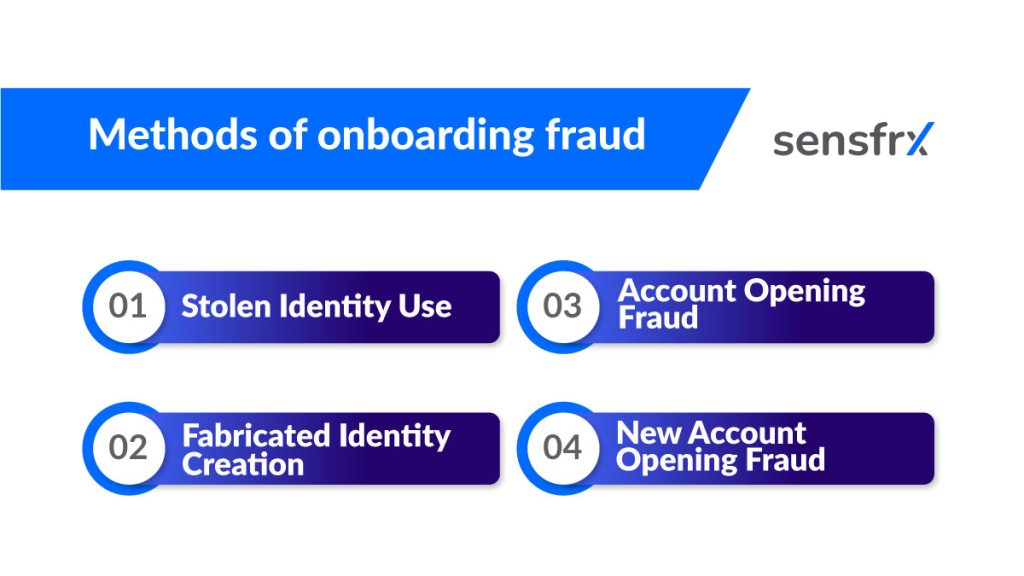
Stolen identity
Names, addresses and dates of birth from breaches, phishing or dark web markets are used to open accounts that pass the first checks, because the data is real. The accounts then make purchases, apply for loans or cards, and move money until the real person notices.
Fabricated identity
Real and invented details are combined into a synthetic person: a real Social Security number with a made-up name and address. Because the identity matches no single real person, nobody reports it and the usual checks do not catch it.
Account opening fraud
The general term for any fraud in opening a new account, whether with a stolen identity, a synthetic one or false documents, to get at financial or other benefits.
New account opening fraud
The same thing with the emphasis on the creation step: the account exists to commit fraud from day one, with stolen or fabricated identities as the means.
What it costs
Three kinds of damage, in the order they usually show up.
- Money. Uncollectible debts, chargebacks and unauthorized transactions, plus the cost of investigating them and of the analysts and tooling needed to stop the next ones.
- Reputation. Customers who see that a business cannot keep fraudsters out stop trusting it with their data. Bad press, churn and lost deals follow, and rebuilding trust takes years.
- Regulation. Data protection and fraud prevention rules such as GDPR and CCPA, plus sector-specific ones, carry fines, sanctions and closer supervision when onboarding controls fail. Staying compliant is ongoing work, not a one-off audit.
What stops it
Five controls, in rough order of how much each one catches.
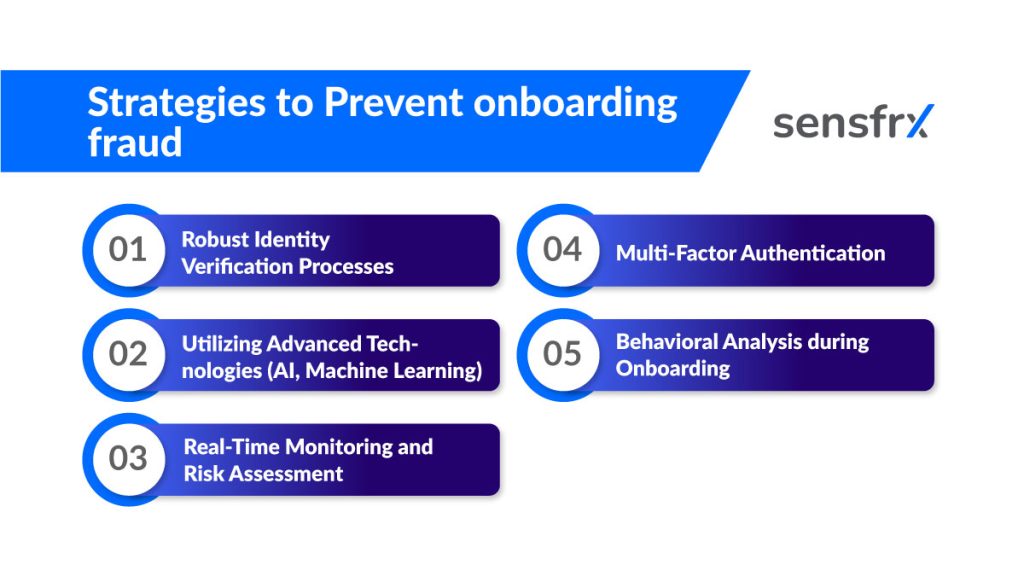
1. Identity verification that is hard to fake
Use more than one form of verification: a government-issued ID, biometric data, and a check of the submitted details against trusted databases. Each layer removes a class of forged or stolen identity, and the combination is what a fraudster cannot assemble cheaply.
2. Machine learning on the signup data
Models read the full stream of signup data as it arrives and pick out the patterns and anomalies that mark fraud. They retrain on new data, so they keep up as the tactics change.
3. Real-time monitoring and risk scoring
Score each registration as it happens and act on the score before the account is live. Unusual behavior and high-risk combinations, such as a new device on a known-bad network, get caught before they cost anything.
4. Multi-factor authentication
A password plus a fingerprint or a one-time code to the user's phone means stolen credentials alone do not open the account.
5. Behavioral analysis during onboarding
Watch how the form is filled: typing pattern, mouse movement, timing between actions. Compared against how real customers behave, scripts and fraud farms stand out, and the signup can be flagged for review. For the practical steps, see 10 ways to prevent onboarding fraud.
Where onboarding fraud prevention is heading
Both sides are getting better tools. The ones changing the defender's side are below.
Technologies
Four are already in production at scale.
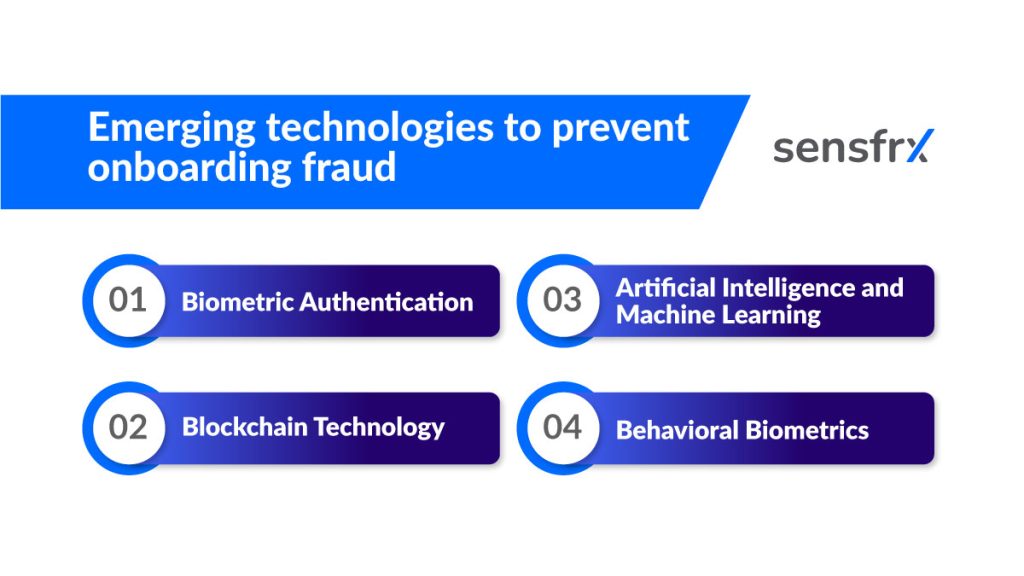
- Biometric authentication. Facial recognition, fingerprint and voice checks tie the account to a person rather than to data that can be bought.
- Blockchain. A decentralized, tamper-evident ledger for identity records and transactions, which makes altering or fabricating an identity history harder.
- AI and machine learning. More accurate real-time detection that reads large volumes of data for the patterns of fraud and adapts as new tactics appear.
- Behavioral biometrics. Keystroke dynamics, mouse movement and device handling, baselined per user so deviations during signup stand out.
Trends
Five shifts to plan for:
- More collaboration and data sharing. Industry-wide databases and shared intelligence, because a fraud ring that hits one business hits its peers next.
- Regulatory change. Requirements and standards keep moving; compliance is a process to run, not a box to tick.
- Better user experience. Security and a smooth signup are being balanced with frictionless MFA and adaptive authentication, so good customers are not punished for the fraudsters.
- Prediction over reaction. Predictive analytics to find the risk before the account is opened, and controls applied in advance.
- IoT signals. More connected devices mean more data points to verify an identity and spot fraud. See also 10 best onboarding fraud detection software.
How Sensfrx stops onboarding fraud
Sensfrx scores every signup as it happens, from device, network and behavior signals, and your rules turn the score into allow, review or block. It is self-serve: plugins for WooCommerce, Shopify, WHMCS, Blesta and WISECP, REST APIs for everything else.
The device and network layer looks at browser fingerprint, IP reputation, proxy and VPN use, geographic location and whether the device has registered before. The behavior layer looks at how the form was filled. A high score can hold the account for review or block it outright before it is created, and the applicant who is a real customer sees no extra step.
Where to start
Onboarding fraud is a stolen or fabricated identity getting an account it should not have, and it grows with every business that moves signup online.
The forms differ (stolen credentials, forged documents, synthetic identities) but the point of entry is the same: the registration flow. That is also where it is cheapest to stop.
Start by scoring every registration on device, network and behavior. It needs no change to the form and catches bulk fake accounts on day one. Add document and biometric verification where the account value justifies the friction.
Frequently asked questions
Why has onboarding fraud increased?
More business happens through online signups, and most signup forms verify little, so the cost of trying is close to zero.
What is the onboarding process?
The steps a business takes to bring a new customer, employee or user into its system: identity documents checked, background verified, credentials issued.
How do fraudsters abuse it?
They submit false information, a stolen or fabricated identity, at registration and verification, and the business issues an account to someone who does not exist or is not who they claim.
How does onboarding fraud affect businesses?
Financial loss, brand damage and legal exposure, felt most in ecommerce and financial services.
How does it differ from other fraud?
It happens at first contact, when the account is created. Transaction fraud abuses an existing account; phishing is how the personal information is collected in the first place.