10 best onboarding fraud detection software compared for 2026
Ten onboarding fraud detection tools compared, from signup scorers like Sensfrx and SEON to bank platforms like Feedzai and Verafin, plus how to choose one.
 By 8 mins readPublished Updated
On this page
Onboarding fraud starts at the signup form: bot registrations, synthetic identities, stolen credentials and one person opening twenty accounts for the welcome bonus. Ten tools below catch it, and they split into two groups: signup and session scorers built for ecommerce, SaaS and hosting, and financial crime platforms built for banks.
The right one depends on what you sell and who regulates you. A fintech with KYC obligations needs different software from a WooCommerce store losing promo codes to multi-accounting.
What they share: each one scores a signup, login or payment from device, network, identity and behaviour signals, and most of them act without a human in the loop.
Getting labelled "high-risk" by a payment processor costs more than the fraud itself, which is why the choice matters.
The 10 onboarding fraud detection tools
In order, with what each one does well.
Sensfrx
Sensfrx scores every signup, login and payment in real time from device, network and behaviour signals, and your rules turn the score into allow, review or block. It is self-serve, with plugins for WooCommerce, Shopify, WHMCS, Blesta and WISECP and a REST API for everything else.
The features that do the work:
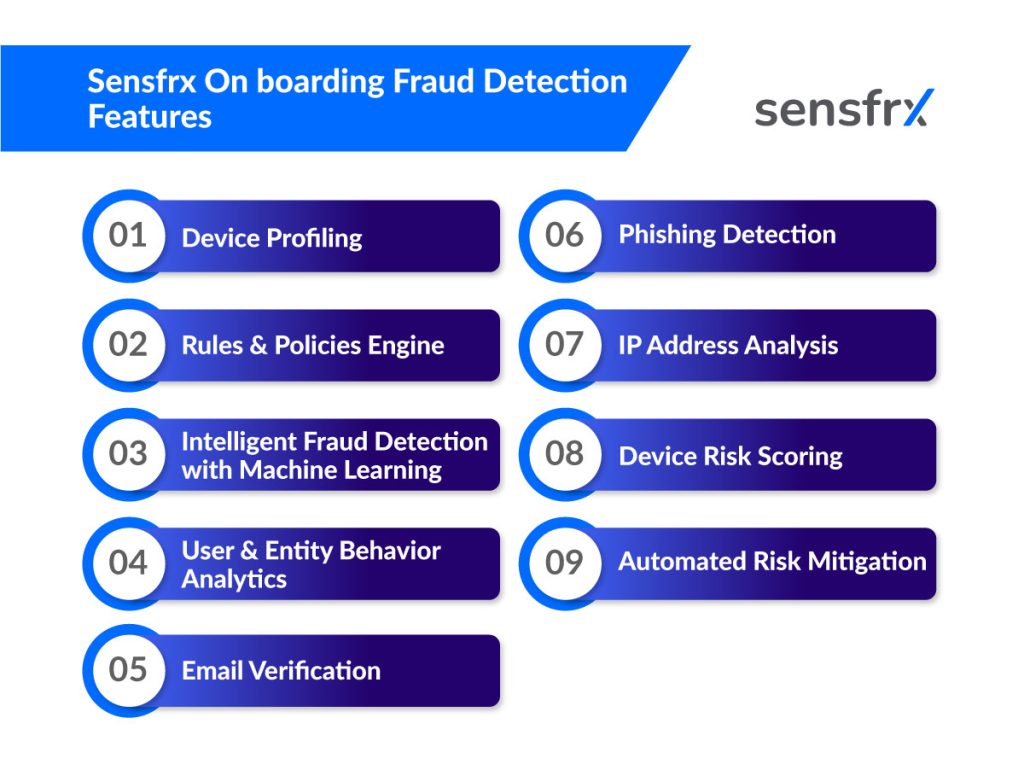
Device profiling
- Builds a fingerprint from device-level attributes so the same device shows up across accounts, which is how account takeover attempts, bots and multi-accounting get caught.
Rules and policies engine
- You write the validation rules and thresholds yourself, per risk type, so the decisions match your own risk appetite rather than a vendor default.
Machine learning detection
- Models read user data, device characteristics and behaviour patterns together to catch application fraud, account takeover and payment fraud.
User and entity behaviour analytics
- Tracks how accounts, devices and IP addresses normally behave, then flags login attempts and transactions that break the pattern.
Email verification
- Checks that a signup email is real and deliverable, which catches throwaway-address registrations.
Phishing detection
- Flags suspicious emails and websites from their content and sender characteristics.
IP address analysis
- Scores the IP address behind each session or transaction for risk.
Device risk scoring
- Each device gets a risk score from its characteristics and behaviour, so you can decide how much friction to add per device instead of per site.
Automated risk mitigation
- Automated workflows handle the clear cases, so manual review is left for the grey zone.
Together these cover account takeover, fake registrations, payment fraud and chargebacks on one score, and the plugins and API mean the setup fits the stack you already run. See fake registration prevention for the signup use case.
IPQualityScore
IPQualityScore combines bot detection, user screening and fraud scoring to find fake accounts, fraudulent payments and chargebacks.
The main pieces:
- Bot detection that blocks automated traffic so only humans reach your services.
- Proxy and VPN detection for sessions hiding behind anonymisers.
- Email validation for authenticity and deliverability.
- Device fingerprinting to spot repeat devices and account takeover attempts.
- User and transaction scoring in real time from more than 25 data points: IP, device, email, phone and billing details.
Everything is reachable through the API, so it drops into an existing signup or checkout flow.
Signifyd
Signifyd scores the intent behind online payments. It reports a 5-7% lift in order approval rates for clients on its API or platform, and its device fingerprinting watches both legitimate and fraudulent behaviour during a transaction.
The aim is to let merchants approve payments without carrying the fraud risk themselves. Machine learning assesses identity and intent and returns a payment score.
Its Chargeback Recovery service and real-time monitoring are the two headline offerings.
What the commerce protection platform offers:
- Big data analysis, machine learning and human oversight combined, with financial protection against fraud on approved transactions.
- Coverage for non-fraud chargebacks such as "item not as described", and a 100% guarantee against chargebacks claiming an item was never received.
- Strong customer authentication for European retailers under PSD2, authenticating customers without step-ups on all transactions, not just exemptions.
- Developer tools and documentation for building, testing and shipping integrations.
- A financial guarantee on approved orders that shifts fraud liability away from the merchant.
In short:
- Fraud protection
- Chargeback recovery
- SCA without step-ups
- Developer tools
- Guaranteed fraud protection
SEON
SEON reads more than 50 social and digital footprint signals per user and lets you tune the scoring to your own risk model.
Its customers span banking, iGaming, online lending, ecommerce, payment gateways and crypto.
It also covers Anti-Money Laundering (AML) and Know Your Customer (KYC) checks, and its behavioural analytics catch schemes from the crude to the well-planned.
The fraud API shows the data behind every interaction and transaction, which helps uncover fraud patterns and find revenue you were turning away.
Features:
- Login authentication
- Data enrichment
- Integration and deployment options
- Multi-accounting detection
- Browser extension for quick lookups
- Graphical user interface
- Real-time transaction monitoring
DataDome
DataDome protects websites, apps and APIs from account takeover, scraping, DDoS, card cracking, credential stuffing, fake account creation and vulnerability scanning.
It processes 3 trillion signals a day and claims 99.99% accuracy in real time, without slowing the site or app it protects.
Because it is built for bot-driven fraud, it fits digital onboarding well. Behavioural detection and a custom CAPTCHA keep the false positive rate at 0.01% or lower, so real users rarely see a challenge.
Features:
- Fraud detection and prevention
- Account takeover protection
- Dashboard and analytics
- Customisation and integration
Salv bridge
Salv Bridge is a collaboration platform: financial crime teams at different institutions share warnings in real time as if they were one team. Banking groups, fintechs and VASPs using it report recovering up to 80% more funds.
It links risk-based prevention with the recall process for confirmed fraud.
What it does:
- Starts fund recovery on high suspicion, before the victim reports anything.
- Removes the delay of waiting for victim confirmation, which improves the odds of recovery.
- Tightens real-time payment controls through cross-institution cooperation.
- Encrypts shared data so no third party, Salv included, can read it.
Acting on suspicion rather than confirmation is what lifts the recovery rate.
Feedzai
Feedzai is built for retail and corporate banks, fintechs, PSPs and acquirers.
Its strengths:
- Customer risk evaluation
- Early risk signals
- Fraud pattern discovery
- User anomaly detection
- Defence against credential theft, impersonation and manipulation attacks
Features:
- AML transaction monitoring
- Alert prioritisation
- Know Your Customer (KYC) and customer due diligence
It monitors transaction fraud across channels in real time with behavioural and transactional pattern-scoring models, and it is strong on authorised push payment (APP) fraud and scams.
Verafin
Verafin sells enterprise anti-financial crime software covering AML/CFT and fraud for financial institutions:
- Targeted analytics for financial crime detection
- Multi-channel transaction monitoring
- Automatic analysis of customer profiles and historical behaviour
It pulls in cross-institutional, third-party and open data to cut false positives and raise alert quality. The FRAML platform covers fraud and AML scenarios on one system across channels.
As of 2023, 92.14% of Verafin's customer base was located or operating in the United States.
Features:
- Fraud detection and management
- Anti-financial crime
- Investigation tooling
- Compliance and reporting
Experian fraud solutions
Experian's fraud suite covers application fraud, account takeover and synthetic identity fraud while keeping friction low for genuine customers. What it offers for onboarding:
- Automatic flagging of suspicious activity so investigators work the high-risk cases and genuine customers pass through.
- Predictive analytics that estimate fraud likelihood before the account opens.
- Identity verification, device intelligence, biometrics and behavioural analytics combined.
- High-accuracy models that cut false positives, so fewer good applicants are declined or challenged.
- Payment options that adjust per customer based on calculated fraud risk.
- AML and KYC support for regulatory obligations.
- Reporting and analytics on fraud trends and control effectiveness.
- A modular design, so you deploy only the capabilities you need.
Features:
- Lower friction for customers
- Compliance and regulatory support
- Flexible, scalable platform
- Cloud-based deployment
- Multilayered fraud protection
- Modular architecture
Kount
Kount does digital identity verification and ecommerce fraud prevention. Equifax, one of the largest consumer credit reporting agencies, acquired it in 2021, which widened its data and reach.
Its detection combines:
- Supervised and unsupervised machine learning
- Signal data from a global network of payment processors, card networks and fraud analysts
That shared network data is what gives its automated decisions their accuracy.
Features:
- Cross-channel fraud detection and prevention
- Account takeover protection
- Login authentication
- Cloud-based deployment
- Compliance and regulatory support
How to choose an onboarding fraud detection tool
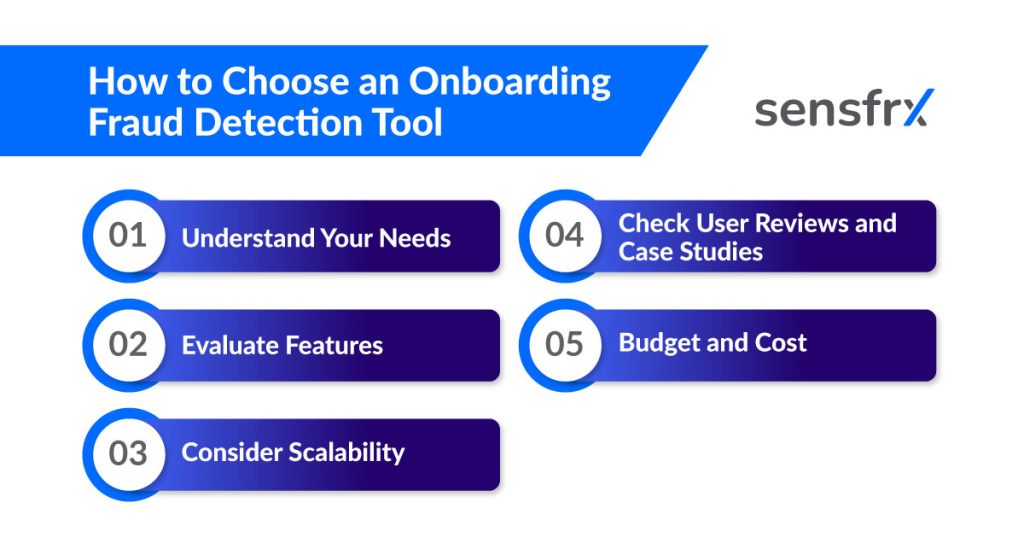
- Start from the fraud you have. Pull the last quarter's fake signups, chargebacks and support tickets and name the top two types. A tool that is excellent at APP fraud does nothing for promo abuse.
- Check the features against that list: real-time scoring, a rules engine you can change yourself, integration with your platform, and support that answers.
- Make sure it scales. Signup volume spikes during campaigns, and the tool has to score every one of them without adding latency.
- Read reviews and case studies from businesses that look like yours, not the largest logo on the vendor's site.
- Price it against what you lose. A per-transaction fee is cheap next to a processor putting you in the high-risk tier.
Where to start
If your fraud arrives at the signup form, Sensfrx is the shortest path to a score on every registration. Sign up for the free plan, install the plugin or call the API, and watch a week of live signups before you write a single rule.
Banks and regulated fintechs should weigh Feedzai, Verafin, Experian and Salv Bridge, where AML monitoring and case management are the core, not an add-on.
Whichever you choose, score early. Fraud caught at registration never reaches the payment step, and fraud caught after the payment is a recovery exercise with poor odds.