Refund fraud: Seven tactics and how to stop each one
What refund fraud is, the NRF numbers, seven tactics from wardrobing to receipt manipulation, and the policies, checks and tools that stop them.
 By 12 mins readPublished Updated
On this page
Refund fraud is a customer, or someone posing as one, using the returns process to get goods or money they are not owed: claiming a parcel never arrived, sending back a used or swapped item, or demanding a refund on a purchase made with someone else's card. The National Retail Federation (NRF) puts the cost to retailers at $24 billion a year. The controls that cut it are mostly process: clear policies, inspection, reconciliation and an identity check at the refund step.
What refund fraud is
The pattern is always the same: a refund goes out with no legitimate purchase or return behind it. Sometimes the item never comes back, sometimes a different item comes back, sometimes the refund exceeds what was paid.
Definition
Refund fraud is a claim for money back that the claimant is not entitled to. It covers people using fake or stolen identities to claim refunds from retailers and banks for goods never bought, and real customers abusing a policy. The label is simple; the forms are not.
Two of the most common: return abuse, where the customer damages an item or lies about it to get a full refund, and wardrobing, buying an item to use once and send back.
How it differs from identity theft and card fraud
Identity theft steals personal data (names, addresses, Social Security numbers) to build identities for loans, tax refunds and the like.
Card fraud uses someone's card without consent. Both hit the consumer first. Refund fraud hits the merchant, who carries the loss.
The scope of the problem
Refund fraud, also called return fraud and sometimes lumped in with friendly fraud, is the customer who buys and then claims the item was faulty or never arrived.
- The numbers. The NRF puts return fraud at $24 billion annually and found that 8% of all returns, online and in store, are fraudulent, with online returns twice as likely to be dishonest as in-store ones.
- Why ecommerce is worse. No counter, no face, no inspection at the moment of return. The shift to online shopping during the COVID-19 pandemic moved more returns into that channel, and the fraud followed.
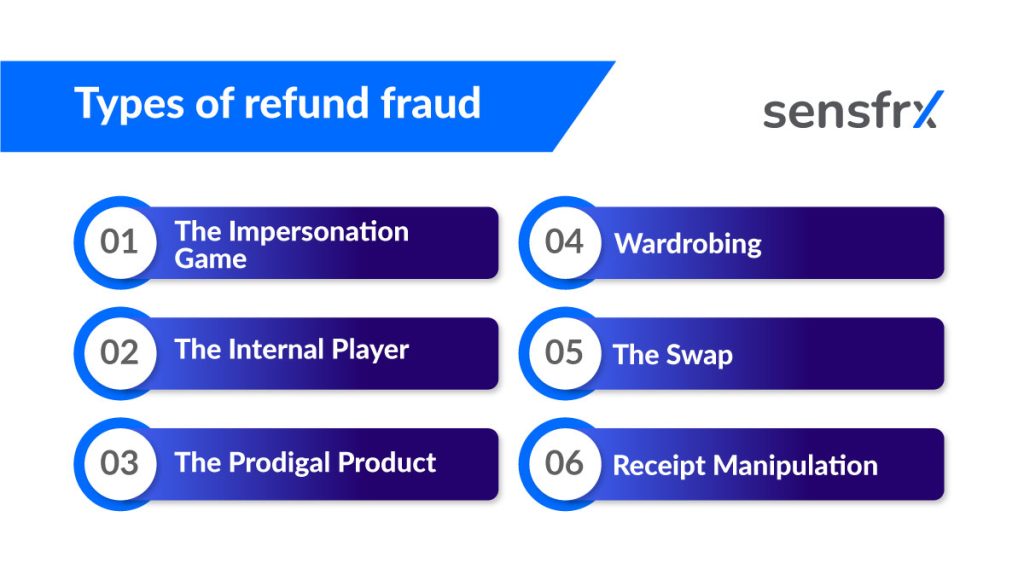
Seven refund fraud tactics
Seven tactics cover most cases. The first two are impersonation and distraction; the rest are ways of abusing a real purchase.
The impersonation game
The scammer poses as a legitimate customer, using stolen card numbers, names and addresses, and claims refunds the real customer never asked for.
Example scenarios
A small online store with weak signup checks gets a run of new accounts built on stolen identities. Each account buys, claims a refund, buys again, and the whole set disappears once the refunds clear.
In “dropping”, the scammer orders expensive goods with stolen card details and an address they can watch, intercepts the delivery, then tells the retailer the parcel never came (or that they never ordered it) and asks for a full refund.
Distraction tactics
At the counter or during online checkout, the fraudster creates confusion, a dispute, a rush, a second transaction mid-process, so that staff or systems approve a refund that should have been checked.
Prevention
Two controls:
- A second check before any refund. For online refunds, two-factor authentication (2FA) or a one-time password (OTP) to the contact on file before the money moves.
- Anti-fraud software at payment. Tools that use machine learning to score behavior during payment processing catch the pattern a distracted employee misses.
The internal player
Insider fraud is a member of staff using their own access to issue refunds to themselves or to accomplices. It happens in businesses of every size.
Monitoring and prevention
Two steps:
- Train staff. Many internal cases involve employees who did not grasp that what they were doing was fraud, or what it would cost them.
- Manage access. Insiders use the access they were legitimately given. Limit who can issue refunds, and log every refund against the user who issued it.
The prodigal product
The customer buys a high-value item, uses it for a while, then damages or alters it and returns it as faulty.
Why it works and how to counter it
It works because a returns desk under time pressure takes the customer's word for the item's condition.
Preventive measures
- A strict, written return policy: original packaging, proof of purchase, a time limit. Fraud that depends on returning a damaged item is deterred when the conditions are explicit.
- Quality control before a return is accepted: does the item match the order, does it show damage or alteration, was it bought recently.
Examples
- Large retailers lean on process. Amazon's “Fulfilled by Amazon” program and Best Buy's “Track My Repair” feature are the usual examples: centralized handling of returned stock in one case, step-by-step tracking of a returned item in the other.
Wardrobing
Wardrobing, or “renting and returning”, is buying an expensive item to wear or use once and returning it for a full refund.
Impact on retailers of high-value items
Designer clothing, luxury accessories and electronics are the main targets.
Impact on retailers:
- Lost margin. The returned item is used or slightly damaged and cannot be sold as new.
- Brand damage. If worn goods are resold as new, the customer who receives them tells people.
The swap
The customer returns a different item in the original box, an older model, a broken unit, a counterfeit, and keeps the new one, collecting a full or partial refund.
Preventive measures
- Inspect every return. Open the box and check serial numbers against the sale.
- Write the policy down. State the conditions for a return and that the item must come back in its original state.
- Track returns per customer. Frequent returners show up in the data long before staff notice them.
Receipt manipulation
The fraudster alters a receipt, the amount, the date or the items listed, to claim a refund on a transaction that did not happen as shown.
Spotting it:
- Misaligned text. Genuine receipts print in a fixed layout; text that drifts has been edited.
- Blurry or smudged print. Sections that look reprinted or digitally altered usually were.
Preventing it:
- Store receipts securely, on paper and digitally, so originals cannot be altered.
- Verify against the transaction record before any refund. The receipt is a claim; the sales system is the evidence.
Preventing refund fraud
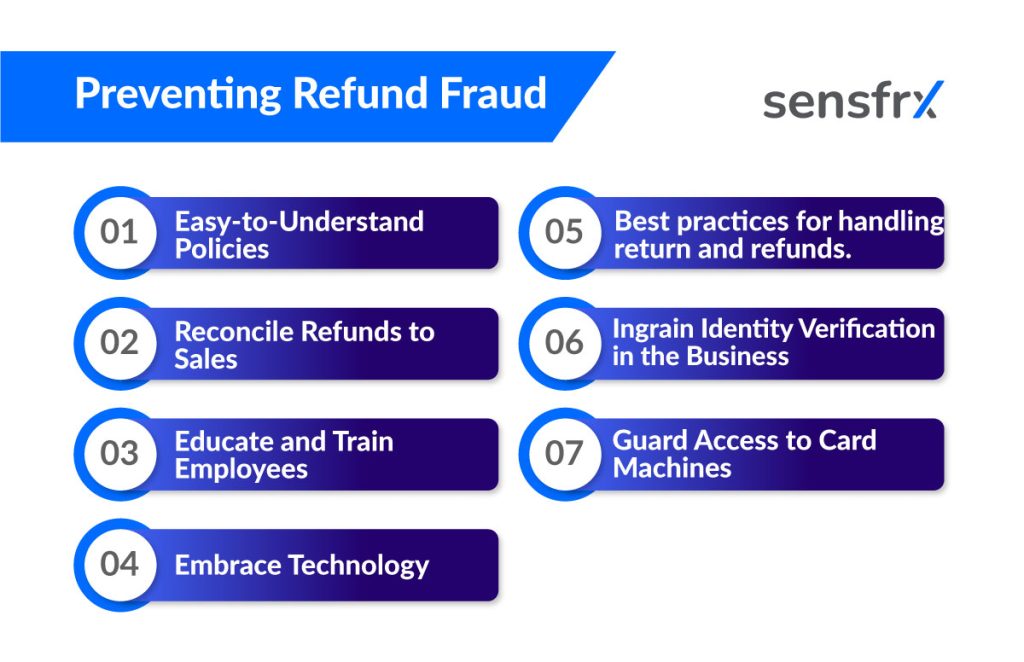
Six controls, most of them process rather than software.
Policies people can read
Write the return and refund policy in plain language and put it where customers see it before they buy. Clear terms cut disputes and remove the “I didn't know” defense.
Why clear policies matter
A customer who knows the time limit, the condition required and the proof needed has fewer gaps to exploit.
Closing the loopholes
Two things to get right:
- State the timelines. How many days to start a return, and how many to request a refund.
- Track every return. A tracking system gives customers visibility and gives you a record of who returns what, and how often.
Reconcile refunds to sales
Every refund should match a sale. Reconciling the two is how you find refunds issued against nothing.
Match every refund to a specific sale
Two reasons:
- Accurate books. Each refund traced to its original sale keeps the financial record honest.
- Fraud detection. Without the match, a refund can go out with no sale behind it, and nobody notices until the quarter closes.
Daily reconciliation
How to run it:
- Manual review. Automation helps, but one named person should check the day's refunds against sales.
- Cross-check inventory. For physical goods, a refund for a return should move stock. If it did not, ask why.
Train staff
Staff on the returns desk and in support see the fraud first, if they know what they are looking at.
Regular training on fraud recognition
Sessions should cover:
- Common tactics. Identity theft, fake IDs, card fraud, and the seven refund tactics above.
- Red flags. Odd customer behavior, unusual purchase patterns, details that do not match the account.
Handling returns and refunds
Two practices:
- Verify the original purchase first. Receipt, serial number, payment method, before any refund is processed.
- Give staff a script for suspected fraud. Decline politely, ask for more information, or escalate to a manager.
Build identity verification into the business
Check identity at the points that matter: account creation, payment and refund requests. Multi-factor authentication (MFA), biometrics and automated verification cut the share of refunds that go to someone other than the buyer.
Identity checks for refund requests
The refund request is where weak checks get exploited. Require more than an email: email verification plus a mobile OTP, with security questions as a fallback.
Cross-reference sales data
Compare the refund request with the sales record, the purchase history and the customer profile. Automated cross-referencing in real time flags the mismatch before the money leaves.
Guard access to card machines
Point of sale (POS) terminals are a target in their own right. Compromise one and the attacker has card data and, often, the ability to issue refunds.
Protecting POS systems
Three controls:
- Physical security. Terminals locked down and accounted for.
- Restricted access. Role-based access so only the people who need a terminal's admin functions have them.
- Surveillance. Cameras on the areas where terminals sit.
Passwords and updates
Passwords
Two rules:
- Unique per terminal. One breached password must not open every POS.
- MFA where the terminal supports it. A second factor such as a code to a phone.
Updates
Keep POS firmware and software current:
- Apply vendor updates. Manufacturers patch vulnerabilities in them.
- Turn on automatic updates where available.
Use the software
Artificial intelligence (AI) and machine learning (ML) find the patterns in refund data that a person reviewing tickets will not.
What AI and ML do for fraud detection
Across large datasets, in real time:
- Pattern recognition. Models trained on past cases learn what fraudulent refund behavior looks like.
- Anomaly detection. A refund request that does not fit the customer's history gets flagged.
- Automated response. Suspicious transactions are flagged without waiting for someone to notice.
Tools businesses can adopt
Three categories, with examples:
- Analytics platforms. Splunk and IBM Watson pull transaction data from existing systems into one view for investigation.
- Payment gateway tools. Stripe Radar and PayPal's Fraud Protection sit inside the payment flow and screen transactions as they are processed.
- Behavioral biometrics. BioCatch and Zighra identify fraud from how a user interacts with the device and the interface.
Balancing fraud prevention with customer satisfaction
Every control above adds friction. The job is to put it where fraudsters feel it and honest customers do not.
Encourage returns over refunds
A return gets the item back. A cash refund with no return is where most of the loss sits.
Why returns beat refunds
Two advantages:
- Lower transaction fees. The payment processor charges a fee to push a refund back to the customer's account; an exchange or store credit avoids it.
- Lower return shipping costs. A structured returns process keeps shipping costs down.
Free return shipping as a deterrent
Free return shipping sounds like a cost but changes behavior in your favor. Genuine buyers purchase with more confidence, and a refund-without-return claim is easier to refuse when sending the item back costs the customer nothing.
Weigh the chargeback
A chargeback is the customer's bank reversing a transaction after a dispute, usually because the customer says they did not receive the item or were not satisfied with it. Know your exposure first: industry, product type and customer base all set the baseline rate.
Chargeback risk versus a refund
When a dispute lands, refund or fight? A chargeback costs the fee, possible penalties and a mark against your ratio. Too many and the processor labels you high-risk, which raises the cost of every transaction after.
Deciding on amount, lifetime value and chargeback ratio
Three inputs to the decision:
- Transaction amount. Small amounts are rarely worth a fight.
- Customer lifetime value (CLV). The total a customer is worth over the whole relationship. A long-standing customer's first dispute is a refund, not a battle.
- Current chargeback ratio. How close you are to the processor's threshold decides what one more chargeback costs you.
Where to start
Refund fraud is a process failure before it is a technology failure. Start with the controls that need no new software: a written policy with time limits and condition requirements, inspection of every return against the sale, and daily reconciliation of refunds to sales.
Then put an identity check at the refund step so the money goes back to the buyer and nobody else. For the dispute side, read understanding chargeback fraud next.
Frequently asked questions (FAQs)
1. What is refund fraud?
A refund claimed on a purchase that was not made, not returned, or not returned as sold.
2. How can businesses differentiate refund fraud from other types of fraud?
Identity theft and card fraud hit the consumer. Refund fraud hits the merchant, who pays out money or goods on a false claim.
3. What are the most common types of refund fraud?
Return abuse (damaging an item to get a refund), wardrobing (use once, then return), the swap, receipt manipulation and impersonation with stolen identities.
4. How prevalent is refund fraud in eCommerce?
More common than in store. The NRF found online returns twice as likely to be fraudulent as in-store returns.
5. What are some examples of refund fraud tactics?
The impersonation game, where stolen identities are used to claim refunds, and distraction tactics that get a refund approved without the usual checks.
6. How can businesses prevent refund fraud through internal controls?
Limit who can issue refunds, train staff, enforce the return policy, and reconcile refunds to sales daily.
7. What is “wardrobing,” and why is it a concern for retailers?
Buying an item to use once and return for a full refund. Retailers of high-value goods lose the margin because the item cannot be resold as new.
8. How can businesses counteract the “prodigal product” fraud tactic?
Enforce a strict return policy, inspect returned items against the sale, and require proof of purchase.