Chargeback fraud: What it is and how to prevent it
Chargeback fraud costs merchants the goods, the sale and the fee. How to tell a real dispute from friendly fraud, and nine practices that cut chargebacks.
 By 6 mins readPublished Updated
On this page
Chargebacks cost money whether the dispute is honest or not. A MasterCard report put 2023 chargeback costs at $117.47 billion. When the dispute is fraudulent, the customer keeps the product and the merchant loses the goods, the sale and the fee.
Chargeback fraud is when a customer buys something with a card, receives it, and then tells the card issuer the transaction was unauthorized or the goods never arrived.
The Fair Credit Billing Act gives cardholders the right to dispute billing errors and charges for goods not delivered. Some customers use that right to get a legitimate purchase for free.
Merchants can fight the claim, but the process is slow and the costs are steep, so many let the dispute go.
Each one that goes through costs revenue, damages reputation and raises processor fees.
The most common types of chargeback fraud
Three patterns come up most often.
1. Friendly fraud
The customer orders online, receives the item, then tells the issuer it never arrived and takes the refund.
2. Card testing
Fraudsters holding stolen card details run small purchases to check which cards still work, then make a large purchase with the ones that do. The real cardholder disputes the charge and the chargeback lands on the merchant.
3. Return policy abuse
The customer buys an item, uses it for an occasion, then returns it as unsatisfactory. The merchant refunds a used product.
Who chargeback fraud targets
Any business that sells at a distance is exposed. These see the most of it:
- Online retailers, because buying and then disputing is easy and the merchant never saw the customer.
- Marketplaces and third-party platforms, where the platform connects the parties and the seller takes the loss.
- Digital goods sellers. A customer who downloaded the software or e-book can still claim they never got what was promised.
- Subscription services such as OTT platforms, where customers dispute charges after canceling.
- High-value and luxury goods, where one fraudulent chargeback is a large loss.
Telling a real dispute from chargeback fraud
Five checks separate the two.
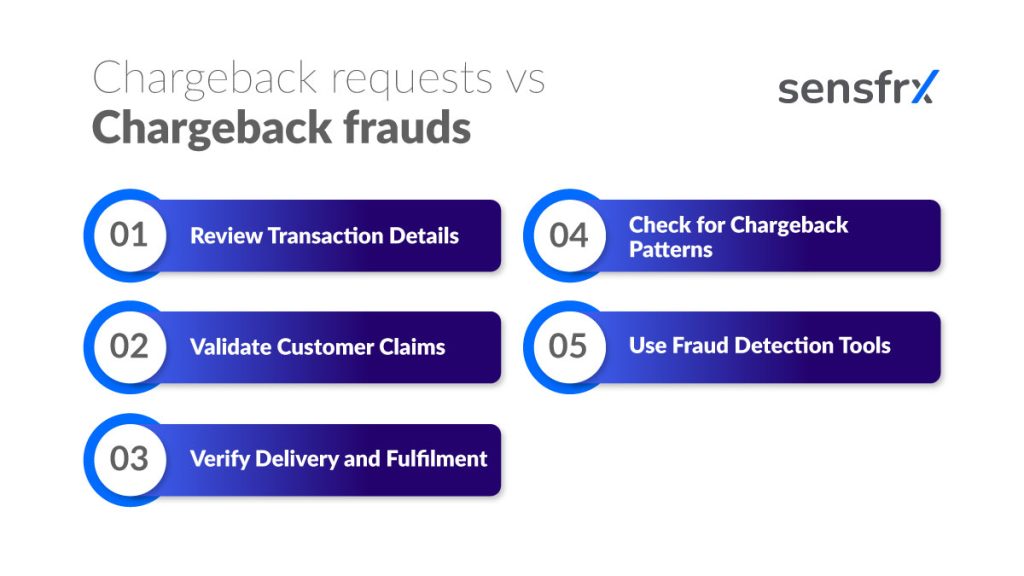
1. Review the transaction details
Check that the transaction ID, order ID, shipping address and product description match the claim. A customer disputing a laptop as undelivered has a weak case when the record shows it was delivered to their address.
2. Validate the claim with the customer
Call the customer and ask why they disputed. Most cases resolve on that call, one way or the other.
3. Verify delivery and fulfillment
Confirm delivery through proof of shipment and the carrier's delivery record for the stated address.
4. Check for chargeback patterns
Look for repeat disputes and frequent refunds on the same account, card, address or device. A pattern is a fraud signal that a single dispute is not.
5. Use fraud detection tools
A fraud detection tool such as Sensfrx flags suspicious transactions before they ship, which is the cheapest point to stop a chargeback.
Nine practices that cut chargebacks
These nine practices cut both honest disputes and fraudulent ones.
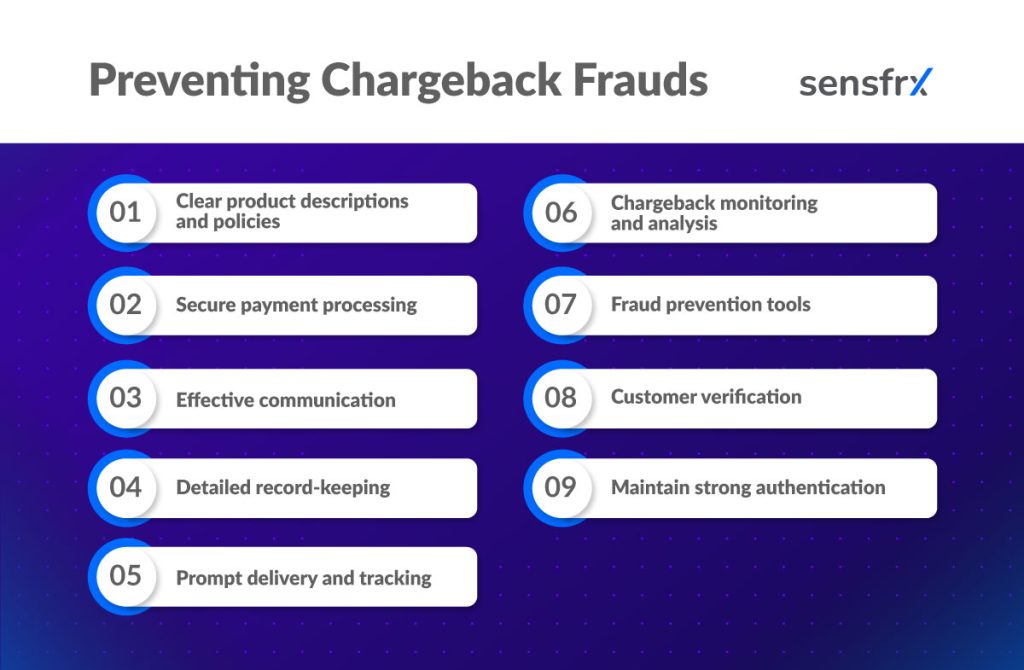
1. Clear product descriptions and policies
Accurate product descriptions, pricing, refund and replacement policies remove the confusion that produces honest disputes and the excuse that produces dishonest ones.
2. Secure payment processing
Screen payments with a chargeback fraud detection tool so unauthorized and suspicious orders are filtered out before they are approved.
3. Clear communication
Keep the customer informed from purchase to delivery and fix problems the moment they are raised. A customer who gets an answer from you does not need one from the bank.
4. Detailed record-keeping
Keep order details, shipping information and every customer message. That is the evidence that wins a dispute.
5. Prompt delivery and tracking
Ship on time and send tracking. Proof of delivery is the direct answer to an "item not received" claim.
6. Chargeback monitoring and analysis
Review chargeback data on a schedule to find patterns and the sources of friendly fraud, then fix the cause rather than the symptom.
7. Fraud prevention tools
Use tools that apply machine learning and data analytics to flag suspicious transactions and chargeback patterns before the order ships.
8. Customer verification
Require the CVV, use two-factor authentication and collect more information on high-risk orders. Each step deters the fraudster and strengthens your evidence if a dispute comes.
9. Strong authentication
Two-factor authentication, biometric verification and encryption keep scammers out of customer accounts, which removes one source of disputed transactions.
What Sensfrx does
Sensfrx's risk engine scores signups, logins and payments. These are the parts that matter for chargebacks.
Encryption
Sensitive user data and transactions are encrypted, so the data stays protected even if someone gets access they should not have.
Device fingerprinting
Captures the browser type, operating system, IP address and other attributes of the device behind each request. When the same device makes multiple registrations, geolocation flags it as unsafe and further registrations from it are stopped.
Behavior analysis
Tracks login patterns, access points and transaction history, and alerts on activity that departs from the account's norm.
Dynamic risk scoring
Scores each transaction in real time on user behavior, device information and transaction history, so the decision rests on evidence rather than a flat rule.
Friendly fraud validators
Identifies friendly fraud instances, which cuts the number of fraudulent chargebacks.
Machine learning detection
Machine learning models read real-time data for suspicious patterns: account takeover attempts, shady transactions, fake registrations.
Disposable email detection
Registrations from temporary or disposable email services are flagged as disposable.
Customizable fraud policies
Security teams write their own validation rules on factors such as merchant country, billing country and transaction amount, rather than taking a one-size-fits-all policy.
Automated fraud mitigation
Automated workflows handle the response, so the team is not reviewing each case by hand.
Real-time decisions
The risk engine returns a decision in 250 milliseconds on average, inside the time a checkout takes.
How Sensfrx protects against chargeback fraud
Four checks run on every registration and transaction:
- A new account created with the same login credentials (username, email and password) as an existing one is flagged as suspicious.
- A new account that matches the username, email and password of an account that has been inactive for a long time is flagged as unsafe.
- An email with multiple failed registration attempts triggers an alert.
- A phone number from a temporary or disposable service is flagged as disposable.
Where to start
Chargeback fraud is digital shoplifting, and it grows where it is easy. Start with proof: tracking on every shipment, a record of every customer message, and a monthly review of your chargeback data for repeat offenders. Then put a risk score in front of checkout so the suspicious orders never ship. Start on the free plan; questions about setup go through the contact page.