Click fraud: How it works, what it costs, and how to stop it
What click fraud is, who runs it, what it costs ($16.59 billion on Google Ads alone in a single year), and the signals, tools and settings that stop it.
 By 6 mins readPublished Updated
On this page
Click fraud is paid-ad clicks that no customer made: bots, click farms, or a competitor burning through your daily budget. On Google Ads alone it cost advertisers $16.59 billion in a single year, by Lunio's estimate. You pay for every one of those clicks, your conversion data gets polluted, and the platform's own filters catch only part of it.
What click fraud is
Click fraud is clicking on pay-per-click ads with no intent to buy, either to earn the publisher's share of the ad revenue or to drain the advertiser's budget. It happens on search, social and display networks, anywhere an advertiser pays per click.
Most advertisers never see it. The clicks look like traffic, the spend looks like marketing, and the only symptom is a cost per lead that keeps climbing.
How click fraud works
Four ways the clicks get generated:
- Manual clicks. A person clicks the ad on purpose, repeatedly, to cost the advertiser money.
- Click bots. Scripts that load the ad and click it thousands of times, rotating IPs and user agents so each click looks new.
- Click farms. Rooms of low-paid workers, or racks of phones, clicking ads by hand or by script. Cheap enough to hire for a single campaign.
- Botnets. Infected consumer devices clicking ads in the background. The traffic comes from real residential IPs in the right geography, which is what makes it hard to filter.
Types of click fraud
Who is behind the click decides how you stop it.
- Automated click fraud. Bots doing the clicking at volume. Imperva's 2022 Bad Bot Report put the share of organic and direct traffic that comes from bots at 27%.
- Manual click fraud. A person clicking to harm the advertiser or to earn publisher revenue. Low volume per person, and hard to tell from a curious visitor.
- Competitor click fraud. A rival, or someone they hire, clicks your ads until your daily budget is spent and your ad drops out of the auction. Your spend goes up, your impressions go down, and they take the slot.
What click fraud costs
The cost is the ad spend first, then the damage to every decision you make from the data.
- Wasted spend. Lunio's Wasted Ad Spend report estimated $16.59 billion lost on Google Ads to fake clicks and invalid traffic over 2024, and another $54.78 billion on Meta, LinkedIn, X and other platforms.
- Broken metrics. Fake clicks inflate CTR and crush conversion rate, so your bidding, keyword and creative decisions rest on bad data. Automated bidding then optimises on that bad data.
- Small advertisers bleed fastest. A large brand absorbs the waste; a small one runs out of budget by noon. ClickCease's State of Click Fraud report found US locksmith ads were the worst hit, with 71% of clicks invalid at around $15 per click.
Industries most exposed to click fraud
Exposure tracks two things: how much of the business depends on paid leads, and how much a click costs. High traffic also hides fraud, because a few thousand fake clicks vanish into a large daily total.
Four sectors where both are high:
- Legal. Law firms buy some of the most expensive keywords in search and lose the most per fake click.
- Healthcare. Clinics, practices and hospitals advertise treatments in competitive regions, where a rival's clicks or a bot run empties the budget before real patients search.
- Education. Universities, coaching centres and training providers run broad campaigns aimed at prospective students, which gives bots a wide target.
- Travel. Flights, hotels and packages are high-value bookings on expensive keywords. A burst of fake clicks on a peak-season campaign is a large bill.
Signs of click fraud
You will not get an alert. You find it in the numbers:
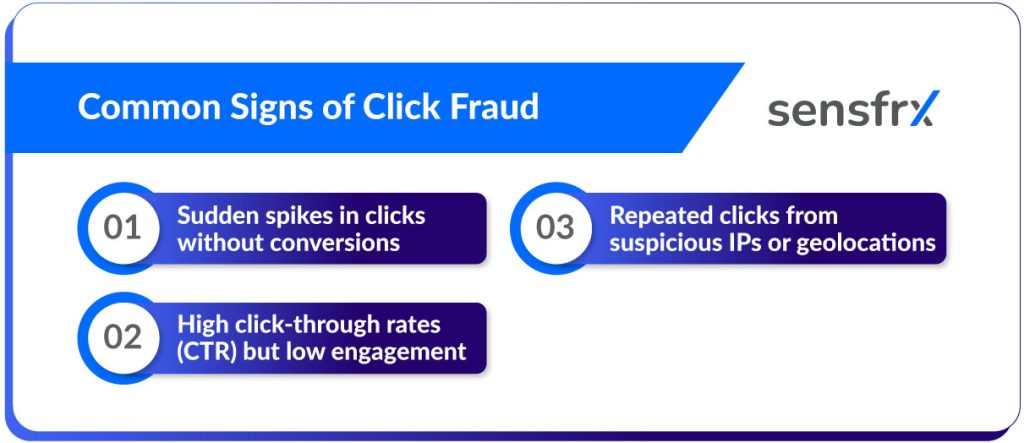
- Click spikes with no conversions. A real surge of interest converts at some rate. A thousand extra clicks and zero form fills is a bot.
- High CTR, no engagement. Visitors who click and leave in under a second, view one page and never scroll are not reading your offer.
- Repeat clicks from the same IPs or odd geographies. The same address or subnet clicking daily, or clicks from countries you do not target, are the plainest tell.
How to detect click fraud
Three methods, cheapest first.
- Traffic pattern analysis. Break clicks down by hour, region, device and placement. A spike from one region at 3am, or a CTR far above the campaign average with no conversions, is where to look first.
- IP monitoring. Log the IP behind every click and count repeats. One address, or one small range, generating a large share of clicks is a bot or a click farm. Exclude it at the campaign level.
- Behavioural analytics. Bots click but do not behave like people on the landing page: no scroll, no mouse movement, no second page, sub-second dwell. Tools that score session behaviour flag these automatically and can block the source.
How to prevent click fraud
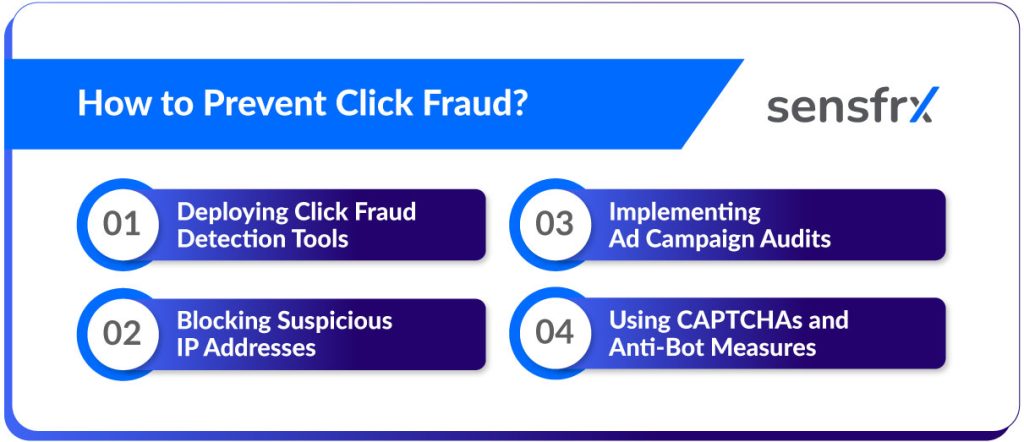
- Run bot detection on your landing pages. Sensfrx scores each session from device, network and behaviour signals and flags the automated ones, so you can exclude the source and dispute the spend.
- Exclude suspicious IPs. Add repeat offenders and known data-centre ranges to your campaign's IP exclusion list.
- Audit campaigns on a schedule. Each month, compare clicks to conversions per placement and per geography. Cut the placements that take budget and never convert.
- Add CAPTCHAs and anti-bot checks. On forms and gated steps, a challenge stops a bot from completing a fake conversion and poisoning your conversion data as well.
Top tools for fighting click fraud
- Google Ads Click Fraud Protection: Google's built-in invalid-click filtering, applied automatically to every campaign.
- ClickCease: Analyses IPs and user behaviour and blocks bots in real time.
- DataDome: Bot detection for websites and ads, using AI to analyse traffic and block bad actors.
- Cheq: AI-driven protection for ad campaigns against fake traffic and invalid clicks, keeping performance data clean.
- Cloudflare Bot Management: Detects and blocks bot traffic at the network edge before it reaches ads or pages.
- Spider AF: Ad fraud prevention for mobile and web apps, stopping bots and fake clicks.
- AppsFlyer Protect360: Mobile app campaign protection against fraudulent installs and fake user actions.
- ShieldSquare: Bot management that identifies and blocks bad traffic aimed at ads and websites.
What the detection tools do now
- Machine learning for bot detection. Models trained on session behaviour are now the standard way of telling bots from people, and they update as the bots change.
- Traffic verification. Continuous checks that traffic comes from the placements and sources you paid for, not from redirected or spoofed inventory.
What changes next
Both sides keep improving. Bots get better at looking human; detection gets better at measuring the things humans do without thinking.
- New fraud techniques. Residential proxies, real device farms and scripted human-like browsing make fake clicks harder to separate from real ones on IP alone.
- Better detection. Behavioural scoring and machine learning on session data replace IP blocklists as the main control.
Where to start
Pull last month's clicks by IP, hour and geography and compare them to conversions. If one slice takes budget and never converts, you have found your fraud. Exclude it, add bot detection on the landing pages so the next source is caught sooner, and audit again in 30 days. Sensfrx scores every session for bot and anomaly signals; try it free.