A documented set of risks, controls, detection rules and response procedures that an organization uses to find fraud, limit the loss and recover. It covers technology, process and people.
How to build a fraud detection and response plan
The seven parts of a fraud detection and response plan: risk assessment, controls, training, authentication, detection, incident response and communication.
 By 10 mins readPublished Updated
On this page
The Association of Certified Fraud Examiners estimates that organizations lose 5% of annual revenue to fraud, and small companies lose the most. Most of that loss is not the first fraudulent transaction. It is the ones that follow while nobody has a plan for what to do next.
A fraud detection and response plan is that plan. It names the risks you face, the controls that catch them, who acts when one fires and what they do. The same plan covers phishing, account takeover and bot-driven payment fraud, because the response steps are the same even when the attack is not.
Why you need a written fraud response plan
Fraud is a cost line for every business that takes payments online, and the ACFE's 5% figure is the average, not the ceiling. Digital transactions make it easier to commit and easier to repeat.
The plan's first job is to cap the loss. Fraud compounds: a card-testing run or a compromised account keeps costing money until someone stops it, and an organization with agreed detection rules and response steps stops it in hours instead of at month-end reconciliation.
Account takeover (ATO)
Account takeover is unauthorized access to a customer's or employee's account, used to steal the data inside it or to transact as the account owner.
Phishing is the standard route in: a fake email or message from a "bank" or "government agency" asks for login credentials, card numbers or social security numbers, and the attacker uses them to log in as the victim.
For how ATO works and how to stop it, see What is Account Takeover Fraud: All That Ecommerce Merchants Must Know.
Bot-driven payment fraud
Bot fraud is automated scripts imitating real users to abuse your systems. For the controls, see 7 Ways to Prevent BOT Attacks on Your Website.
Against a payment flow, bots are built to:
- Run stolen card details through checkout to find the ones that still work.
- Place orders with stolen credentials at a speed no review team can match.
- Skew your analytics by inflating transaction volumes or faking user activity.
Before you write rules for bot fraud, make sure the team agrees on what it looks like in your own data. A short session walking through a real card-testing run or a credential-stuffing burst does more than a generic training deck.
The seven components of a fraud response plan
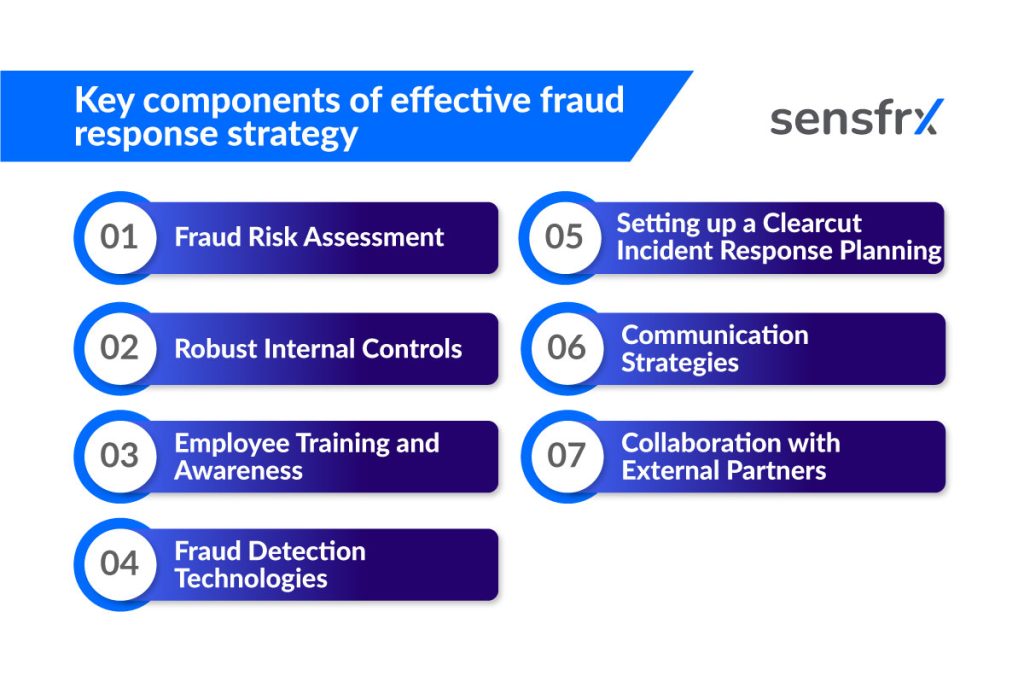
A working plan has prevention, real-time detection and a response procedure. The seven parts below cover all three.
1. Fraud risk assessment
A fraud risk assessment lists where the organization is exposed and rates each exposure by likelihood and impact.
Three things make it useful:
- Finance, compliance, IT and legal all contribute; each sees a different part of the exposure.
- It is built on historical and real-time data, not opinion.
- It is repeated, because the risks change.
Run the assessment on a schedule, across fraud types
A one-off assessment goes stale within a quarter. Repeat it, and cover each fraud type separately: card fraud, ATO, bot abuse, refund abuse and insider fraud each have different weak points.
The inputs are the records you already keep: financial records, customer data, employee logs, transaction logs and security reports. Patterns in that data show where the last incidents came from and where the next ones will.
Score internal and external risk separately
Internal risk is weakness inside the organization: thin controls, one person who controls a payment from start to finish, a dishonest employee. External risk is attack from outside: credential stuffing, phishing, data breaches.
For each, estimate how likely it is, what it would cost, and what it would do to the company's reputation. That ranking decides where the next control goes.
2. Internal controls
Internal controls are the checks and balances that prevent, deter and detect fraud inside the organization.
Some are physical: locks, security systems, restricted access to sensitive data and assets. The procedural ones matter more for payment fraud:
- segregation of duties,
- dual authorization for transactions,
- regular reconciliation, and
- background checks for people in sensitive roles.
Segregation of duties and access controls
No single person should be able to carry a process from start to finish on their own.
Segregation of duties splits responsibility across people or teams, so committing fraud means recruiting a second person or defeating a second control. Access controls enforce the same split in the systems: a person sees and changes only what their role requires.
Audits and compliance checks
Audits confirm the controls still work as designed and find the gaps before an attacker does.
Set the scope, the goals, who is responsible and the timeline in writing, then run them on that timeline. An audit that slips is a control that has quietly switched off.
3. Employee training and awareness
Staff who know what fraud looks like catch it earlier than any system that does not have their context. Train them on the fraud types that touch their job, how to recognize each one and how to report it.
Training lands better in a culture where reporting is expected: a clear code of conduct, ethics training that is more than a checkbox, and managers who want to hear about the odd request a colleague received.
Recognizing fraud signs and reporting them
Staff who can name the red flags and know the reporting route turn into a detection layer that costs nothing extra.
Make the route short: one address or channel for suspected fraud, acknowledged within the day, with no penalty for a false alarm.
Simulated scenarios
Simulations let staff feel the pressure and ambiguity of a live incident without the losses. People who have handled a rehearsed CEO-fraud email respond better to the real one.
Build each scenario from a risk in your assessment: a phishing campaign, a data breach, a social-engineering call to the support desk, an insider moving funds. Cover both external and internal threats.
Authentication and authorization practices
Only authorized users should reach sensitive systems and data, and the following controls are how that is enforced:
- Strong password policies. Enforce complex passwords of letters, numbers and special characters, and reject known-breached ones.
- Multi-factor authentication. MFA asks for a second proof, such as a one-time code to the user's phone or email, so a stolen password alone does not open the account.
- Role-based access control. RBAC limits each user to the data and systems their role needs, which cuts both insider risk and accidental exposure.
- Step-up authorization for sensitive transactions. Beyond MFA at login, verify high-value actions such as transfers or large purchases through a second channel: an SMS code or a biometric check.
4. Fraud detection technology
Manual review does not scale to the volume or speed of automated fraud, so the plan needs a detection layer that scores events as they happen.
Sensfrx is that layer for signups, logins and payments. Each event is scored in real time from device, network and behaviour signals, and your rules turn the score into allow, review or block.
It installs as a plugin for WooCommerce, Shopify, WHMCS, Blesta and WISECP, and through a REST API for anything else, so the detection layer goes in without replacing the systems you already run.
5. Incident response planning
The incident response plan is the step-by-step procedure for a suspected or confirmed fraud: who is told, who decides, what is done, in what order. It is what limits the damage once prevention has failed.
- Identify the risks. Start from the assessment: which internal processes, systems and behaviours could lead to a fraud incident.
- Write the procedures. For each risk, the detailed steps to contain it, investigate it and recover.
- Set the communication rules. Who is notified, by whom, through which channel, both at the first alarm and as new facts come in.
- Train the people in it. The plan only works if the people named in it know their role and the rest of the staff know how to raise the alarm.
6. Communication
A fraud incident involves employees, customers, shareholders and sometimes law enforcement, and each needs different information at different times. Handled well, communication limits the damage and keeps trust; handled badly, it becomes the second incident.
Start inside the organization: who reports suspected fraud and to whom, how an incident is escalated, and what may be said about it, to whom, while it is being investigated.
7. External partners
Outside partners bring skills, data and tooling you do not have in house: payment processors, fraud data networks, forensic investigators, law enforcement contacts. Three steps to make the relationship work:
- Know what you need. Define the gap before you look for a partner.
- Check the record. Look at what the partner has done against your type of fraud, and where their strengths are.
- Agree the terms. Objectives, timelines, roles, responsibilities and deliverables, in writing, at the start.
Keep the plan current
Fraudsters change tactics when a control starts working, so a plan that is never revised stops working.
Ongoing monitoring is the first input: review transactions and data for anomalies and red flags, and feed what you find back into the rules and the risk assessment.
The second is the outside world: new fraud patterns, new tooling, new regulation. Schedule the review so it happens whether or not there has been an incident.
Where Sensfrx fits in the plan
Of the seven components, the detection layer is the one you can switch on today. The rest are process and people, and they take longer.
Sensfrx scores every signup, login and payment in real time from device, network and behaviour signals, and your rules decide which events are allowed, sent to review or blocked. Review decisions and the reasons behind them give the team real cases to train on.
Rules are yours to change, so when a new pattern appears in the review queue you tighten the rule the same day.
Start on the free plan or the 14-day trial. If your platform is not one of the five plugins and you want to check the API fits, tell us what you run.
Where to start
Run the risk assessment first; everything else in the plan depends on knowing where you are exposed. Then put the controls in the order the assessment ranks them: segregation of duties and MFA for the internal risks, real-time scoring at signup, login and checkout for the external ones.
Write the incident response procedure before you need it and rehearse it once with the people named in it.
Then put a date in the calendar to review the whole plan. Fraud patterns change, and the plan has to change with them.
Frequently asked questions