A scammer uses your stolen identity to take out payday loans in your name and leaves you with the debt.
Payday loan identity theft: Causes, signs, and prevention
Payday loan identity theft from both sides: the six scam patterns, the warning signs a lender or borrower should catch, and the controls that stop it.
 By 10 mins readPublished Updated
On this page
- How scammers Target payday loans
- Common payday loan fraud techniques
- Key warning signs of a payday loan scam
- Impact analysis for organizations
- Key components of a payday loan fraud prevention solution
- Risk mitigation and prevention strategies
- Stronger KYC and onboarding
- Best practices for security managers and risk analysts
- Where to start
- Frequently asked questions
A payday loan is a small loan borrowed against the next paycheck, repaid in two to four weeks and carrying fees high enough to hurt if the repayment is late. That mix of urgency, high fees and speed is what draws fraud to it.
A typical loan looks like this:
- You borrow ₹5,000.
- The lender wants it back within 2 weeks.
- The fee for those two weeks is ₹750.
When your salary lands you owe ₹5,750: the ₹5,000 loan plus the ₹750 fee.
The global payday loan market was valued at $35 billion in 2023, with forecasts putting it at $52.3 billion by 2033.
How scammers Target payday loans
A 2025 figure put almost 85% of new payday loan applicants online, and the schemes below are built for that channel.
Payday borrowers are already under pressure: the fees are high, the repayment window is short and the need is urgent. Scammers work that pressure. A person who needs cash by Friday rarely checks whether the lender is licensed.
The schemes rest on three things: a false promise, a threat, or a stolen identity, and often all three in sequence.
Common payday loan fraud techniques
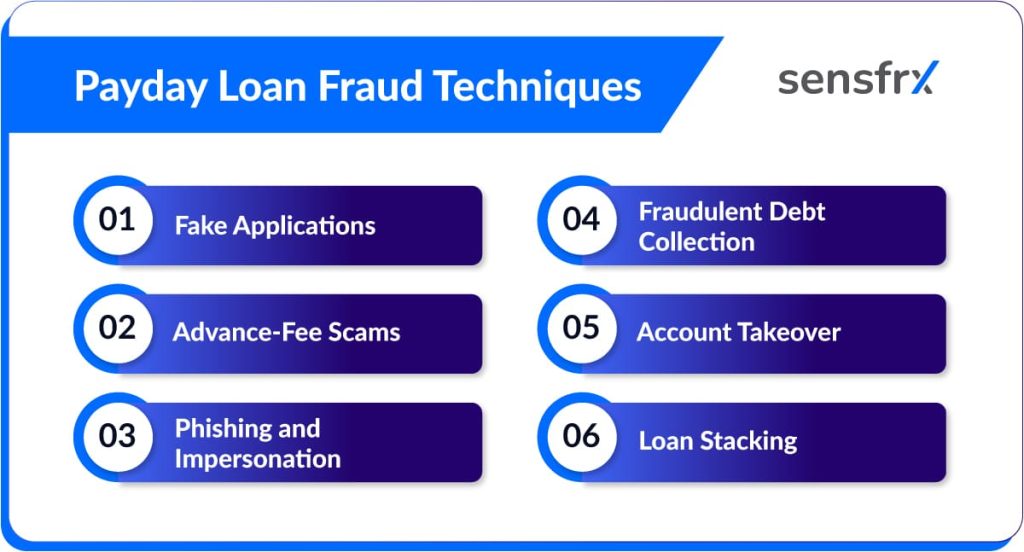
Six techniques account for most of what lenders and borrowers see.
Fake applications
- Fraudsters apply with personal details stolen in data breaches or phishing.
- Others build synthetic identities from a mix of real and invented data, pass weak verification, take the loan and disappear.
Advance-fee scams
- The scammer promises instant approval but needs a "processing" or "insurance" fee first. The fee is paid; the loan never arrives.
- Real lenders take their fees out of the loan. None of them asks for money before funding it.
Phishing and impersonation
- Fake websites, calls and emails that imitate real payday lenders collect personal data, bank details or payments.
- The hook is usually "no credit check" or a deadline that leaves no time to think.
Fraudulent debt collection
- Criminals pose as payday loan collectors and threaten victims into paying debts that do not exist.
- Spoofed caller IDs and stolen personal details make the call sound real.
Account takeover
- Attackers log in with stolen credentials, change account settings, intercept loan payouts and move the money out before anyone notices.
- The payout is often redirected to an account the scammer controls.
Loan stacking
- The fraudster applies to several payday lenders in the same hour. Reporting lags mean every lender approves before the first default shows up.
What it looks like in practice
- A caller promises a fast loan and asks for a processing fee upfront. After payment, the number goes dead.
- A fake lending site collects applications, personal details and fees for a few weeks, then vanishes with all of it.
- A loan taken out on a stolen identity is paid into a throwaway account. The lender learns it was fraud when the first repayment defaults.
Key warning signs of a payday loan scam
Most payday loan fraud is caught late, after the money is gone. These are the signs that show up first.
- A loan on your credit report you never applied for. Often the first hint is a sudden credit score drop from missed payments on a loan you never took.
- A credit application refused for no clear reason. Fraudulent debts in your name damage your file, and many victims learn of the fraud when a bank turns them down.
- Collection calls for debts you do not recognise. Expect threats and pressure; that is the tell.
- A lender asking for fees before funding. Real lenders deduct fees from the loan. A "$200 insurance fee" by wire transfer before disbursement is a scam every time.
Application inconsistencies
- Mismatched addresses. Addresses that change between applications or do not match official records.
- Unverifiable employers. Employers that cannot be confirmed, vague job details, or forged employment documents.
- Tampered documents. Edited ID images, erased or overwritten fields, fonts and formatting that do not match.
- Repeated fast-track requests. Several applications in quick succession from one device or with near-identical personal details, usually loan stacking by an organized group.
Impact analysis for organizations
Fraud hits a lender in four places, and each one compounds the others.
Financially, charge-offs pile up and collection spend rises as the "borrowers" default or turn out never to have existed.
On compliance, loans issued to stolen or synthetic identities are KYC and AML failures. Regulators answer with fines, licence conditions or worse, and an audit after an incident will find the weak controls that let it through.
Reputation goes next. Repeated fraud events become negative reviews, press coverage and partners who stop returning calls.
Operationally, a lender swamped by fraud delays launches and expansion, and the risk and engineering teams spend their time on clean-up instead of product.
Key components of a payday loan fraud prevention solution
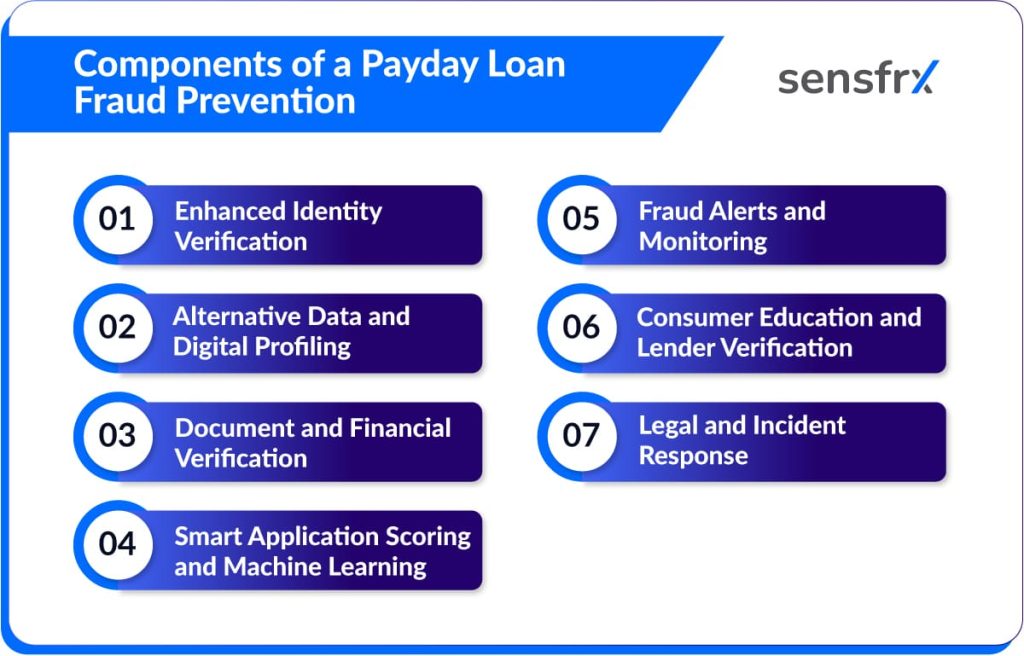
1. Enhanced identity verification
- Check government ID against a live selfie with automated face matching, and cross-check the identity against public and private databases.
- Run a liveness test so a photo, a video replay or a deepfake fails where a present applicant passes.
2. Alternative data and digital profiling
- Read the applicant's digital footprint: social presence, how long the phone number has been registered, the age and history of the email address. A thin or contradictory footprint does not match a real identity.
- Use device fingerprinting to tie applications to devices. It exposes multi-accounting, device rotation and bots.
3. Document and financial verification
- Confirm the bank account with micro-deposits or directly with the bank before any money leaves.
- Call the employer and verify bank statements at the source rather than trusting uploaded or emailed files.
4. Smart application scoring and machine learning
- Score each application on hundreds of data points, among them address consistency, geolocation, transaction habits and loan stacking patterns, so high-risk applications are flagged at once.
- Retrain the models on new fraud cases so they keep up with new scam tactics.
5. Fraud alerts and monitoring
- Monitor transactions in real time for patterns such as several applications from one IP or address, or a new payee added minutes after funding.
- Notify credit bureaus automatically, and let the person whose identity was used place a fraud alert or freeze.
6. Consumer education and lender verification
- Tell borrowers how real lenders behave: no upfront fees, official contact channels, and a licence from the regulator.
- Tell them to check the lender's registration on the regulator's site (RBI or SEBI, for example) and to verify the website and office address before sharing personal data.
7. Legal and incident response
- Make it easy for victims to report to the national cybercrime unit or the banking ombudsman at once.
- Inside the company, document each fraud pattern, run a root-cause review and change onboarding and monitoring rules based on what the cases show.
Risk mitigation and prevention strategies
No single control holds. The lenders that keep fraud down layer the tools below and watch the account after approval, not just at the door.
Advanced fraud tools and data enrichment
Digital ID profiling scores the applicant's footprint: social media, work history, behavioural markers, and live data services that add current activity and context to the baseline identity.
Device fingerprinting, behavioural biometrics and dynamic risk scoring together read mouse movement, typing rhythm and device details, compare them with known low-risk profiles and produce a risk score per application.
Email and phone analysis checks when the address or number was created, how it has been used and whether it is linked to fraud complaints. Disposable or days-old emails score badly.
Network analysis maps the links between applications, devices and IPs to find fraud rings and repeat abusers who look clean one application at a time.
Stronger KYC and onboarding
Validate the applicant against several databases, regional and international, require live face matching against government ID, and use liveness detection against deepfakes.
Keep watching after approval. A fast withdrawal to a new destination right after funding should be flagged and frozen the moment it happens.
Machine learning models learn the fraud patterns as they shift, so the rules do not need a manual rewrite every time scammers change tactics.
Organizational and ecosystem measures
Train staff to spot social engineering and technical fraud, and keep an incident playbook with step-by-step actions for confirmed cases.
Set clear escalation and mandatory reporting channels that match local and international regulation.
Join a fraud consortium and share fraud signatures as soon as you see them. The ring that hit you is already applying to the lender next door.
The table below pairs each risk with its control.
| Risk | Mitigation Strategy |
|---|---|
| Evolving and sophisticated fraud tactics | Adopt layered defenses combining advanced technology, data intelligence, and continuous monitoring |
| Incomplete or outdated identity verification | Use full digital ID profiling with alternative scoring, OSINT, and live data enrichment |
| Device spoofing or abnormal user behavior | Implement device fingerprinting, behavioral biometrics, and dynamic risk scoring |
| Use of disposable or recently created email/phone IDs | Analyze email and phone credibility using creation dates, usage patterns, and linked fraud complaints |
| Organized fraud rings and collusion | Perform network analysis to map connections and detect coordinated fraud |
| Weak or fraudulent customer onboarding | Apply robust KYC with multi-source database validation, biometric verification, and liveness detection |
| Risky behavior after onboarding | Continuous post-onboarding transaction monitoring and rapid flagging of suspicious activity |
| Rapidly changing fraud patterns | Deploy AI and machine learning models for adaptive pattern and anomaly detection |
| Lack of employee awareness and incident preparedness | Conduct regular staff training and maintain incident response playbooks |
| Inefficient or unclear fraud reporting | Establish clear reporting protocols and regulatory engagement |
| Limited threat intelligence sharing | Join partnerships and consortiums for industry-wide intelligence sharing and immediate fraud signature sharing |
Best practices for security managers and risk analysts
The job is to hold fraud down without turning away real borrowers, and to show the business the numbers behind both. Five habits do most of the work:
- Layer static checks (ID, blocklists) with dynamic ones (device, network, transaction behaviour).
- Set friction thresholds on measured drop-off, so you block high-risk profiles without losing good applicants to the extra step.
- Update rule sets as new fraud methods appear, and feed threat intelligence into them.
- Measure what prevention returns, in fraud losses avoided, approval rate gains and fewer false positives, and put those numbers in front of leadership as ROI.
- Review every missed case for the process or policy gap that let it through, and fix that gap.
Where to start
Payday loan identity theft works because verification is weak and the borrower is in a hurry. The lender fixes the first part: check the device and the digital footprint at signup, verify the bank account before funding, and keep watching the account after approval. Loan stacking and synthetic applications are the first two patterns to measure.
Sensfrx scores every signup, login and payout on device, network and behaviour signals, and your rules decide what is approved, reviewed or blocked. Start on the free plan or the 14-day trial.
Frequently asked questions