9 best fraud detection software in 2026
Nine fraud detection tools compared on features, pricing and fit, from Sensfrx and SEON to Signifyd, Forter, Riskified and DataDome, plus how to choose.
 By 11 mins readPublished Updated
On this page
- Customer touchpoints under threat
- How online fraud happens
- Types of online fraud
- What fraud detection software is
- What you get from fraud detection software
- Features to look for in a fraud detection solution
- How to choose a fraud detection software
- Top 9 fraud detection software for businesses
- Choosing the right fraud detection solution
- References
MarketsandMarkets projects the fraud detection and prevention market will grow from $27.7 billion to $66.6 billion by 2028, a 19.1% compound annual growth rate. That spend follows the losses. A fraud detection tool that combines device fingerprinting, data analysis and real-time risk scoring is now the baseline for any business that takes payments or logins online.
The scale is not abstract. The Consumer Sentinel Network logged 2.4 million fraud reports in its 2022 data.
Below: where fraud enters, how the common attacks work, what to look for in a tool, how to choose one, and nine tools compared.
Customer touchpoints under threat
Every channel you serve customers through is also a way in: websites, apps, point-of-sale systems and the CRM. A breach at any of them means financial loss, legal liability and customers who do not come back.
How each one gets exploited:
- Websites and mobile apps: code vulnerabilities, insecure APIs and misconfigurations expose personal data, payment details and login credentials
- Point-of-sale systems: skimmers or malware on a poorly secured POS capture card data at the moment of payment
- CRM systems: contact details, purchase history and communication records, reached through phishing, feed identity theft
- Customer service channels: chat, phone and email staff are social-engineered (phishing, smishing) into handing over data or access
How online fraud happens
The common entry points:
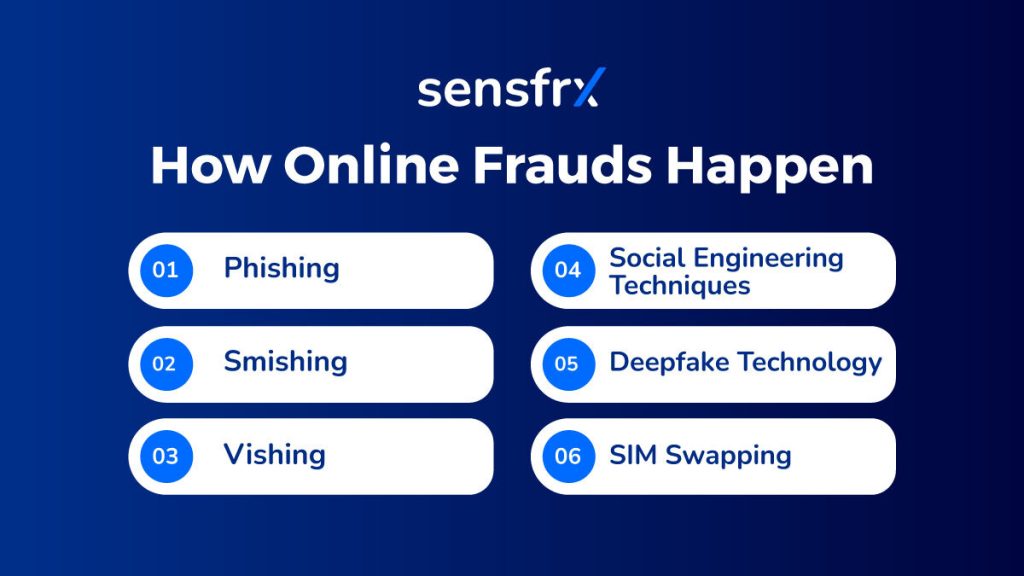
- Phishing: emails that look like they come from a bank or retailer and harvest passwords
- Smishing: the same trick over SMS
- Vishing: a phone call from someone pretending to be a trusted company
- Social engineering: psychological pressure to get someone to give up sensitive information
- Deepfakes: AI-generated identities, images and video convincing enough to impersonate a real person
- SIM swapping: the attacker gets the carrier to move the victim's number to a new SIM, then receives their authentication codes and empties the bank account
Types of online fraud
Tools have improved and fraudsters have adapted. Four forms come up most often:
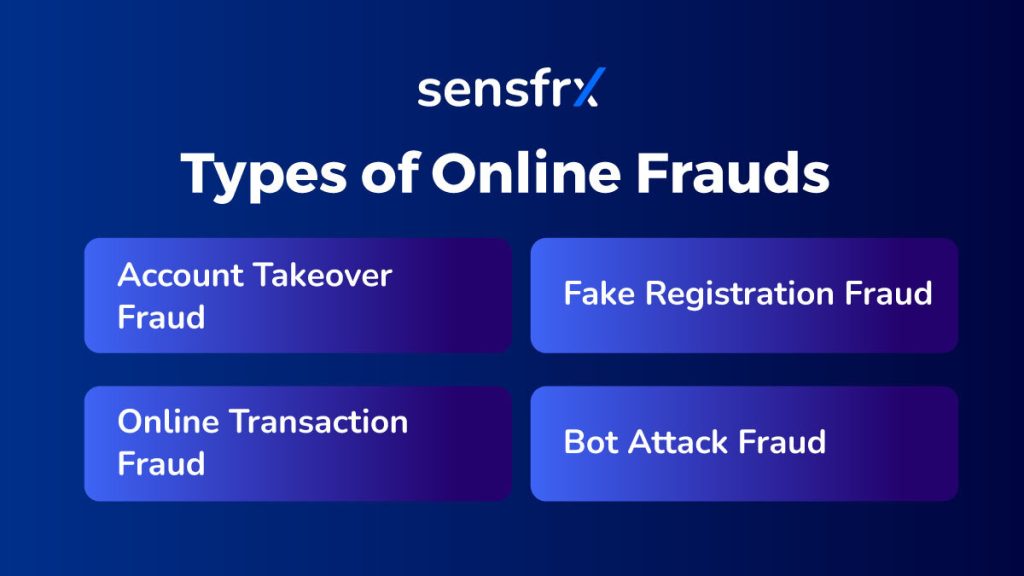
Account takeover fraud. Credentials stolen through phishing, SIM swapping or smishing are used to take over the account, then to make unauthorised transactions or steal data.
Fake registration fraud. Bots and scripts create accounts in bulk for spam, phishing and promo abuse.
Online transaction fraud. Payments made with stolen cards, compromised wallets or other unauthorised payment methods.
Bot attack fraud. Automated attacks such as data scraping and credential stuffing that set up fraudulent transactions.
What fraud detection software is
Software that watches activity on your site or app, scores it with machine learning and predictive analytics, and flags or blocks what looks wrong before it costs you money. The better tools give the early warning and the decision in the same step.
What you get from fraud detection software
The returns, in rough order of how fast you see them:
- Fewer fraud losses: transaction data is scored and suspicious patterns stopped before settlement
- Fewer chargebacks: which protects both margin and your standing with card schemes
- Lower false positives: less friction at checkout, so fewer good orders lost
- Real-time monitoring: suspicious activity is caught as it happens, not in next month's reconciliation
- Automated decisions: rules and models handle the clear cases, so analysts see only the edge cases
- Pattern visibility: trends in fraud attempts become visible across all your traffic
- Layered defence: several signals have to be beaten at once
- Compliance: easier adherence to standards such as PCI DSS
- Cost control: less manual review, lower remediation and legal cost
- Customer trust and reputation: customers keep buying, and a fraud incident does not become a headline
Features to look for in a fraud detection solution
Seven features separate a tool that catches fraud from one that generates alerts.
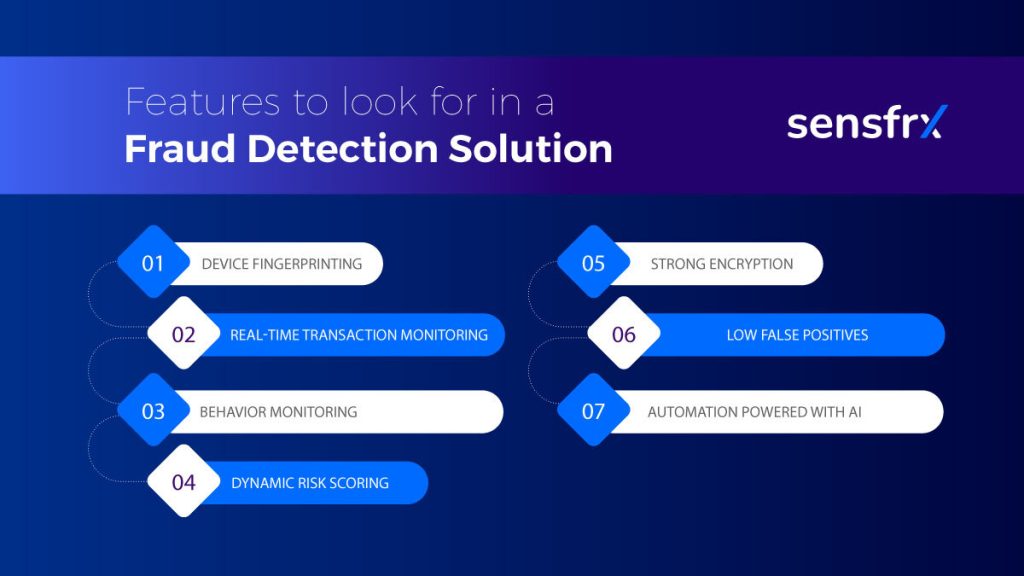
Device fingerprinting. The tool identifies a device from the combination of its attributes: IP address, HTTP headers, installed fonts and plugins, screen resolution, battery state, operating system, user agent, VPN and browser details, time zone and language.
No single attribute is unique. The combination almost never repeats on another device, which gives you a stable profile to track across sessions and transactions and a way to link one actor's many accounts.
Real-time transaction monitoring. Transactions and behaviour are analysed as they happen, against both the customer's history and the current session, and the security team gets the alert while there is still time to act.
It is also how you catch large or unusual cash movements before they escalate, meet anti-money laundering (AML) and counter-terrorism financing (CTF) obligations, and file suspicious activity reports (SARs) on time.
Behaviour monitoring. The tool builds a baseline of how connections and sessions normally look and flags deviations. It watches the pattern of activity, not the content.
Patterns that matter:
- Frequent or rapid connections to the same host
- Periodic communication with the same destination
- Large data transfers to one host, in one go or in many small pieces, the way "structuring" works in money laundering
- Username testing: repeated attempts with different usernames on one host, then the same on the next
- Clusters of unusual events on a server, which need review to separate real risk from noise
- Many password changes in a short period, handled with care, because you do not want to discourage legitimate password hygiene
Dynamic risk scoring. Not every risk is the same size. A dynamic risk scoring system predicts severity from many factors at once, so the team can act in proportion.
Strong encryption. The tool holds sensitive data about your customers. It has to keep that data confidential and out of reach of attackers.
Low false positives. A false positive is a legitimate transaction flagged as fraud. Each one costs a sale, and too many bury the risk team in a backlog that also slows regulatory work.
A low false positive rate means the system catches fraud without disrupting good customers. Ask every vendor how they measure and manage it.
Automation with AI. Machine learning models analyse large datasets, find patterns and anomalies, and keep learning from new data as tactics change. In practice that means real-time detection, scale without extra headcount, and fewer manual reviews.
It also means fewer false positives over time and faster adaptation to new fraud typologies than a hand-maintained rule set can manage.
How to choose a fraud detection software
There are many tools and they do not all solve the same problem. Seven steps:
1. Start from your own risk. Each industry faces different risks, so work out which ones you have before you look at feature lists.
A firm whose losses are in transaction fraud needs a tool built for that, not a broad suite. Matching the tool to the priority also keeps the budget on the problem that costs money.
2. Accuracy. The tool should make accurate calls from real-time monitoring, behaviour monitoring and dynamic risk scoring. Test its false positive and true positive rates on your own data.
A tool that wrongly flags 4% of legitimate transactions while catching 96% of fraud is a tool you can reason about. A vendor who cannot give you those two numbers is not.
3. Ease of integration. Deployment pain is where projects stall. Read what other buyers hit during rollout on Gartner Peer Insights, Capterra, G2, FinancesOnline, TrustRadius and Software Reviews.
4. Cost. Pricing ranges from fixed subscriptions to models scaled by business size and industry. A feature-heavy tool is tempting; the bill still has to be justified by the losses it stops.
Price also tracks scope. A fraud screening tool costs less up front than a full-service detection platform.
5. Compliance. Keep a checklist of your obligations and test each tool against it.
An ecommerce site taking card payments needs a tool that helps it meet PCI DSS. A travel platform handling EU customers has GDPR to think about. The requirements differ, so the choice does.
6. Support and training. Check what training material exists for your team and how responsive support is when something breaks. A tool nobody knows how to tune catches less than a simpler one that is well run.
7. Trial first. Run the tool against your own traffic before you sign. A trial shows how it integrates and what it catches in your environment, which no demo can.
Top 9 fraud detection software for businesses
Nine tools, with features, pricing and who each suits. Pricing figures are the vendors' published figures when this list was compiled; check the vendor's page before you budget.
1. Sensfrx
Sensfrx is a fraud detection and prevention platform that scores every signup, login and payment in real time. It covers account takeover, transaction fraud, price manipulation, fake registration and bot traffic.
It combines machine learning with device, network and behaviour signals to detect and stop fraudulent account activity, and presents the results in a way a non-specialist can read.
Sensfrx features
- Device profiling that fingerprints the devices behind payments and account activity
- Quick integration into web and mobile apps through SDKs and a REST API
- Rules and policy engine that automates detection logic and enforces policy in real time
- Analysis of device behaviour, including user interactions and navigation paths
- User behaviour modelling and risk scoring to surface fraud patterns
- Phishing prevention that blocks credential theft and flags suspicious logins
- Transaction protection for payment flows
- Custom validation rules and policies to fit your business
Website: [sensfrx.ai](/)
Pricing: Free plan and paid plans; see the pricing page
Free trial: Free plan available, plus a 14-day trial
Suitable for: Ecommerce, BFSI, gaming and gambling, travel, crypto trading
2. SEON
SEON uses digital footprinting, ID verification and real-time signals to spot suspicious traffic. It covers account takeover, onboarding fraud, bonus abuse and related attacks.
SEON features
- Device fingerprinting
- Real-time monitoring of user activity
- AI/ML risk scoring
- IP lookup
Website: SEON
Pricing: Three plans: Free, Starter ($599/month) and Professional (custom)
Free trial: Free plan available
Suitable for: Small and medium businesses
3. Signifyd
Signifyd is a risk intelligence platform for enterprise ecommerce. It takes accountability for fraud decisions, which suits merchants with high transaction volumes.
Signifyd features
- Real-time decision engine that scores each transaction
- Machine learning fraud detection
- Integration with ecommerce platforms, payment gateways and other business systems
- Automated order approval that removes manual review
Website: Signifyd
Free trial: Not available
Pricing: On request
Suitable for: Digital marketplaces
4. Kount
Kount helps online businesses analyse and cut losses from fraudulent transactions, covering detection, response, alerting, administration, risk evaluation, identity protection and compliance.
Kount features
- Transaction scoring and ID analytics
- Real-time monitoring
- Continuous device tracking
- Blacklisting
- Chargeback fraud protection
Website: Kount
Free trial: Not available
Pricing: Custom, on request
Suitable for: Ecommerce and payment platforms
5. Sift
Sift, formerly Sift Science, protects online businesses in real time using its AI models and a global data network. Its products cover payment protection, content integrity and account defence.
Sift features
- Machine learning to optimise campaign performance
- APIs and connectors for integration with your existing stack
- AI-driven insights
- Real-time fraud detection
Website: Sift
Free trial: Not available
Pricing: Not published
Suitable for: Online commerce, retail, fintech, digital goods and services
6. Forter
Forter's trust platform applies identity intelligence at each step of a purchase, using AI/ML to cut payment fraud and chargebacks while keeping the checkout smooth for real customers.
Forter features
- Real-time fraud assessment for accurate transaction approvals
- Full automation, with no manual review
- Instant decisions on every transaction
- Customisable fraud detection process
- Integrated chargeback protection
Website: Forter
Pricing: On request
Free trial: Not available
Suitable for: Identity intelligence and digital marketplaces
7. Riskified
Riskified is an ecommerce fraud prevention and chargeback protection platform that gives retailers real-time, data-driven decisions.
Riskified features
- Customisable fraud parameters
- Transaction approval pattern recognition
- Dispute resolution
- Account Secure, which blocks malicious login attempts by bots and humans
- Merchant insights for finding and blocking fraud
Website: Riskified
Pricing: On request
Free trial: Not available
Suitable for: Large enterprises, mid-size and small businesses
8. ClearSale
ClearSale sells a chargeback-guarantee fraud solution to merchants worldwide, from small and medium businesses to enterprise commerce. It aims for a high order approval rate with carefully designed customer interactions.
ClearSale features
- Chargeback protection
- Protection from false declines
- Plug and play fraud prevention
- Dashboard and custom reports
Website: ClearSale
Pricing: Three models: KPI pricing, performance-based pricing and custom pricing
Free trial: Not available
Suitable for: Ecommerce merchants
9. DataDome
DataDome is a bot management and fraud detection platform. It uses AI and machine learning to detect and block bots in real time on websites and mobile apps.
DataDome features
- Protection against account takeover and web scraping
- Blocks fake account creation
- Real-time bot protection
- Integration with multiple cloud and CDN setups
- Low-latency validation, so protection does not slow the site
Website: DataDome
Pricing: Four plans: Business, Corporate, Enterprise and Enterprise Plus
Plans start from $3690 per month
Free trial: 30-day trial for bot protection
Suitable for: Online retailers and payment processing
Choosing the right fraud detection solution
The market has more fraud tools than any one business needs. Start from your own losses and obligations, list the features that address them, and judge each tool against that list rather than against its brochure.
Prevention beats reaction. Sensfrx scores every signup, login and payment before it completes, so the fraud never reaches the chargeback stage.
Start on the free plan. Contact us with integration questions.
Email works too: info@sensfrx.ai.
References
MarketsandMarkets, Fraud Detection and Prevention Market report