Card testing and account takeover have one victim. Triangulation has three: the retailer eats the chargeback, the cardholder sees a charge they did not make, and the buyer, who got their goods, never learns they took part. That spread of victims is what makes it hard to detect and prosecute.
Triangulation fraud: How it works and how to stop it
How triangulation fraud turns a fake storefront and a stolen card into a chargeback on your store, the red flags to watch for, and the controls that stop it.
 By 10 mins readPublished Updated
On this page
- What triangulation fraud is
- How triangulation fraud works, step by step
- What triangulation fraud costs
- Red flags of a triangulation scam
- How to detect and prevent triangulation fraud
- Defensive moves that work
- How Sensfrx catches triangulation fraud
- Stopping it before the first order
- Where to start
- Triangulation fraud FAQs
A shopper buys a discounted pair of sneakers from a marketplace seller. The seller orders the same pair from your store with a stolen card and has it shipped straight to the shopper. The shopper is happy, the seller keeps the money, and the chargeback lands on you. That is triangulation fraud.
The Federal Trade Commission put the rise in incidents at 35% in a year, with online merchants losing an estimated $1.8 billion to chargebacks and lost inventory. Many ecommerce teams have still never heard of it.
The scheme works because every leg looks normal on its own. Your store sees a paid order with a real shipping address. The buyer sees a parcel arrive. Only the cardholder sees a charge they did not make, and by the time they dispute it the goods are gone.
It grows for two reasons. Marketplaces check new sellers weakly, so a fake storefront costs nothing to open. And during sales events and holiday peaks, order volume swamps the manual review that would otherwise catch the pattern.
What triangulation fraud is
Triangulation fraud is card-not-present (CNP) fraud in which a criminal sits as a hidden middleman between a real customer and a legitimate retailer. The customer buys from a marketplace listing or a standalone fake store. The goods they receive were bought from a real retailer with a stolen card.
The fraudster keeps the customer's payment and the retailer takes the loss. The name comes from the three parties the scheme needs at minimum.
The parties in a triangulation scam
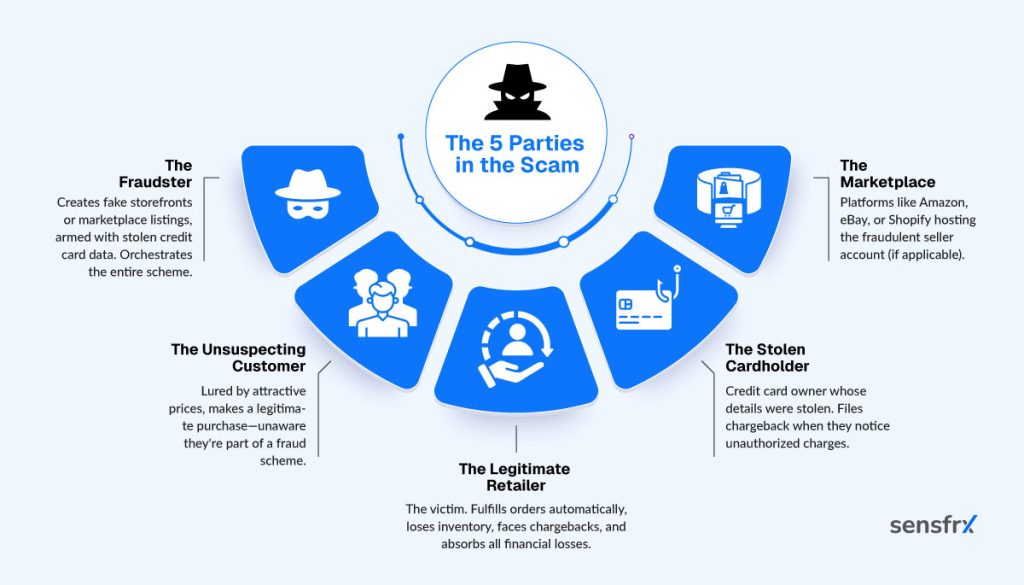
Up to five parties can be involved. The first three are always present.
- The fraudster, who runs the fake storefront or listing and holds the stolen card data.
- The customer, drawn in by the low price and unaware they are acting as a mule.
- The legitimate retailer, who fulfils the order through an automated checkout.
- The cardholder, whose card pays for the goods.
- The marketplace, such as Amazon or eBay, that hosts the fraudulent seller account.
How triangulation fraud works, step by step
The steps are arranged so the loss lands on the retailer.
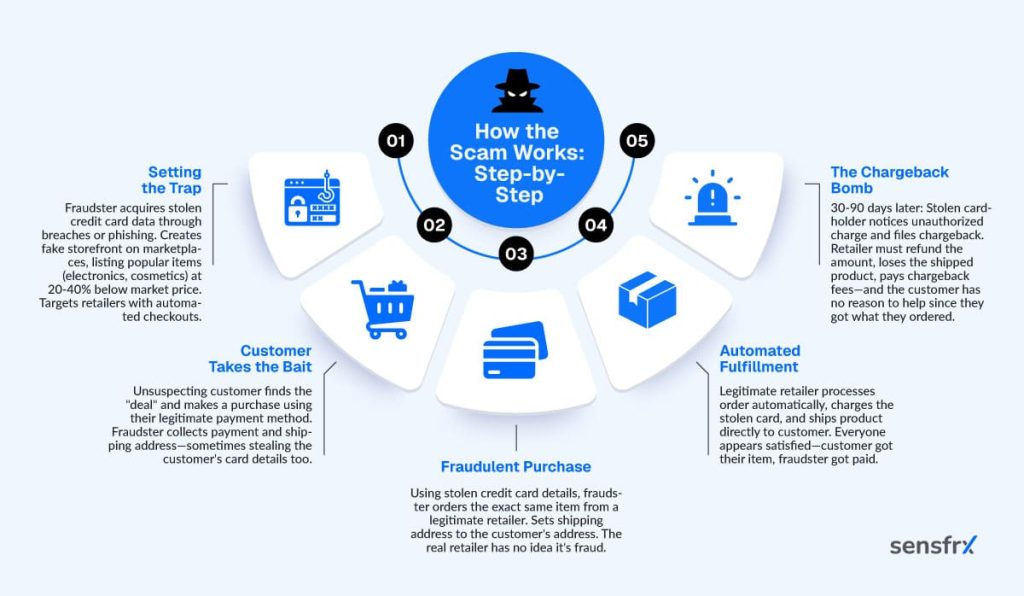
- Set the trap. The fraudster buys stolen card details from breaches or phishing, opens a store or seller account on eBay, Amazon or Shopify, and lists popular mid-priced goods such as electronics or cosmetics at prices too low to be real. They pick retailers with automated checkout so nobody looks at the order.
- The customer orders. A shopper pays by credit card, debit card or PayPal. The fraudster now has the payment, the shipping address and sometimes the customer's card details for later use.
- The fraudster buys the item. They order the same item from a legitimate retailer with the stolen card and enter the customer's address as the shipping address.
- The retailer ships. The order passes, the stolen card is charged, and the parcel goes to the customer, who sees nothing wrong.
- The chargeback arrives. The cardholder spots the charge and disputes it. The retailer refunds the money and cannot recover the goods, so it loses both.
What triangulation fraud costs
A real case: The sneaker flip
- Victim: a mid-size online sneaker reseller on a popular marketplace.
- Loss: $12,800 in chargebacks over two weeks.
- How: the fraudster listed limited-edition shoes at 30% below market price. Buyers paid with stolen Visa cards. The reseller's payment processor flagged the transactions only after the shoes had shipped and the cards had been cancelled.
Knock-on effects on your business
- Chargeback fees of up to $100 per dispute.
- Inventory gone before you could verify the payment.
- Bad reviews and lost trust from real customers.
Triangulation is one slice of CNP fraud. US CNP losses were projected to pass $10 billion by 2024, and global CNP losses were put at $130 billion for 2018 to 2023.
Impact on retailers
A chargeback takes both the product and the payment. For small and mid-size retailers, those double losses can run to six figures in a single quarter.
Then the processor steps in. Visa's chargeback threshold is 1% and Mastercard's is 1.5%; cross them and you face fines, rolling reserves or account termination. A merchant on thin margins can be pushed over by a handful of triangulation orders.
Each dispute also eats 2 to 4 hours of staff time gathering evidence, answering the issuer and handling the customer. That is time taken from fulfilment and growth.
The buyer got their item and walks away satisfied. The retailer takes the blame from the issuer. Over time, unresolved disputes sour the processor relationship and lead to higher fees or fewer payment options, which squeezes cash flow.
Impact on customers
Buyers become unwitting accomplices. They received what they ordered, so they report nothing, and the scheme keeps running under their cover. Buyers who paid the fraudster through an unsecured channel may also have had their own card details taken, which sets them up for a second round of fraud.
Cardholders take the direct hit, and older cardholders take it hardest. The AARP Fraud Watch Network reports that seniors make up nearly 40% of payment-card fraud victims, yet only 15% dispute the charges within the issuer's deadline. Many do not recognise the merchant name on the statement, assume it was a real purchase, or do not know a chargeback is an option. Once the window closes, they carry the loss.
The after-effects last. Victims lose trust in online shopping for months or years, and older victims often stay quiet out of shame, which leaves them open to follow-up scams and identity theft.
Economic impact
Lost revenue, legal fees and supply chain disruption push merchants to raise prices, and the cost spreads to everyone.
Red flags of a triangulation scam
Triangulation is hard to spot because each transaction looks real: a real customer, a real order, a real product and clean card and billing data. The signals show up in patterns across orders rather than in any one of them.
Red flags for marketplaces and seller accounts
- Prices well below market.
- New seller accounts with few reviews and a large inventory.
- Several listings for the same item or brand.
- Accounts sharing similar email addresses, payment methods or card BINs.
- Fake or unresponsive seller contact details.
Red flags for retailers and transactions
- Billing and shipping addresses that differ a lot.
- Sudden spikes in order volume, or many orders from one location in a short time.
- A run on resellable categories: electronics, gift cards, cosmetics, laptops, small appliances.
- Clean payment data paired with an odd email, such as a "John Smith" ordering from sandy.connor@outlook.com.
How to detect and prevent triangulation fraud
No single control catches it. Put the basics in first, then add the signals that connect orders to each other.
The basics
- Verify more than the card: address and location checks, risk-based authentication, email and phone validation, and multi-factor authentication on accounts.
- Review transaction history for order spikes and high-risk IP addresses.
- Ask high-risk sellers to confirm a small temporary charge, such as $1, before they can trade.
- Train staff on the red flags above and give them a way to report what they see.
- Tell customers to be wary of deals that are too cheap and to buy from sellers they know.
Device, behaviour and machine learning
- Score each order in real time with models that learn from your own fraud outcomes.
- Use device fingerprinting, behavioural signals such as typing and mouse patterns, and VPN detection to link orders that share a device or hide their origin.
- Draw on shared fraud networks for signals seen across other merchants.
- Update rules and retrain models as the pattern shifts.
Defensive moves that work
| Strategy | What It Does | Quick Implementation |
|---|---|---|
| Address Verification Service (AVS) | Confirms billing address matches card issuer data | Enable in your payment gateway settings |
| Device Fingerprinting | Tags each shopper’s device to spot anomalies | Add Sensfrx fraud-risk script |
| Velocity Rules | Blocks multiple high-value orders from the same IP or card in a short window | Set thresholds (e.g., > 3 orders > $500 in 24 h) |
| Manual Review for “Too Good to Be True” Deals | Human eyes catch patterns algorithms miss | Flag orders > 30 % below average price for review |
How Sensfrx catches triangulation fraud
Triangulation sits where identity theft, marketplace abuse and payment fraud meet, so it takes more than a card check to see it. Sensfrx scores every signup, login and payment from device, network and behaviour signals, and your rules turn that score into allow, review or block.
The signals that give triangulation away are the ones a card check misses: the same device behind several "different" buyers, a fresh account placing a large first order, an IP that resolves to a data centre or a commercial VPN while the billing address says a suburb, and a sudden run on electronics or gift cards. Sensfrx surfaces these on each order so a rule can hold it for review before it ships.
A billing and shipping mismatch on its own is noisy; gift purchases and corporate buyers trip it every day. What separates them from a drop-ship operation is the context: whether the device matches the cardholder's history, whether the network matches the billing address, and whether the order fits the account's past behaviour. Scoring the order on that context lets you pass the gift and hold the fraud.
Stopping it before the first order
Triangulation starts with a fraudulent storefront and ends with a chargeback. Sensfrx scores at both ends.
- At signup. New seller and buyer registrations are scored before the account can trade, from the device, network and behaviour of the signup. Your rules can hold or block signups whose signals match earlier fraud.
- At payment. Each order is scored in real time. Your rules send high-risk orders to review or decline them before they ship, which is before a chargeback can be filed.
- Your thresholds. Velocity caps, category-specific flags and address rules are yours to set and change as the pattern changes.
Where to start
Look for the pattern, not the single order: several orders converging on one address paid with different cards, new sellers underpricing the market by 20 to 40%, first-time buyers asking for rush shipping. Put the four controls in the table above in place, then score each signup and payment so your rules can act before the parcel leaves.
Start your free trial and score your next order before it ships.
Triangulation fraud FAQs