Payment fraud: The 7 types merchants see and how to stop each one
What payment fraud is, the seven types merchants see most with their warning signs, the statistics that size the problem, and the controls that cut losses.
 By 10 mins readPublished Updated
On this page
- What payment fraud is
- How big the problem has become
- Where payment fraud is heading
- Cross-border ecommerce
- What payment fraud costs
- The seven types of payment fraud
- How to stop payment fraud
- Why PCI DSS compliance matters
- Legal and compliance obligations
- Clear policies cut disputes
- Cases where the controls worked
- Where to start
Global online payment fraud losses passed $41 billion in 2022. For most online businesses, fraud is now the fastest-growing line on the loss sheet.
The problem is not awareness. Businesses know the risk and spend on it. The fraudsters still move faster than the controls, and each new payment method gives them a new way in.
The cost lands on both sides of the transaction: direct losses and chargebacks for the merchant, regulatory penalties and lawsuits after a breach, and identity theft and months of clean-up for the customer.
Below: what payment fraud is, how large it has grown, the seven types merchants meet most often with the warning signs for each, and the controls that cut losses.
What payment fraud is
Payment fraud is any unauthorized transaction made by exploiting a weakness in a payment system. The way in varies: malware, phishing, skimming devices, or a phone call that talks someone out of a one-time code.
Every variant works the same way underneath. It takes advantage of a system weakness or a human mistake to get hold of payment data or an account, then spends.
For a merchant, the damage goes past the lost goods. Chargebacks, operational disruption and a damaged reputation all follow, and each one eats into customer trust.
For the customer, a single fraudulent payment can mean identity theft, financial strain and a slow, frustrating recovery.
How big the problem has become
Applications and data have moved to the cloud and every application talks to the others through APIs. The attack surface has grown with them, and fraudsters have more ways in than ever.
Nearly half of global businesses reported payment fraud in 2023.
Ecommerce and marketplaces make it worse, because card-not-present (CNP) transactions give the merchant no card and no cardholder to inspect.
The numbers that size the problem:
- Global merchant losses from online payment fraud were projected to exceed $343 billion between 2023 and 2027 (Global Online Payment Fraud Prevention Market Report 2023-2028).
- Juniper Research projected card-not-present fraud losses of $28.1 billion for 2026.
- Digital payment fraud losses reached about $20 billion worldwide in 2023 (FIS Worldpay Global Payments Report).
- The US accounts for more than 42% of ecommerce fraud by value (Aite-Novarica Group).
Where payment fraud is heading
Five shifts stand out in current payment fraud:
AI-driven attacks
Fraudsters use artificial intelligence to run credential stuffing at scale and to write phishing that reads like the real thing, which makes both harder to catch.
Synthetic identity fraud
Criminals build fake identities from a mix of real and invented details. Synthetic identities account for up to 15% of charge-offs in unsecured lending portfolios.
Cross-border ecommerce
Cross-border sales mean cross-border fraud. Authorities struggle to trace and prosecute a fraudster who buys in one jurisdiction, ships to a second and lives in a third.
Mobile payments
As payments move to mobile, mobile fraud losses have risen 19% year over year.
Pig butchering and other long-con scams
Pig butchering, where a fraudster builds trust through a fake online persona before steering the victim into a bogus investment, produced more than $3.5 billion in reported losses in 2023.
What payment fraud costs
Fraud prevention protects revenue, keeps operations running and keeps customers willing to pay you online.
Fail at it and three things happen:
- Direct losses in authorizations and chargebacks, which cost businesses billions each year.
- Reputation damage. News of a breach or a run of fraud incidents drives customers away, and the revenue dip can last years.
- Regulatory fines and lawsuits for breaches of data protection rules such as GDPR or PCI DSS.
Then the indirect costs: closer scrutiny from banks and processors, fewer repeat customers, and the staff time spent recovering. Fraud prevention has to be built around the weaknesses in your own business, not a generic checklist.
The seven types of payment fraud
Each type has its own warning signs. Learn them and you catch most attacks before the money moves.
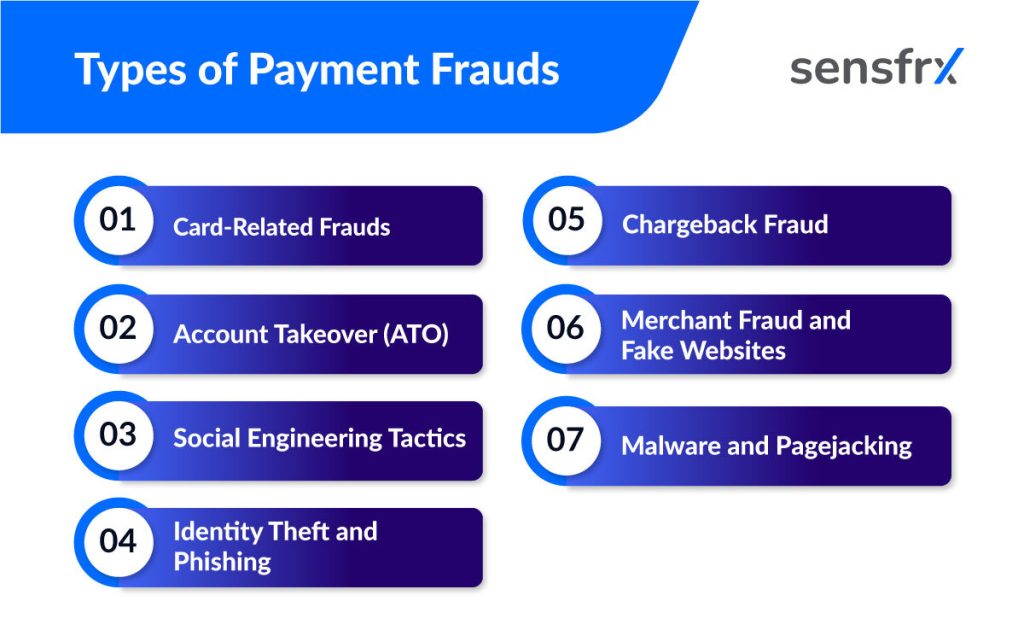
1. Card fraud
Card testing
Fraudsters run small transactions to find out which stolen card numbers still work. See card testing fraud for how the attacks run.
Warning signs: bursts of small-value transactions, especially from new accounts or unexpected locations.
Skimming and cloning
Card data is captured by a skimmer fitted to an ATM or by malware on a point-of-sale system, then written to a cloned card.
Warning signs: unauthorized charges reported after use of one particular terminal, or repeated duplicate transactions.
2. Account takeover (ATO)
Stolen credentials get the fraudster into a real customer's account, where saved cards and stored addresses are ready to use. See account takeover fraud.
Warning signs: several failed logins followed by a successful one from an unrecognized device or location.
3. Social engineering
The fraudster talks the victim into handing over a one-time password or login, usually by impersonating a bank, a courier or your own support team.
Warning signs: customers reporting unsolicited calls or emails that ask for sensitive details in your name.
4. Identity theft and phishing
Phishing emails and cloned websites collect payment details from users who think they are on the real site.
Warning signs: reports of emails with urgent requests and links to lookalike sites carrying your brand.
5. Chargeback fraud
A customer makes a real purchase, then disputes it as unauthorized and keeps the goods. See chargeback fraud.
Warning signs: repeat chargebacks from the same customers, especially on high-ticket items.
6. Merchant fraud and fake websites
A fake merchant takes payment, never ships, and disappears.
Warning signs: complaints about undelivered goods, and a merchant website that goes offline after the sales.
7. Malware and pagejacking
Malware captures payment details on the customer's device or redirects them to a fake checkout page. See page jacking.
Warning signs: customers reporting login trouble or redirects to odd pages during checkout.
How to stop payment fraud
No single control stops all seven types. The ones below work in layers, and each covers something the others miss.
Real-time fraud detection
Score every transaction as it happens. Machine learning models read transaction patterns in real time and flag the ones that do not fit.
They catch the obvious anomalies, such as a high-value order from a suspicious IP address, and they catch them before approval, so you can hold the order instead of chasing a chargeback.
The models learn from past fraud, so they recognize the same pattern when it returns in a new shape. Accuracy improves with every case.
Done well, that means more fraud caught and fewer good customers declined.
Behavioural analytics adds a further layer by flagging users who act differently from the way they usually do.
Encryption, tokenization and PCI DSS
Encrypt payment data in transit so it stays confidential between the customer and your processor. Tokenize card data at rest so a breach yields tokens that are useless to the thief. PCI DSS compliance holds you to the industry standard for both.
Review these controls on a schedule, because attacks change. Secure coding practices in any application that touches payment data close the holes before an attacker finds them.
Authentication and device checks
Multi-factor authentication (MFA) on every payment flow cuts unauthorized access sharply.
MFA asks for two or more proofs, such as a password plus a one-time code, so a stolen password alone is not enough.
Biometrics such as fingerprint or face recognition add a factor that is hard to steal or copy.
Device fingerprinting recognizes the devices your customers normally use and flags access from devices it has never seen.
Staff and customer training
Teach staff what fraud looks like in your own payment logs and what current phishing and social engineering attempts look like. Short, regular sessions beat one long one.
Tell customers what to watch for and how to report it. A customer who recognizes a scam does not become a chargeback.
A security-aware team and customer base catch attempts that no tool sees.
Monitoring and audits
Watch payment logs for sudden spikes in failed transactions or high-value orders from new accounts. These are the earliest signs of an attack in progress.
Audit your controls on a schedule to confirm they still do what you set them up to do and to find weaknesses before an attacker does.
Review transaction data and user behaviour patterns together; the combination shows problems neither reveals alone.
An outside security assessment gives you an objective read on your controls and a list of what to fix first.
Incident response
Write a fraud response plan that names who detects, who reports and who acts when fraud is found.
Run drills so everyone knows their part before a real incident. Fast response shortens recovery and cuts the cost.
Work with your bank and processor
Banks and payment processors see fraud across thousands of merchants and have tools and threat intelligence you do not.
Stay in contact with them. They will tell you about new fraud patterns early and can help you monitor transaction batches.
Put these layers together and you have a defence that holds up against each of the seven types above.
Why PCI DSS compliance matters
The PCI Data Security Standard (PCI DSS) defines how cardholder data must be protected.
It requires encryption of sensitive data, access controls that limit data to authorized staff, and monitoring of network traffic for unusual behaviour.
It also requires regular vulnerability assessments and written security policies. Together these protect against unauthorized access and data breaches. See PCI compliance and fraud monitoring for how the two fit.
Customers notice too. A compliant checkout is one they are willing to pay through.
Legal and compliance obligations
Regulation sets the floor for fraud prevention, and missing it brings penalties on top of the fraud losses.
Data protection law
GDPR, CCPA and similar laws require you to handle customer data responsibly, which also reduces the chance of a breach.
Industry standards
PCI DSS gives you a tested framework for securing payment systems and shows customers and partners that you meet it.
Secure payment gateways
Established gateways such as Stripe and PayPal bring their own fraud detection, tokenization and secure processing, which adds a layer on top of your own controls.
Clear policies cut disputes
Plain refund, return and transaction policies build trust and remove the ambiguity that turns a complaint into a chargeback.
Cases where the controls worked
Businesses that combine machine learning, real-time monitoring and the controls above report large drops in fraud.
The table below collects real incidents of digital fraud, covering account takeover, page jacking, identity theft and travel booking fraud, with the measures that stopped further damage:
| Incident | Description | Prevention Measures |
| Account Takeover (Chase, 2021) | Fraudsters attempted to access customer accounts using stolen credentials. | Chase implemented multi-factor authentication (MFA) and real-time monitoring to detect suspicious activities. |
| Identity Theft (Experian, 2017) | Identity Theft (Experian, 2017) | Experian strengthened its security measures, including encryption and improved monitoring of user accounts. |
| Travel Booking Fraud (Bengaluru, 2023) | Scammers created fake booking websites, tricking consumers into paying for nonexistent flights. | Airlines adopted secure payment gateways and verified travel service providers to prevent fraudulent bookings. |
Where to start
Payment fraud does not go away. It changes shape as your controls change.
Know the seven types, train your team on the warning signs, and layer the controls above so that no single failure lets an attack through.
If you want the scoring layer without building it, [Sensfrx](/) scores every signup, login and payment in real time and your rules turn the score into allow, review or block. Try it for free.