Cryptocurrency fraud prevention: How crypto scams work and how to stop them
The main crypto scams, why crypto attracts fraudsters, how to spot a scam, what MiCA and the SEC require, and the controls exchanges and wallets should run.
 By 18 mins readPublished Updated
On this page
Crypto fraud grows with crypto adoption. Chainalysis put cryptocurrency-related crime at $4.52 billion in 2019, and the losses have kept climbing since. Transactions are pseudonymous, final, and cross borders in seconds, which is exactly what a thief wants from a payment rail.
Below: the scams that take most of the money, what makes crypto attractive to fraudsters, how to spot a scam before you fund it, the rules regulators now apply, and the controls an exchange, wallet or trading platform should run.
What cryptocurrency is
Cryptocurrency is digital money secured by cryptography and run without a central authority. It lives on a blockchain, a shared ledger of every transaction, verified by a network of computers rather than a bank.
Bitcoin is the best known, but thousands of others, including Ethereum, Litecoin and Ripple, are in circulation. They are bought, sold and spent through exchanges and wallets.
Cryptography in cryptocurrencies
Cryptography is what separates crypto from other money. Every transfer is signed and recorded in a form that is close to impossible to forge, which is why coins cannot be counterfeited or spent twice.
Why people use it
Crypto moves money across borders at a fraction of what banks charge for international transfers, and it is not tied to any one country's economy or inflation. For many users, that is the whole point.
Where the risk comes from
The same properties attract scammers. Transactions are hard to attribute, some regions have little oversight, and a stolen coin does not come back.
The two scams that come up most
Phishing is the most common: a fake site or email tricks the victim into handing over login credentials or private keys. The Ponzi scheme is second: investors are promised high returns and lose everything when the scheme collapses.
What is being done about it
Governments and the industry have responded. Several countries now regulate exchanges and require monitoring, and public awareness campaigns have taught users the warning signs.
How cryptocurrency runs on a blockchain
Bitcoin, Ethereum and Litecoin all sit on a blockchain, a decentralized system for recording transactions that anyone can inspect and nobody can quietly edit. The steps:
- The ledger. A blockchain stores transactions in blocks. Each block holds the sender's and receiver's wallet addresses and the amount, and the blocks are chained together with cryptography.
- Mining. New coins are created by mining: computers solve mathematical puzzles to validate transactions. It takes heavy computing power and a lot of electricity.
- Storage. Coins sit in digital wallets secured by a public key, which works like an account number, and a private key, which works like a password.
- Broadcasting a transaction. When a user sends coins, the transaction goes to every node on the network. The nodes check the sender has the funds and that the transaction meets the network's rules.
- Verification and hashing. Valid transactions are grouped into a block, which is given a hash based on its contents and on the previous block's hash. Changing an old record would change every hash after it.
- Distribution. The hashed block is copied to every node. The chain can be read by anyone and changed by no one without consensus, which is what makes the record trustworthy.
How crypto fraud has grown
Chainalysis reported that cryptocurrency-related crime reached $4.52 billion in 2019, close to three times the $1.74 billion of 2018.
- Why it spiked. More people pay and invest with crypto, so more scammers follow the money.
- The complaint numbers. In 2020 the US Federal Trade Commission (FTC) received more than 10,000 reports of cryptocurrency scams, with losses over $80 million, almost three times the 2019 count.
- Phishing and social engineering. Fake login pages and impersonation messages trick victims into giving up credentials or private keys, and the attacker then empties the wallet.
- Ponzi schemes. New investors' money pays earlier investors until the money runs out and the operators disappear.
- Initial coin offering (ICO) fraud. ICOs raise funds by selling tokens instead of shares. Many have turned out to be fraudulent or failed ventures that left investors holding worthless tokens.
- Decentralized finance (DeFi) scams and hacks. DeFi protocols let users lend and borrow without an intermediary, which also makes them a prime target for hackers.
Types of crypto fraud
Fraud in crypto follows the technology. New tokens, new protocols and new wallets each open a new angle, and the old scams keep working alongside them.
The forms you will meet most often:
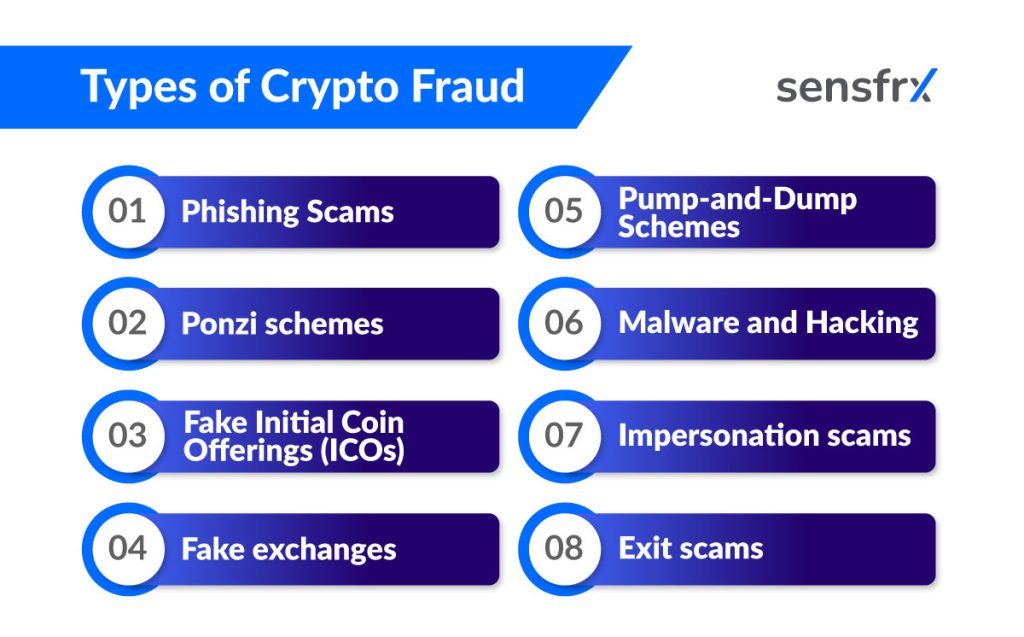
Phishing
Phishing is the most common crypto fraud because it is the cheapest to run and it works.
The scammer sends an email or message that looks like it came from an exchange or wallet provider and asks for login credentials, a seed phrase or a private key. With those, they drain the account. Crypto phishing has its own playbook, from fake airdrop pages to wallet-drainer scripts.
Ponzi schemes
A Ponzi scheme promises high returns and pays them out of new deposits. The payouts look like proof the scheme works, which pulls in more investors, until the inflow stops and most of them lose everything.
Fake initial coin offerings (ICOs)
An ICO sells tokens that represent ownership or usage rights in a new platform. Scammers copy the format: a website, a whitepaper, a token sale, and no intention of building anything. Once the sale closes, they disappear with the funds.
Fake exchanges
A fake exchange is a website that looks like a real trading platform and exists to take deposits.
Some also harvest the personal details entered at signup and use them to get into the victim's accounts on real exchanges.
Pump-and-dump schemes
A pump and dump inflates the price of a thin coin with false information, then sells into the spike.
The operators build hype on social media and messaging apps, often with invented news about partnerships or product launches. Buyers pile in, the price jumps, the insiders sell, and the price collapses on everyone else.
Malware and hacking
Malware on a victim's device can read wallet files, swap a copied wallet address in the clipboard, or capture exchange logins. Attackers pair it with phishing pages to collect credentials, then move the funds out.
Impersonation scams
Scammers pose as well-known investors, project founders or exchange staff and ask victims to send crypto, often with a promise to send back more. The fake profiles use the real person's name and photo and run on social media and messaging apps.
Exit scams
An exit scam is an exchange or investment scheme that shuts down without warning and keeps the users' funds. Some operators plant news stories claiming a hack to cover a departure they planned from the start.
The common defence against all of these is the same: check who you are dealing with before you fund anything, and treat any promise of guaranteed returns as a scam until proven otherwise.
What makes cryptocurrency appealing to fraudsters
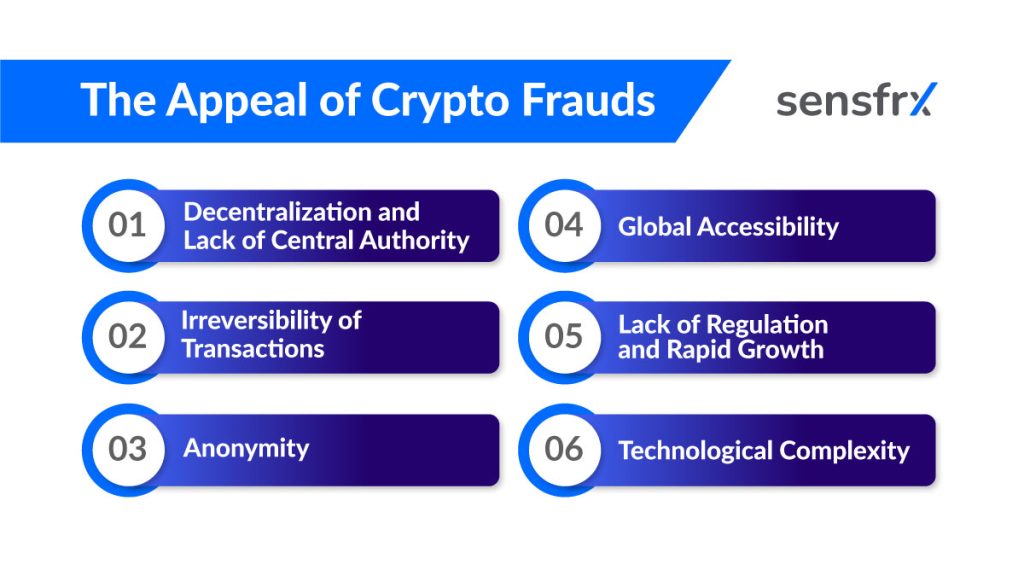
Crypto draws fraudsters for the same reasons it draws investors: no central control, high volatility, and the chance of a fast profit.
The biggest draw is pseudonymity. A bank transfer is tied to a name and an address. A crypto transaction is tied to a wallet address, so the person behind it stays hidden unless something else links them to it.
No central authority
There is no bank or government in the middle of a crypto transaction. That is the appeal for honest users and the opening for dishonest ones.
With no single point of control, no one can freeze a suspicious transfer or step in when something goes wrong.
Fraudsters work in that gap. They clone exchange websites and wallet apps, and trick users into entering credentials or sending funds to an address they control.
Transactions cannot be reversed
Once a transaction is confirmed on the blockchain, it is final. If it was fraudulent, the victim has no mechanism to pull the funds back.
That also closes the legal route. A bank or card issuer can freeze an account or reverse a charge; a decentralized network cannot, so legal recourse is limited.
Most crypto moves peer to peer with no intermediary, so there is no third party to arbitrate a dispute between the two sides.
Anonymity
A card payment or bank transfer carries a name and an address. A crypto transfer does not. Users can buy and send funds without revealing who they are.
The ledger is public but the identities are not: wallets are random strings of characters, and transactions are recorded across a network of computers rather than at an institution that knows the account holder. Tracing where funds came from and where they went takes specialist work.
Global reach
Crypto crosses borders with no paper trail, so funds can leave one jurisdiction and land in another in minutes. An investigator in the victim's country often has no reach into the country where the money ended up.
Many countries still lack clear crypto laws, which gives scammers places to operate without fear of prosecution and makes fake ICOs easy to run.
Thin regulation and fast growth
Three things together make crypto a good hunting ground: light regulation, fast growth, and technical complexity.
Crypto still runs with far less oversight than banking. In many markets no body monitors transactions or protects consumers from fraud.
The market also moves faster than most investors can follow. New coins launch daily and prices swing, so a scam has plenty of noise to hide in.
Technical complexity
Blockchains are secure but hard for most people to understand. That complexity gives cover to sophisticated schemes, because few victims can trace where their funds went or who took them.
And once a transaction is made, no bank or card company can undo it. Scammers get away with the money because there is no one to take it back.
How to spot a cryptocurrency scam
Most crypto scams share a handful of tells. Learn them and you avoid the majority of losses before any money moves.
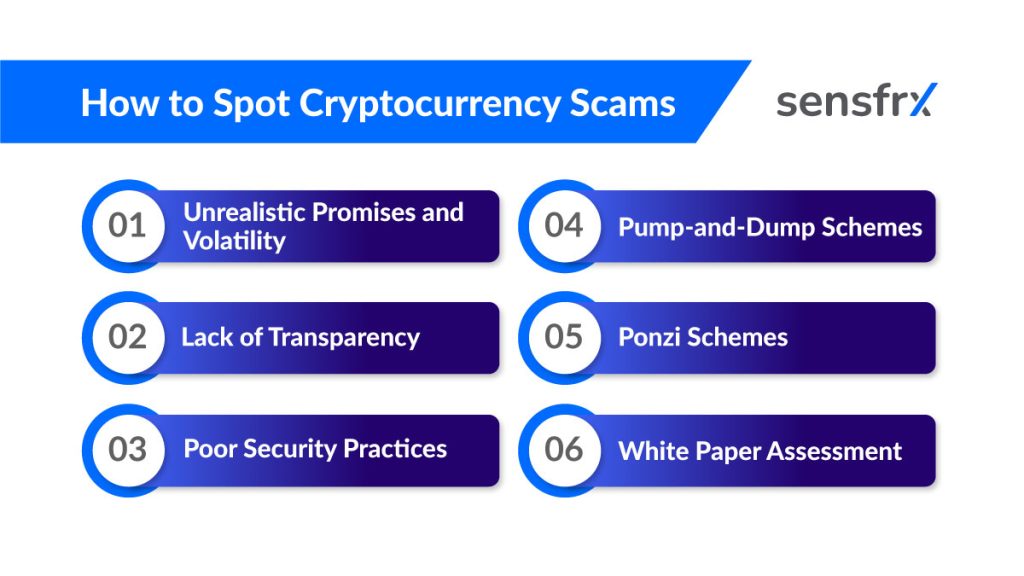
Unrealistic promises
The first tell is the return on offer.
Any opportunity that promises high returns in a short time with little or no risk should stop you. Crypto is volatile. Real gains are possible, and so are real losses, and no honest operator guarantees either. Research the project before you commit.
Lack of transparency
A real project has a roadmap, clear goals and a team that communicates with investors. Vague whitepapers, missing team details and evasive answers mean the project is either not genuine or hiding something.
Poor security practices
Check the security history of any exchange or wallet before you use it. Read user reviews and confirm it offers two-factor authentication and encrypts customer data.
Be careful with every request for personal details or funds. Phishing sites copy real exchanges down to the pixel. Use only platforms you have verified, and never share a private key or login with anyone.
Pump and dump
Watch for a sudden price spike followed by a sharp fall, usually pushed along by messages urging you to buy before you miss out. Fear of missing out (FOMO) is the mechanism. A coin that is surging because of a rumour is a coin you should not be buying.
Ponzi schemes
Ponzi schemes often dress up as investment funds or multi-level marketing (MLM) programmes. The giveaway is a payout that depends on recruiting more people rather than on any product or trading. Returns that seem too good to be true, with nothing tangible behind them, are the second giveaway.
Read the whitepaper
A whitepaper sets out a project's goals, technical design and intended use cases. How clear, deep and honest it is tells you a lot about the project.
A real whitepaper names the team and their backgrounds, explains how the system works, lists the risks, gives realistic timelines, describes the target users, and says how the funds raised will be spent and what the token is for.
Thin, vague or heavily promotional whitepapers are a red flag. Cross-check the claims against outside sources before you invest.
Fraud controls for businesses that handle crypto
If you run an exchange, a wallet, or any business that accepts crypto, you carry the fraud risk your users cannot carry themselves. These are the controls that work.
The two controls that do most of the work
Verify who is signing up, then watch what they do once they are in. Everything else in this section supports one of those two.
Verify user identities
Know Your Customer (KYC) checks and multi-factor authentication (MFA) keep impostors out. KYC collects government ID and proof of address at onboarding, which confirms who the customer is and keeps you on the right side of regulation. MFA stops a stolen password from being enough to log in.
Protect privacy with zero-knowledge proofs (ZKP)
Zero-knowledge proofs let a user prove something about themselves, such as that they passed a check or hold a credential, without revealing the underlying personal data.
ZKPs are already used in cryptocurrency transactions to keep peer-to-peer payments private. For a business, they offer a way to verify users while holding less of their data.
What the blockchain itself gives you
CipherTrace reported more than $1.9 billion of cryptocurrency stolen or scammed in 2020 alone.
Part of the defence is built into the technology you already run. Blockchain records help in three ways:
Tamper-proof records. The ledger is copied across many computers, so a fraudster cannot quietly edit a transaction after the fact.
Digital identities. A user's on-chain identity is tied to their transactions, which makes it harder for a bad actor to stay anonymous while committing fraud on your platform.
Smart contracts. Self-executing agreements run when their conditions are met and leave an immutable record, so every party is held to the terms and there is less room to cheat.
Real-time transaction monitoring
Machine learning models score transactions as they happen, reading device, network and behaviour signals together and flagging the patterns a human would miss. The decision comes back before the transaction completes, which is the only point at which a block does any good.
Automated systems read far more data, from far more sources, than a review team can, and they spot patterns across accounts that look unrelated on their own.
They also learn as new fraud appears, which cuts both losses and the false positives that annoy good customers. See transaction monitoring for how this fits with AML.
User education
Tell your customers what the scams look like. Blog posts, social media, email newsletters and a help-centre page all work.
A user who knows what a phishing page or a fake ICO looks like is a user who does not call your support desk after losing their funds.
Sharing intelligence across the industry
Fraudsters hit several platforms with the same identities, devices and wallets. Businesses that share threat data with each other see the attack coming instead of discovering it afterwards.
Shared intelligence also helps track fraudsters who move between platforms, which protects every participant's customers.
Cryptocurrency regulation
As crypto fraud has grown, regulators have built frameworks around it. The two that matter most to a platform serving US or EU customers are described below.
In the United States, the Securities and Exchange Commission (SEC) and the Commodity Futures Trading Commission (CFTC) are the two bodies that oversee the crypto market.
What the US regulators do
- SEC and security tokens. The SEC treats security tokens as securities. Any token offering that counts as an investment contract under the SEC's criteria falls under federal securities law, which exists to protect investors from Ponzi schemes and misleading issuers.
- The classification debate. Regulators still argue over whether a given cryptocurrency is a security or a commodity. One side says all digital assets are investments and should be regulated as securities. The other says coins like Bitcoin have utility beyond investment.
Why classification matters
A token classed as a security faces stricter rules, which makes an ICO harder to launch. A token classed as a commodity opens the door to futures trading and institutional investment.
Existing financial law
Regulators also apply laws that predate crypto. The Bank Secrecy Act (BSA) requires financial institutions to report suspicious activity, including cryptocurrency transactions, and is used against money laundering and fraud in the crypto market.
MiCA in the European Union
The EU's answer is the Markets in Crypto-Assets Regulation (MiCA), a single framework for crypto assets across all member states, now in force.
- Licensing. Companies that issue or trade crypto assets must hold a licence from the relevant authority, which binds them to EU standards.
- AML and KYC. To get and keep that licence, companies must follow strict anti-money laundering (AML) and know-your-customer (KYC) rules, aimed at money laundering and terrorist financing.
Tax
Tax treatment still varies by member state. Some tax crypto profits as income, others as capital gains at lower rates. Anyone trading or accepting crypto in the EU needs to know which rules apply to them.
Towards consistent rules
EU regulators continue to align the rules across member states, covering consumer protection, market stability and transparency.
Closing the gaps
Gaps remain, and fraudsters look for them. Regulators are weighing stricter reporting requirements for crypto asset service providers and penalties for non-compliance.
How Sensfrx helps crypto platforms
Sensfrx scores every signup, login and withdrawal on your platform in real time, using device fingerprinting, network signals, behaviour analysis and dynamic risk scoring. Your rules turn the score into allow, review or block, through the API or the dashboard. See the crypto fraud prevention page for the full setup.
What it catches
The attacks Sensfrx is built to stop:
- Fake registrations. Bulk accounts that farm signup bonuses, launder funds or dodge limits are checked on device, email, phone and IP signals before the account exists. See fake registration prevention.
- Account takeover. A hijacked exchange account is emptied in minutes. Sensfrx flags logins from unfamiliar devices, locations or behaviour before a withdrawal is requested. See account takeover protection.
- Deposit and chargeback fraud. Card-funded deposit, instant withdrawal, then a chargeback on the card. Sensfrx flags the sequence before the withdrawal clears.
- Suspicious withdrawals. Every withdrawal request is scored against device trust, session behaviour, velocity and account history, and the suspicious ones are held for review.
- Bot traffic. Credential stuffing and automated signups are caught on behaviour and device signals. See bot attack prevention.
How it works
- Device fingerprinting. A small JavaScript tag collects device, network and behaviour signals and builds a fingerprint, so a device seen in earlier fraud is recognized the next time it appears.
- Behaviour analysis. Each session is compared with the account's own history. A login that does not match the usual device and behaviour is flagged before it is used.
- Dynamic risk scoring. Every event gets a 0 to 100 score from behaviour anomalies, device mismatches and your policy rules, with the signals behind the score visible in the dashboard.
- Integration. REST APIs for custom platforms, with no extra step for trusted users, and a free plan to start on.
The same controls the large exchanges run
Exchanges such as Coinbase, Binance, Kraken and Bitfinex run the controls described above at scale: identity checks at onboarding, device and login monitoring, and risk scoring on withdrawals. Sensfrx gives smaller platforms the same signals through an API, without building the stack in-house.
- Identity at onboarding. KYC plus device and network checks before the account is live.
- Login monitoring. Device, location and behaviour compared against the account's history on every session.
- Withdrawal scoring. Velocity, device trust and account history checked before funds move.
- Shared signals. Devices and identities seen in fraud on one platform flagged when they appear on another.
Where to start
Crypto fraud is a people problem and a systems problem at once. Users need to recognize the scams above. Platforms need identity checks at onboarding, monitoring on every login and withdrawal, and a way to act on what the monitoring finds before the funds leave.
Start with the controls that stop the most money: MFA on every account, device fingerprinting and risk scoring on logins and withdrawals, and a review queue for the scores that land in between.
Treat compliance as part of the same work. MiCA in the EU and SEC and CFTC oversight in the US set the baseline for what a platform must check and report, and meeting it keeps your customers' trust as well as your licence.
Frequently asked questions
Q. What is cryptocurrency fraud?
A. Any scam or deception used to steal digital currency or the credentials that control it. The common forms are phishing, Ponzi schemes, fake ICOs and hacks.
Q. Why does cryptocurrency fraud prevention matter?
A. Crypto transactions cannot be reversed, so prevention is the only protection that works. It keeps investors' funds safe and keeps trust in the market.
Q. Which regulators oversee cryptocurrency fraud prevention?
A. In the United States, the Securities and Exchange Commission (SEC) and the Commodity Futures Trading Commission (CFTC). In the European Union, the Markets in Crypto-Assets Regulation (MiCA) sets the rules for crypto assets.
Q. What are the main strategies for preventing cryptocurrency fraud?
A. Verify identities with KYC, protect privacy with tools such as zero-knowledge proofs, follow anti-money laundering rules, and monitor transactions in real time.
Q. How does regulatory compliance help prevent cryptocurrency fraud?
A. Compliance with MiCA and AML law forces the checks that stop fraud: licensed operators, verified customers, and suspicious activity reported.
Q. What role does user education play?
A. A user who recognizes a phishing page or a fake ICO does not fall for it. Blogs, social media, newsletters and help-centre content all get the message across.
Q. How does cryptocurrency operate on blockchain technology?
A. A blockchain is a distributed ledger that records every transaction across a network of computers. Transactions are grouped into blocks, each block is linked to the one before it, and no record can be changed without the network's agreement. That is what makes transactions transparent and hard to tamper with.