Two or more players working together to beat the other participants by manipulating the game, usually through outside communication or alternate accounts.
Collusion fraud: How players cheat together in gaming and betting
Chip dumping, soft play, ghosting, syndicates and insider collusion in online gaming and betting, what they cost operators, and how to detect and stop them.
 By 10 mins readPublished Updated
On this page
- What collusion in online betting is
- Three types of collusion in online betting
- What collusion does to gaming and betting operators
- Methods used in collusion fraud
- How collusion in betting works
- How to detect and prevent collusion in online betting
- Where Sensfrx fits
- Where to start
- Frequently asked questions
Collusion fraud is two or more players secretly working together against everyone else at the table. Poker is where it is best known, but it turns up in any game where players can pass value to each other, and it is a common cover for money laundering.
The forms are chip dumping, soft play, stack balancing, proxies, squeezing and plain coordinated strategy. Each one skews outcomes, drains honest players and costs the operator money and trust.
What collusion in online betting is
Collusion in online betting is cheating by agreement: players who should be competing instead coordinate to tilt the game. The honest players at the table are the victims, and the operator pays through withdrawals, chargebacks and churn.
The same agreement can hide money laundering. Chips dumped from a funded account to a clean one come out the other side as "winnings".
Definition
Collusion is a covert agreement between parties who would normally compete, made to gain an advantage the rules do not allow. The word comes from business and antitrust; in gaming it means the same thing at a smaller scale.
Four characteristics
Whatever the game, collusion has the same four marks:
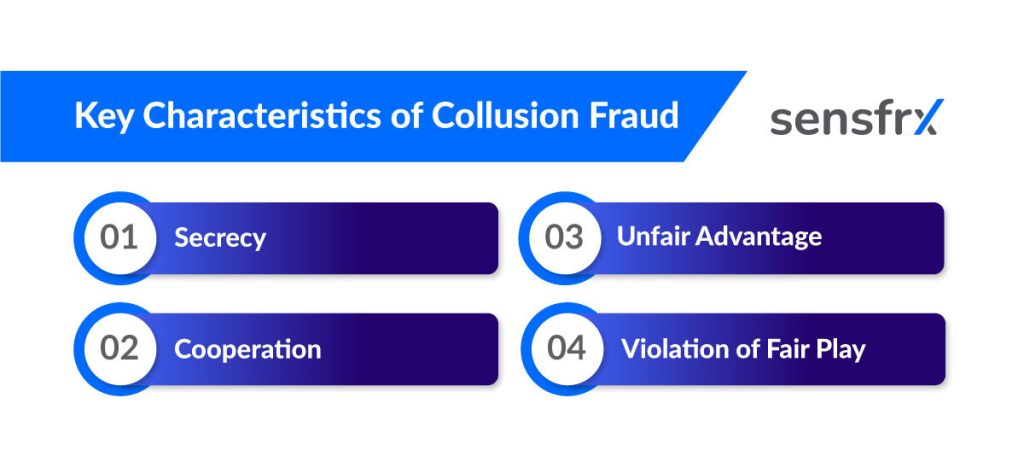
- Secrecy. The coordination happens off-platform, in a messaging app or a voice call, which is why operators and honest players rarely see it directly.
- Cooperation. Two or more accounts share information, coordinate bets or pass resources to each other.
- An unfair edge. The point is to win more than the rules would allow: by coordinating bets, sharing hand information or pooling bankrolls.
- A broken contract. It breaks the terms of service and the fair-play assumption every other player signed up for.
Three types of collusion in online betting
Collusion comes in three shapes, defined by who is in on it.
Player collusion
Two or more ordinary players coordinate at the same table. It runs from quiet cooperation (not raising against each other) to full schemes with shared hole cards and scripted betting. The aim is to win more often, or win bigger pots, than fair play would give them.
Example: Player collusion in poker
The textbook case:
Two players at one table share their hands over a messaging app. They coordinate the betting to inflate the pot when one of them is strong and to fold out of each other's way when not. One wins, the other feeds, and the rest of the table pays for both.
Syndicate collusion
A syndicate is an organised group rather than two friends. It appears in online multiplayer games, card games and sports betting, and it works on the simple arithmetic that several coordinated accounts beat one.
In sports betting the syndicate move is coordinated staking to shift a line: enough money on one side to move the odds, then the real bet on the other side at the better price.
Insider collusion
Insider collusion needs someone with access: a player with admin rights who tilts the game for themselves or their friends, or a staff member with data the players do not have.
Insider information in gaming is anything the public cannot see: upcoming updates, opponents' strategies, or a flaw in the system. Any of it is worth money to the player who has it first.
What collusion does to gaming and betting operators
Collusion attacks the one thing an operator sells: a fair game. The damage shows up in four places.
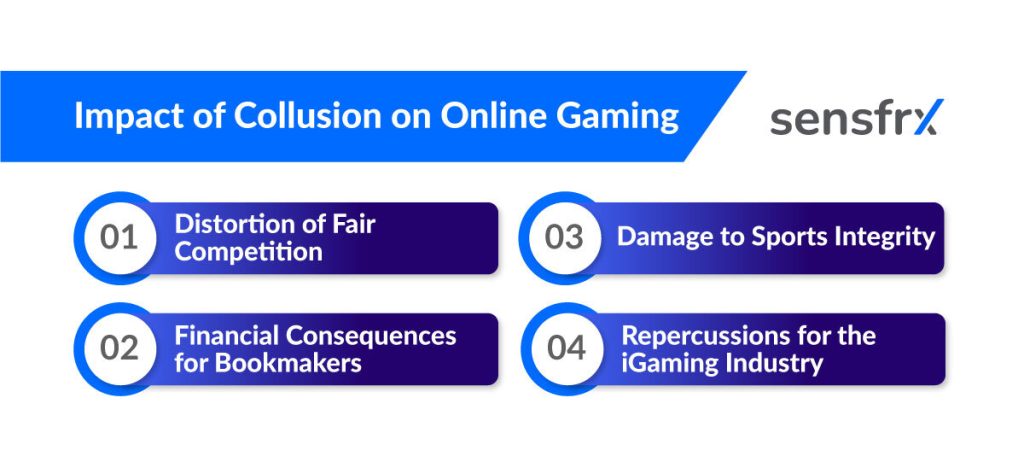
- Fair competition. Colluding players do not just win more; they change the game for everyone else at the table. Skill stops deciding outcomes.
- Bookmaker losses. Coordinated bets and manipulated outcomes pay out at a rate the book never priced for. The money comes straight off the operator's margin.
- Sports integrity. The same tactics work in real-life sport. Match-fixing, where players lose or shape a result on purpose, is collusion with a stadium around it.
- The iGaming business. Skewed odds and rigged tables drive away the honest bettors who fund the platform. Once they stop trusting the market, the losses outlast the fraud.
Methods used in collusion fraud
The most common technique is ghosting: a second person watches the game as a "ghost" and feeds the player real-time information and advice, so the player sees the opponent's moves coming. Four other methods account for most of the rest.
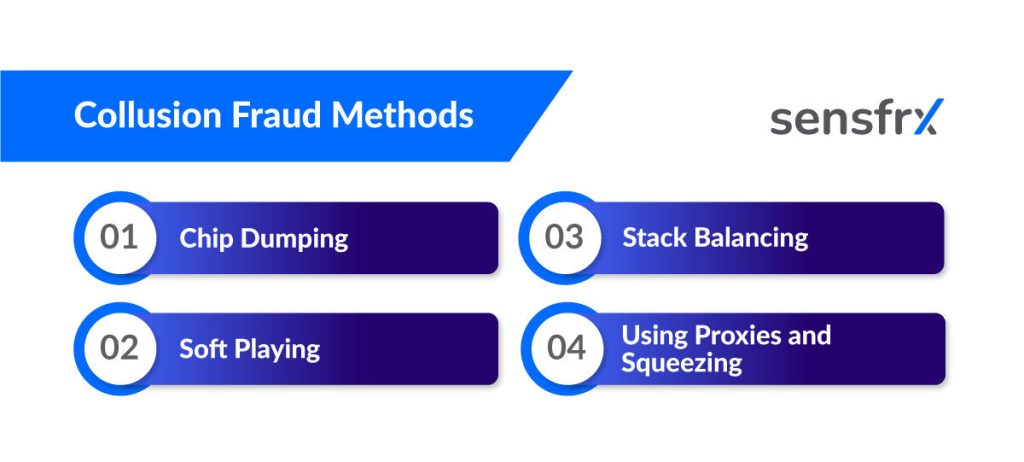
1. Chip dumping
Chip dumping is one player losing chips to another on purpose, usually in large amounts, to move value between accounts. It is most common in poker but works in any multiplayer game with a virtual currency or tradeable items.
Dumping pairs naturally with multi-accounting: one person runs several accounts, dumps the bonus balance from each into one, and cashes out. The same pattern drives the bonus fraud covered in Bonus abuse: definition, prevention and more.
2. Soft playing
Soft play is underperforming on purpose, checking a strong hand or folding to a friend, so another player or team wins. It looks harmless next to chip dumping, but it moves money just as surely and it is harder to prove.
To catch it, start with who benefits. Two accounts that never raise against each other, across hundreds of hands, are telling you something.
3. Stack balancing
Stack balancing is colluders managing their in-game resources as a team, so the right account has the big stack at the right moment. It is common in competitive multiplayer games such as first-person shooters and battle royales as well as at the poker table.
It starts with communication outside the game, over private messages, voice chat or a separate platform, so the colluders know each other's positions and stay out of each other's way. From there they pick stakes to suit: most games offer tables or lobbies at different buy-ins, and the group moves its combined bankroll to the level where it does the most damage.
4. Proxies and squeezing
A proxy sits between a device and the internet and hides the real IP address, so two accounts on the same desk look like two players in different cities. Squeezing is a sports betting tactic: placing a large sum on one side of a market to move the odds toward that outcome.
Examples in sports betting
Two well-known cases show the two ends of the scale:
- The Olympic badminton scandal. Four doubles pairs from China, Indonesia and South Korea were disqualified for losing matches on purpose to get an easier opponent in the next round. The coordination was visible to a stadium full of spectators.
- Online poker collusion. Online poker brought cases of players teaming up against a table and sharing hole cards over instant messaging or phone calls, an edge no honest opponent could see.
How collusion in betting works
The mechanism is always the same: two or more minds sharing information that the rules say should be private. Shared cards, shared reads on opponents, shared bankrolls. Each one raises the group's edge above what any member could earn alone.
Collusion in poker games
In poker, collusion means sharing card information, signalling to each other, or losing to each other on purpose. Two patterns show how it plays out, in poker and beyond:
- Communication during games. In team games this starts as callouts, one player telling another where an enemy is, and escalates to throwing rounds so a partner wins. In poker it is hole cards shared in real time.
- Finding value in betting lines. Bookmakers set odds from team form, injuries, historical data and public opinion, and sometimes the line is wrong. Spotting that is legitimate skill. Moving the line yourself with coordinated money, then betting the other side, is collusion.
How to detect and prevent collusion in online betting
Colluders leave patterns. The ones worth watching are accounts that keep taking opposite sides of the same bet, accounts that only ever play at the same tables, and accounts with identical betting strategies down to the sizing.
Detection techniques
Pattern analysis is the workhorse: track who plays with whom, how often, and how the money moves between them, then flag the pairs that sit outside the normal distribution. At scale this is a data job, not a human one. The potential of AI in transactional fraud detection covers how the models pick out unusual betting patterns.
- Algorithmic approaches in poker and sports betting. The same mathematics that gives players an edge gives operators a detector: model the expected behaviour of two independent players and score the deviation. Real-time monitoring turns that score into an alert while the session is still open.
Regulatory measures
Operators and regulators lean on rules as well as detection.
The most common instrument is the terms of service: it names cheating and collusion as prohibited, gets updated as new forms appear, and backs the operator's right to suspend or ban. A ban is only as good as the detection behind it, which is why the two go together.
- Legal frameworks against collusion. Anti-collusion clauses in gaming contracts and the wider laws they sit under give operators a basis to prosecute, and give colluders a reason to think twice.
Technological solutions
Machine learning does the heavy lifting: models trained on player behaviour, game patterns and transaction records learn what independent play looks like and flag what does not. With real-time scoring, the flag arrives while the colluders are still seated.
- Player verification. The cheapest win is making sure one person is one account. Identity checks, IP analysis and device fingerprinting tie the accounts in a collusion ring back to the handful of devices and networks that run them.
Where Sensfrx fits
Sensfrx does not read hands or watch tables. It scores the three events every collusion ring depends on: the signups that create the accounts, the logins that run them and the payments that cash them out. Each score comes from device, network and behaviour signals, and your rules turn it into allow, review or block.
That is where collusion is cheapest to break. Five "different" players who register from one device fingerprint, log in through the same proxy range and withdraw to the same destination are one ring, and the signup and login scores say so before the first chip is dumped. Your game analytics still have to spot the soft play; Sensfrx tells you which accounts belong together.
It runs on a free plan and a 14-day trial, through REST APIs for a custom gaming stack. See fake registration prevention for how the signup scoring works.
Questions about a specific integration go through the contact page.
Where to start
Collusion, whether through external chat, alternate accounts or organised syndicates, attacks the fairness your platform sells. It costs honest players their money, bookmakers their margin and real-world sport its credibility.
Defence is three layers: terms of service that name the offence, pattern detection that finds coordinated play, and account-level signals that tie a ring's accounts together.
Start with the third. Score signups and logins, link accounts by device and network, and most rings become visible before they have played a hand.
Frequently asked questions